ETL Explained: Meaning, Process, Benefits, and Tools
Data has become one of the most valuable resources for modern businesses. Companies collect information from websites, mobile applications, customer databases, online stores, financial systems, and many other sources. However, collecting information is only the first step. Organizations also need a reliable way to organize, clean, combine, and prepare that information for analysis. This is where ETL becomes important.
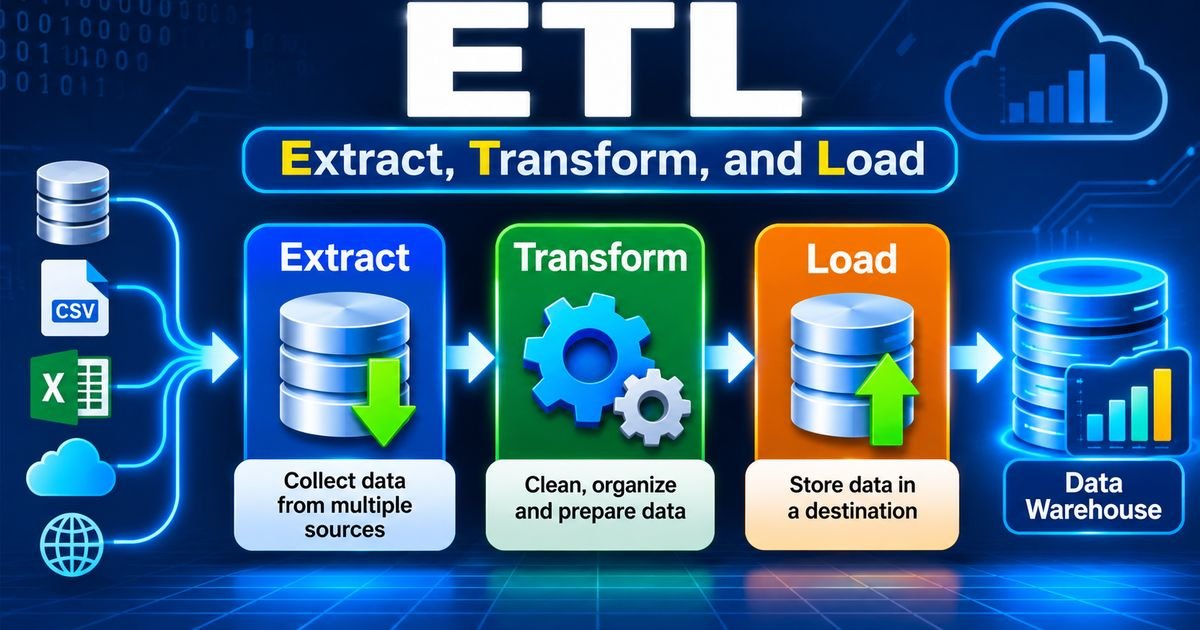
ETL stands for Extract, Transform, and Load. It is a data integration process that moves information from different sources into a central destination after preparing it for use. Businesses use ETL to bring together information that might otherwise remain separated across multiple systems.
For example, an online retailer may store customer details in one database, product information in another system, and payment records in a separate application. An ETL process can collect information from these sources, standardize the formats, remove unnecessary records, and transfer the prepared data into a data warehouse.
ETL plays an important role in business intelligence, reporting, analytics, data warehousing, and decision-making. It helps organizations turn scattered information into structured and useful data.
Understanding ETL is valuable for data analysts, software developers, database administrators, business owners, and anyone interested in modern data management.
What Does ETL Mean?
ETL is a three-stage process designed to prepare information for storage and analysis. Each stage performs a specific function.
The first stage is Extract, which collects information from different sources. The second stage is Transform, which cleans and organizes the collected information. The third stage is Load, which transfers the prepared information into its final destination.
These stages work together to create a consistent data pipeline. Instead of manually collecting and organizing information, businesses can automate much of the process.
ETL is commonly used when organizations need to combine data from different applications, databases, spreadsheets, and external platforms. It makes information easier to access and helps reduce inconsistencies between systems.
The process can operate on a scheduled basis, such as every hour or once per day. Some organizations also use more frequent processing to keep their reporting systems updated.
Understanding the Extract Stage
Extract is the first stage of ETL. During this stage, a system collects information from one or more data sources.
Businesses often store information in different formats and locations. Some information may exist in relational databases, while other records may be available through application programming interfaces, spreadsheets, cloud applications, or text files.
The extraction stage brings this information into the ETL workflow.
Common Data Sources
ETL tools can collect information from many types of sources. These include:
- Relational databases such as MySQL, PostgreSQL, and Microsoft SQL Server.
- Cloud-based applications and business platforms.
- CSV and Excel spreadsheets.
- Website and application APIs.
- Customer relationship management systems.
- Enterprise resource planning software.
- Log files and operational systems.
- Online databases and external data services.
The exact sources depend on the organization’s requirements and the capabilities of its ETL platform.
Full Data Extraction
Full extraction collects all available records from a selected source. This method is useful when a system is being configured for the first time or when a complete refresh is required.
For example, a company moving customer information into a new data warehouse may perform a full extraction to collect its existing customer records.
However, extracting every record repeatedly can consume time, network resources, and processing capacity. Large organizations often prefer more efficient methods for regular updates.
Incremental Data Extraction
Incremental extraction collects only new or changed information since the previous extraction.
For example, an online store may have millions of historical orders but receive only a few thousand new orders each day. Instead of extracting the entire order database every time, the ETL process can identify and collect the new records.
This approach can reduce unnecessary processing and improve efficiency.
Change Data Capture
Change Data Capture, commonly called CDC, identifies changes made to a database. These changes may include inserted records, updated information, or deleted entries.
CDC can help an ETL pipeline collect only the information that has changed.
It is particularly useful for systems that need frequent data updates. However, implementing CDC requires suitable database support, permissions, and careful handling of changes.
Understanding the Transform Stage
Transform is the second stage of ETL. After information has been collected, it must be prepared for its intended purpose.
Data from different sources often contains inconsistencies. One system may store dates in one format, while another uses a different format. Customer names may contain spelling differences, and some records may contain missing values.
The transformation stage addresses these problems and creates a more consistent dataset.
Data Cleaning
Data cleaning involves identifying and correcting errors in collected information.
For example, a customer database might contain duplicate entries, incomplete addresses, incorrect email formats, or inconsistent product descriptions.
A transformation process can identify duplicate records, standardize values, and apply rules for handling incomplete information.
Clean data improves the reliability of reports and reduces the risk of misleading conclusions.
Data Standardization
Different applications may use different formats for similar information.
For example, one system might record a date as 11/06/2026, while another uses 2026-11-06. An ETL process can convert both formats into a consistent standard.
The same principle applies to currency, phone numbers, addresses, product codes, and measurement units.
Standardization makes it easier to combine information from different sources.
Data Validation
Data validation checks whether records follow defined rules.
A company may require every order to contain an order number, customer identifier, and transaction date. Records that do not meet these requirements can be flagged for review.
Validation rules help identify incorrect information before it reaches the destination.
Data Deduplication
Duplicate information can create problems in reporting and analysis.
Imagine a customer appears three times in a database because the same information was entered through different applications. Counting all three records as separate customers could produce inaccurate business reports.
ETL workflows can use unique identifiers and matching rules to identify potential duplicates.
Deduplication rules should be designed carefully because two different people may share similar names or other details.
Data Filtering
Filtering selects the records required for a particular purpose.
For example, a sales report may only need completed transactions from the current financial year. The ETL process can filter out unrelated records before loading the results.
This reduces unnecessary data movement and helps create focused datasets.
Data Aggregation
Aggregation combines multiple records into summarized information.
A retail business may have thousands of individual transactions every day. An ETL workflow can calculate daily sales totals, product quantities, or regional revenue figures.
These summaries can make reporting easier and help business teams understand important patterns.
Data Enrichment
Data enrichment adds useful information to existing records.
For example, a business might combine customer records with location information or connect product identifiers with additional product descriptions.
Enrichment can provide more context for analysis, but organizations must ensure that additional information is accurate and collected appropriately.
Understanding the Load Stage
Load is the final stage of ETL. Once the information has been extracted and transformed, it is transferred into the destination system.
The destination is often a data warehouse, database, reporting platform, or analytical environment.
The purpose of loading is to make prepared information available for applications, dashboards, business intelligence tools, and other systems.
Initial Data Loading
Initial loading transfers a complete dataset into a new destination.
For example, when an organization creates a new data warehouse, it may need to load historical customer, sales, and inventory records.
This process can take time when the source contains a large volume of information.
Incremental Loading
Incremental loading transfers only new or changed records.
After the initial load, an ETL system may process new orders or updated customer details without replacing the entire destination dataset.
This method is useful for regular data updates and can reduce processing requirements.
Full Refresh Loading
A full refresh replaces the existing destination data with a newly prepared dataset.
This method can be appropriate for smaller datasets or situations where the destination should always represent a complete snapshot of the source.
However, full refresh operations must be planned carefully because they can consume resources and may temporarily affect data availability.
Common ETL Destinations
The destination depends on how an organization intends to use its data.
Common destinations include:
- Cloud data warehouses.
- Traditional relational databases.
- Data marts.
- Business intelligence platforms.
- Analytical databases.
- Central reporting systems.
- Enterprise data platforms.
A well-designed loading process also checks whether records were transferred successfully and whether the destination contains the expected information.
How Does ETL Work?
An ETL workflow connects multiple data sources with a central destination. Although the exact implementation varies, the general process follows a consistent pattern.
First, the organization identifies the information it needs. This includes selecting the source systems, defining the required fields, and deciding how frequently information should be updated.
Next, the ETL tool connects to the selected sources and extracts the required records. The collected information is then passed through transformation rules.
During transformation, the system may remove duplicate records, correct inconsistent formats, validate required fields, and combine information from different sources.
After the transformation stage, the prepared dataset is loaded into its destination.
The pipeline may then record its execution status, report errors, and generate logs for administrators.
A simple example can explain the process.
Imagine a company operating an online shopping platform. It collects product information from an inventory database, customer details from a CRM system, and purchase records from its payment application.
The ETL process extracts the information from all three systems. It then checks product identifiers, standardizes customer records, and organizes transaction dates.
Finally, the processed information is loaded into a data warehouse. Business analysts can use the combined dataset to study sales performance, customer activity, and product demand.
This example demonstrates how ETL converts information from separate systems into a more useful resource.
Why Is ETL Important?
Organizations depend on accurate information to understand operations and make informed decisions. However, data stored across separate applications can be difficult to analyze.
ETL addresses this problem by creating a structured process for combining information.
One important benefit is data consistency. When information follows common standards, different departments can work with the same definitions and reporting formats.
Another benefit is improved reporting. Instead of collecting information manually from multiple systems, organizations can use a centralized destination.
ETL can also reduce repetitive work. Automated pipelines perform routine extraction, transformation, and loading tasks according to predefined schedules.
It supports historical analysis as well. A data warehouse can preserve information from previous periods, allowing businesses to compare performance over time.
ETL also helps organizations prepare information for advanced analytics, forecasting, and machine learning projects.
These advantages make ETL an important part of many modern data management strategies.
Main Benefits of ETL
Better Data Quality
Information from different sources can contain errors and inconsistencies. ETL provides an opportunity to clean and validate records before they reach the destination.
Better data quality supports more reliable reporting and analysis.
Centralized Information
Businesses often use many applications to manage their operations. ETL can combine information from these systems into a centralized environment.
This gives authorized users a more complete view of business activities.
Improved Decision-Making
Managers need reliable information to evaluate performance and plan future activities.
ETL makes it easier to prepare datasets for dashboards and analytical reports. As a result, decision-makers can work with more organized information.
Automation
Manual data collection can require considerable time and effort.
ETL tools can automate repeated tasks, including scheduled extraction, transformation rules, and destination loading.
Automation also helps organizations establish consistent workflows.
Historical Data Analysis
Many businesses need to understand how their performance changes over time.
ETL can transfer historical records into a data warehouse, making it easier to compare sales, customer activity, and operational performance across different periods.
Integration Across Systems
ETL connects information from databases, cloud applications, spreadsheets, and other platforms.
This is especially useful for organizations that use software from different vendors.
Support for Business Intelligence
Business intelligence platforms depend on organized information.
ETL prepares datasets that can be used by reporting applications, dashboards, and analytical tools.
More Efficient Reporting
A centralized and prepared dataset can reduce the time required to create recurring reports.
Teams can focus more on interpreting results instead of repeatedly collecting information.
ETL vs. ELT: What Is the Difference?
ETL and ELT are two approaches to data integration. Their names are similar, but they handle transformation differently.
ETL stands for Extract, Transform, and Load. In this approach, information is transformed before it is loaded into the final destination.
ELT stands for Extract, Load, and Transform. In ELT, information is first extracted and loaded into the destination. Transformation happens afterward, often using the processing capabilities of the destination platform.
Traditional ETL commonly uses a separate processing environment to prepare information before loading it into a warehouse.
ELT is popular in modern cloud data environments because cloud platforms can provide substantial storage and processing resources.
Neither approach is automatically better for every organization.
ETL may be appropriate when information must be cleaned, standardized, or filtered before entering the destination.
ELT can be useful when organizations want to retain raw information and perform transformations within a scalable cloud data platform.
The right choice depends on data volume, security requirements, infrastructure, performance expectations, and business needs.
Common ETL Tools and Platforms
Organizations use different tools to build and manage ETL pipelines. Some platforms provide graphical interfaces, while others support code-based workflows and advanced integrations.
Apache Airflow
Apache Airflow is an open-source platform used to schedule, manage, and monitor workflows.
It allows developers to define tasks and their dependencies. Airflow is frequently used to coordinate ETL pipelines, although it is primarily a workflow orchestration platform rather than a complete data transformation engine.
Talend
Talend provides data integration and management capabilities for organizations that need to connect different systems.
It supports data movement, transformation, and quality-related workflows.
Informatica
Informatica offers enterprise data management and integration products.
Organizations can use its capabilities to connect data sources, manage information, and develop complex integration processes.
Microsoft SQL Server Integration Services
SQL Server Integration Services, commonly known as SSIS, is a Microsoft platform for data integration and workflow automation.
It is widely associated with SQL Server environments and supports data extraction, transformation, and loading operations.
AWS Glue
AWS Glue is a managed data integration service from Amazon Web Services.
It helps users discover, prepare, and integrate information for analytical workloads. It can support ETL processes within the AWS ecosystem.
Google Cloud Dataflow
Google Cloud Dataflow is a managed service for batch and stream data processing.
It can be used to build data pipelines that process information from different sources.
Azure Data Factory
Azure Data Factory is a cloud-based data integration service from Microsoft.
It helps organizations create, schedule, and manage data pipelines across different environments.
Apache NiFi
Apache NiFi is an open-source dataflow automation platform.
It provides a visual interface for designing data movement and processing workflows. It can be useful for managing information across different systems.
The best tool depends on the organization’s existing infrastructure, technical skills, budget, data requirements, and operational goals.
Real-World Applications of ETL
ETL is used across many industries because organizations need to combine and prepare information from different sources.
ETL in Healthcare
Healthcare organizations manage information from electronic health record systems, laboratory applications, appointment platforms, and administrative databases.
ETL can help prepare authorized datasets for operational reporting and research.
For example, a healthcare organization may combine appointment records with administrative information to understand service demand.
Sensitive information must be handled according to applicable privacy laws, security standards, and access controls.
ETL in Banking and Finance
Financial institutions process information from transaction systems, customer databases, account platforms, and reporting applications.
ETL can organize this information for authorized financial analysis and operational reporting.
It can also help institutions standardize transaction records and prepare historical datasets.
Financial data requires strong security, validation, and auditing practices.
ETL in Retail
Retail businesses collect information from online stores, physical locations, inventory platforms, and customer management systems.
ETL can combine these records to provide a clearer picture of product performance.
For example, a retailer may analyze product sales across multiple branches and compare them with inventory information.
This can support stock planning and sales reporting.
ETL in Education
Educational institutions manage information about students, courses, attendance, assessments, and administrative operations.
ETL can bring together information from different educational systems for authorized reporting.
Schools and universities can use prepared datasets to understand enrollment patterns and evaluate institutional performance.
ETL in Manufacturing
Manufacturing companies collect information from production systems, equipment monitoring platforms, supply chains, and inventory applications.
ETL can prepare this information for operational analysis.
Organizations may use the resulting datasets to study production output, equipment performance, and material requirements.
ETL in Marketing
Marketing teams work with information from websites, advertising platforms, customer relationship management systems, and email applications.
ETL can combine campaign information to create a more organized reporting environment.
Teams can compare campaign performance and understand how different marketing channels contribute to business goals.
ETL in Telecommunications
Telecommunications providers manage information about subscriptions, network activity, customer accounts, and service usage.
ETL can help prepare this information for internal reporting and operational analysis.
Large-scale telecommunications environments may require specialized processing infrastructure to handle high data volumes.
ETL and Data Warehousing
Data warehousing is closely connected to ETL.
A data warehouse is a centralized system designed to store structured information for reporting and analytical purposes.
Organizations collect information from different operational systems and prepare it before placing it in the warehouse.
ETL supports this process by making records more consistent and suitable for analytical queries.
For example, a business may maintain separate systems for sales, inventory, and customer management. An ETL pipeline can combine relevant records into a warehouse where analysts can study overall performance.
A data warehouse can also preserve historical information. This allows teams to compare current results with previous periods.
ETL is therefore an important component of many traditional data warehouse architectures.
ETL in Business Intelligence
Business intelligence refers to technologies and practices that help organizations understand their information.
BI tools use reports, dashboards, charts, and analytical features to present business performance.
However, these applications need reliable data to produce meaningful results.
ETL prepares information for BI systems by collecting records from different sources and applying consistent transformation rules.
For example, a sales dashboard may display revenue by month, region, and product category. To create this report, information may need to be collected from several databases.
ETL can organize these records into a dataset that the BI platform can access.
This connection between ETL and business intelligence helps organizations turn operational records into understandable business insights.
Common ETL Challenges
Although ETL provides many benefits, building and maintaining a reliable pipeline can be challenging.
Large Data Volumes
Organizations may need to process millions or billions of records.
Large datasets can increase processing time and infrastructure requirements.
Developers may need to optimize queries, use parallel processing, and select appropriate storage systems.
Inconsistent Data Formats
Different systems may represent similar information in different ways.
Dates, currencies, customer identifiers, and product descriptions can all contain formatting differences.
Transformation rules must address these inconsistencies without changing the meaning of the original information.
Data Quality Problems
Source systems may contain incomplete, outdated, or incorrect records.
ETL pipelines can identify many of these problems, but organizations still need clear data quality rules and processes for handling exceptions.
Pipeline Failures
A pipeline may fail because of network interruptions, unavailable databases, expired credentials, or unexpected source changes.
Reliable systems should include logging, monitoring, error handling, and recovery procedures.
Performance Issues
Complex transformations can require substantial computing resources.
Poorly designed workflows may take too long to complete or interfere with other systems.
Performance testing and optimization are important parts of ETL development.
Security and Privacy
Data integration can involve sensitive business and personal information.
Organizations should apply appropriate authentication, encryption, access controls, and retention policies.
They should also ensure that data processing follows relevant legal and regulatory requirements.
Changing Source Systems
Applications and databases are updated regularly.
A source system may introduce new fields, change existing formats, or modify how information is stored.
ETL pipelines must be maintained to accommodate these changes.
Monitoring and Maintenance
A pipeline that worked correctly yesterday may encounter problems after a source update or infrastructure change.
Organizations need monitoring systems that identify failures, unusual record counts, and unexpected processing delays.
Regular maintenance helps preserve pipeline reliability.
Best Practices for Building an ETL Pipeline
A successful ETL system requires careful planning and ongoing management.
Define Clear Business Requirements
Start by understanding why the organization needs the pipeline.
Identify the information required, its sources, the destination, and the intended users.
Clear requirements help prevent unnecessary processing.
Understand the Source Data
Before creating transformations, examine the source systems.
Understand their structures, field names, data types, relationships, and limitations.
This makes it easier to design accurate extraction and transformation rules.
Create Consistent Transformation Rules
Transformation logic should follow documented standards.
For example, the organization should decide how to handle missing dates, duplicate customers, invalid email addresses, and inconsistent currencies.
Consistent rules improve the quality of the resulting dataset.
Use Incremental Processing Where Appropriate
Repeatedly processing complete datasets may waste resources.
Incremental extraction and loading can improve efficiency when only a small portion of the source data changes.
However, the organization must also plan how to handle deleted records and changes that arrive late.
Maintain Data Quality Checks
Include validation steps throughout the pipeline.
Check record counts, required fields, unique identifiers, and expected data ranges.
Quality checks help identify issues before they affect reports.
Protect Sensitive Information
Use secure connections, suitable authentication methods, and role-based access controls.
Sensitive information should only be available to authorized users.
Organizations should also establish appropriate data retention and deletion policies.
Monitor Pipeline Performance
Monitor execution time, failures, processing volumes, and destination updates.
Useful alerts can help administrators identify problems before they affect business operations.
Document the Workflow
Documentation should explain source systems, transformation rules, destination structures, schedules, and error-handling procedures.
Good documentation makes pipelines easier to understand, troubleshoot, and maintain.
Test Before Deployment
Test ETL workflows using realistic sample data.
Check whether records are extracted correctly, transformations produce the expected results, and loading operations preserve data accuracy.
Testing should include unusual records and failure scenarios.
ETL and Data Security
Data security is an important part of every data integration project.
ETL pipelines may transfer customer details, financial information, employee records, and confidential business data.
If these records are not protected, organizations may face privacy violations, unauthorized access, or data loss.
A secure ETL architecture should use encryption when transferring and storing sensitive information.
Authentication mechanisms should verify the identity of systems connecting to data sources.
Access permissions should follow the principle of least privilege, meaning that users and applications receive only the permissions necessary for their responsibilities.
Organizations should also maintain audit logs that record important pipeline activities.
Sensitive fields may require masking, tokenization, or other protection methods before information is made available for analytical use.
Security requirements vary by industry and jurisdiction, so organizations should consult relevant compliance standards and legal requirements.
Batch ETL and Real-Time Data Processing
ETL pipelines can operate using different processing approaches.
Batch processing collects and processes information in groups at scheduled intervals.
For example, an organization may process all transactions from the previous day every morning.
Batch ETL is useful when immediate updates are not required. It can also be easier to schedule and manage.
Real-time data processing handles incoming information continuously or with very low delays.
This approach may be useful for applications that need frequent updates, such as operational monitoring and transaction analysis.
However, real-time data processing often requires more complex infrastructure.
Organizations should choose an approach based on how quickly information needs to become available.
Some systems use a combination of batch and streaming processing to support different business requirements.
Is ETL Suitable for Small Businesses?
ETL is not limited to large enterprises.
Small businesses can also benefit from data integration when they use multiple applications to manage sales, customers, inventory, and finances.
For example, a small online retailer may maintain customer information in an e-commerce platform and sales records in a separate accounting application.
An ETL workflow can combine selected records into a reporting database.
This can make monthly reporting easier and reduce repetitive manual work.
However, small businesses do not always need a complex ETL infrastructure.
A simple integration tool, scheduled script, or managed cloud service may be sufficient.
The best solution should match the amount of data, technical resources, budget, and reporting requirements of the business.
Skills Needed to Work With ETL
People interested in ETL development can benefit from several technical and analytical skills.
SQL is particularly useful because many ETL workflows interact with relational databases.
Knowledge of Python can also help developers automate data processing and build custom transformations.
Understanding database design, data types, file formats, and data modeling is important when working with different sources.
Developers should also understand data quality, error handling, security, and workflow monitoring.
Experience with platforms such as Azure Data Factory, AWS Glue, SSIS, or other integration tools can be valuable.
Communication skills are important too. ETL developers often work with business analysts and other departments to understand reporting requirements.
A strong foundation in data management makes it easier to learn different ETL technologies.
The Future of ETL
Data integration continues to evolve as organizations adopt cloud platforms, artificial intelligence, and increasingly complex applications.
Traditional ETL remains useful, but modern architectures offer additional ways to move and process information.
Cloud data warehouses provide scalable environments for storing and analyzing large datasets.
Managed integration services can reduce the infrastructure work required to operate pipelines.
Automation is also becoming more important. Modern platforms provide features for scheduling workflows, monitoring execution, and managing dependencies.
Artificial intelligence may assist with identifying data quality issues, suggesting transformations, and helping developers understand complex datasets.
However, automated suggestions still require human review. Organizations must verify transformation logic, protect sensitive information, and ensure that analytical results are reliable.
The growing use of real-time applications is also encouraging businesses to explore streaming data pipelines.
These developments are changing how ETL systems are designed, but the basic need to collect, prepare, and organize information remains important.
Frequently Asked Questions About ETL
What does ETL stand for?
ETL stands for Extract, Transform, and Load. It is a data integration process used to collect information from different sources, prepare it, and transfer it into a destination such as a data warehouse.
What are the three main stages of ETL?
The three stages are extraction, transformation, and loading. Extraction collects information, transformation cleans and organizes it, and loading transfers the prepared dataset to its destination.
What is an example of ETL?
An online retailer may collect customer information, product details, and purchase records from separate applications. An ETL pipeline can combine and standardize these records before loading them into a data warehouse for reporting.
Why do businesses use ETL?
Businesses use ETL to integrate information, improve data quality, automate recurring processes, support business intelligence, and prepare datasets for analysis.
What is the difference between ETL and ELT?
ETL transforms information before loading it into the destination. ELT loads the extracted information first and performs transformation afterward, usually within the destination platform.
Is ETL a programming language?
No. ETL is a data integration process, not a programming language. However, developers may use SQL, Python, and specialized software to build ETL workflows.
Is SQL required for ETL?
SQL is not required for every ETL platform, but it is extremely useful. Many data integration workflows use SQL to extract, filter, join, and transform database records.
What is an ETL pipeline?
An ETL pipeline is an automated workflow that performs extraction, transformation, and loading tasks. It connects data sources with a destination and may run on a defined schedule.
What is an ETL developer?
An ETL developer designs, builds, tests, and maintains data integration workflows. The role often involves working with databases, transformation logic, automation, and data quality.
Can ETL work with cloud data?
Yes. ETL tools can collect information from cloud applications and transfer prepared datasets into cloud databases and data warehouses.
Is ETL used in data analytics?
Yes. ETL prepares information for analytical systems by combining different sources and improving data consistency. Analysts can then use the prepared information to create reports and explore trends.
Is ETL still relevant?
Yes. Organizations continue to use ETL for data integration, data warehousing, reporting, and analytics. Modern ELT and streaming technologies provide additional approaches, but ETL remains an important data management method.
Conclusion
ETL is a fundamental process in modern data management. It helps organizations collect information from different sources, transform it into a consistent format, and load it into systems designed for storage and analysis.
The three stages work together to make scattered information more useful. Extraction gathers the required records, transformation improves their quality and structure, and loading makes the prepared data available for reporting and analytical applications.
Organizations across retail, healthcare, finance, education, manufacturing, and telecommunications use ETL to support their data operations.
Although ETL projects can face challenges involving data quality, performance, security, and changing source systems, careful planning and monitoring can make pipelines more reliable.
As businesses continue adopting cloud computing, automation, and advanced analytics, the importance of well-managed data integration will remain strong. Understanding ETL provides a valuable foundation for anyone interested in databases, business intelligence, data engineering, and modern technology.