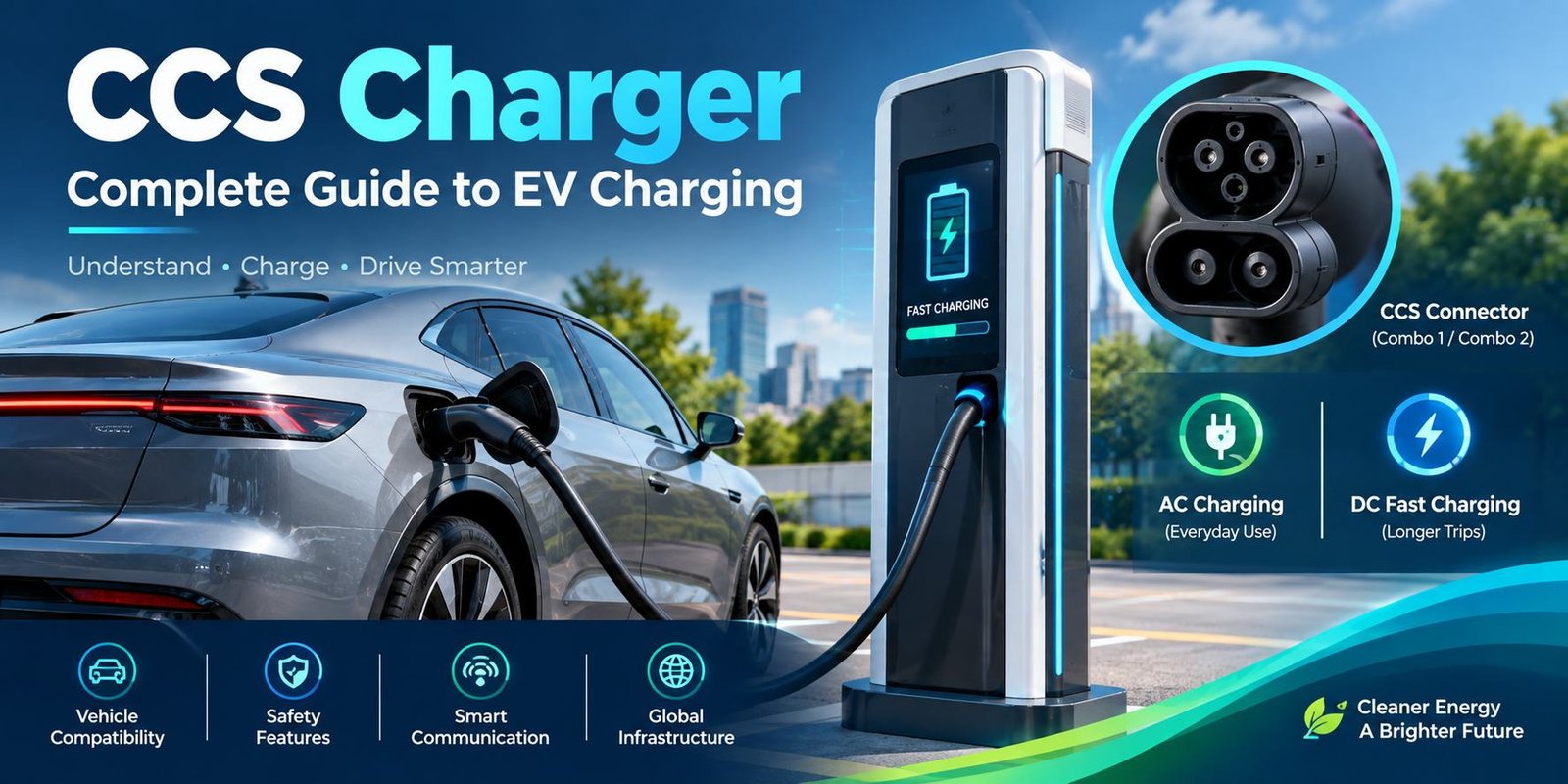
CCS Charger: Complete Guide to Electric Vehicle Charging
Electric vehicles have made charging technology an important part of everyday driving. When people start researching EVs, they often encounter terms such as CCS Charger, CCS1, CCS2, DC fast charging, and Plug & Charge. Understanding these terms can make it much easier to choose compatible charging equipment.
A CCS Charger works with the Combined Charging System, an EV charging architecture designed to bring charging, communication, control, and safety functions together. The system can support both AC and DC charging through a compatible vehicle interface.
For drivers, however, the technology does not need to be complicated. The important questions are whether the vehicle supports CCS, which connector version it uses, how much charging power it can accept, and where compatible chargers are available.
What Is a CCS Charger?
A CCS Charger is equipment designed to charge electric vehicles that support the Combined Charging System.
The system is more than a physical connector. It combines the connection between the vehicle and charging equipment with electrical power transfer, charging control, and communication.
This approach allows a compatible EV to use the same general charging inlet architecture for different charging situations. AC charging and DC charging use different contacts within the combined interface.
For an EV owner, this means one vehicle inlet can support multiple charging scenarios when the vehicle is designed for them.
What Does CCS Stand For?
CCS stands for Combined Charging System.
The name comes from the way the system combines different charging capabilities within one overall architecture.
CCS is based on international standards and includes both hardware and communication elements. CharIN describes the system as covering the connector, charging control, and communication between the electric vehicle and charging infrastructure.
This is why it is more accurate to describe CCS as a charging system rather than simply calling it a plug.
Why Is CCS Important for EV Charging?
An electric vehicle may need different types of charging depending on where it is parked.
A car sitting at home overnight has plenty of time to recharge. A driver stopping during a long journey may want to add substantial battery energy in a much shorter period.
CCS was designed to accommodate different charging requirements within an integrated approach.
Its technical framework addresses areas including:
- Electrical safety
- Communication
- Power transfer
- Physical connection
- Interoperability
- Charging control
CharIN’s implementation guidance specifically identifies electrical safety, interoperability, performance, and electromagnetic compatibility as important properties of CCS charging systems.
How Does a CCS Charging Session Work?
The driver usually sees only a simple sequence: connect the cable, start charging, and disconnect when finished.
Behind that simple experience, several processes take place.
Connecting the Vehicle
The first requirement is physical compatibility.
The connector must match the charging inlet fitted to the EV. This is why knowing whether the vehicle uses CCS1 or CCS2 matters.
Establishing Communication
The vehicle and charging equipment exchange information through the charging communication system.
This communication helps coordinate the charging session.
Checking the Charging Conditions
Control and safety functions are used before and during energy transfer.
The system is designed to prevent charging from proceeding normally when required conditions are not satisfied.
Transferring Electrical Power
Once the charging session is ready, energy is delivered to the vehicle.
The exact charging method depends on whether the session is using AC or DC charging.
Adjusting the Session
Charging power does not necessarily remain constant.
The vehicle and charging equipment can manage the session according to the vehicle’s requirements and operating conditions.
CCS1 vs CCS2
The terms CCS1 and CCS2 refer to different connector configurations within the CCS family.
They should not be treated as interchangeable simply because both use the CCS name.
What Is CCS1?
CCS1, also known as Combo 1, is primarily associated with North American charging infrastructure.
Its design is based around the Type 1 AC connection with additional contacts for DC charging.
What Is CCS2?
CCS2, also called Combo 2, is widely associated with Europe and a number of other markets.
It builds on the Type 2 AC connection and adds the additional contacts required for DC charging.
CharIN’s connector documentation distinguishes the Combo 1 and Combo 2 configurations and notes that different connector types are used in different geographical regions.
Why Does the Connector Version Matter?
Imagine arriving at a charging station with a cable that does not physically match your vehicle.
The station may support EV charging, but that does not make it compatible with your particular car.
Before choosing a charger, always verify the connector configuration specified for the vehicle.
AC Charging With CCS
AC stands for alternating current.
During AC charging, electricity is supplied to the vehicle and the car’s onboard charging equipment handles the conversion needed for battery charging.
This type of charging can be convenient when an EV remains parked for a relatively long period.
Typical situations include:
- Overnight charging
- Workplace charging
- Hotel charging
- Long parking periods
- Home charging
For many drivers, AC charging is practical because the vehicle can simply remain connected while it is not being used.
DC Charging With CCS
DC stands for direct current.
DC charging is particularly important for public fast-charging infrastructure.
Instead of relying on the vehicle’s onboard AC charger for the same conversion process, the charging station supplies DC power to the vehicle’s battery system.
This allows compatible charging stations to provide much higher charging power.
The actual rate still depends on the vehicle and charging equipment.
Is Every CCS Charger a Fast Charger?
No.
This is an important distinction.
CCS identifies the charging system, not one universal charging speed.
A CCS-compatible charging setup can be used for different charging scenarios. The power available during a particular session depends on several factors.
CharIN’s CCS information describes the system as supporting both conventional AC charging and high-power DC charging.
Therefore, seeing “CCS” on a charging station does not tell you the exact charging speed.
What Determines Charging Speed?
The maximum number printed on a charging station is only part of the story.
Vehicle Capability
The EV itself has charging limits.
If the car is designed to accept a certain maximum power, connecting it to a charger with a higher rating will not automatically make the vehicle accept more.
Battery State
Charging behavior can change as the battery becomes fuller.
The power available during the early portion of a charging session may differ from the rate later in the session.
Battery Temperature
Temperature can influence how the vehicle manages charging.
The battery-management system may adjust charging behavior when conditions require it.
Charger Output
The charging station also has a defined power capability.
A vehicle cannot receive more power than the charging equipment is capable of supplying.
Site Conditions
At some charging locations, electrical capacity may be managed across several charging points.
As a result, the advertised maximum should not be interpreted as a guaranteed charging rate for every vehicle.
What Makes CCS Different From a Normal EV Connector?
A physical connector is only one part of the CCS system.
CCS also addresses how the charging session is controlled and how information moves between the vehicle and charging infrastructure.
CharIN’s technical documentation identifies three major charging functions:
- Communication
- Power transfer
- Physical coupling
The same documentation also emphasizes safety, interoperability, reliability, and performance.
That combination is what makes CCS a complete charging architecture rather than merely a cable shape.
CCS Communication Explained
Communication allows the vehicle and charging equipment to exchange information during a charging session.
Modern CCS implementations can use communication technologies associated with ISO/IEC 15118.
This standard family provides a framework for advanced charging functions, including automated authorization and other services.
Communication is important because modern EV charging involves much more than switching electricity on and off.
The vehicle needs to interact with the charging infrastructure in a controlled way.
What Is Plug & Charge?
Plug & Charge is designed to simplify the charging experience.
With compatible equipment, the EV and charging station can communicate automatically so that identification and billing can take place without the driver manually presenting a card or opening a charging application for every session.
CharIN explains that Plug & Charge uses ISO 15118 interfaces for automated communication and billing.
However, having a CCS connector does not automatically mean Plug & Charge will work.
The vehicle, charger, network, software, and account infrastructure all need to support the feature.
CCS Charger vs CHAdeMO
CCS and CHAdeMO are different EV charging systems.
They use different connector designs and technical approaches.
For an EV owner, the important issue is compatibility rather than simply comparing the names.
If a vehicle has a CCS inlet, the driver should use charging equipment designed for that connection unless an officially supported alternative is available.
The charging ecosystem also varies between countries, so connector availability can differ depending on location.
CCS Charger vs NACS
NACS is another charging connector system that has become particularly important in North America.
The EV charging market continues to change, with manufacturers and charging networks supporting different connector strategies.
This makes it important to check the specifications of the exact EV rather than assuming that all electric cars use the same connector.
For anyone buying a charging station, vehicle compatibility should come before charger power or extra features.
Where Are CCS Chargers Used?
CCS charging infrastructure can appear in many different locations.
Public Charging Stations
Public stations allow drivers to recharge away from home.
Highway Charging Sites
Fast-charging locations along major routes can help drivers add battery energy during longer journeys.
Shopping Areas
Charging equipment may be available at shopping centers and other destinations where vehicles remain parked.
Workplaces
Some businesses provide EV charging for employees or company vehicles.
Fleet Facilities
Electric fleets may use dedicated charging infrastructure designed around the requirements of multiple vehicles.
The exact availability of CCS depends on the region and charging network.
Can You Use a CCS Charger at Home?
Home charging is possible, but the practical setup depends on the type of charging equipment.
AC charging is generally easier to accommodate in residential environments because the vehicle can remain connected for several hours.
High-power DC charging can require significantly more electrical infrastructure.
Before installing fixed charging equipment, homeowners should have the electrical installation assessed by a qualified professional and follow applicable local requirements.
How to Choose a CCS Charger
Buying a charging station should begin with the vehicle.
Check the Vehicle Connector
Find out whether the EV uses:
- CCS1
- CCS2
- Another connector
Never assume the connector based only on the vehicle brand.
Check AC Capability
Find out how much AC power the vehicle can accept.
This helps determine whether a particular home or workplace charging setup makes sense.
Check DC Capability
If you plan to use public fast chargers, check the vehicle’s maximum DC charging capability.
Consider Your Routine
Think about how you actually drive.
If the vehicle spends most nights at home, convenient overnight charging may matter more than an extremely high charging rate.
If you frequently travel long distances, access to suitable DC charging may become more important.
Consider the Installation
For fixed equipment, consider the electrical supply, mounting location, cable length, weather exposure, and local installation requirements.
Check Additional Features
Depending on the equipment, you may also encounter features involving:
- Charging schedules
- Network connectivity
- Authentication
- Load management
- Smart charging
- Plug & Charge
Choose features that match your actual needs rather than paying for functions you will never use.
Common CCS Charging Mistakes
Mistake 1: Assuming CCS1 and CCS2 Are the Same
They belong to the same family but have different connector configurations.
Mistake 2: Looking Only at Kilowatts
A powerful charger does not force an EV to accept more power than its charging system allows.
Mistake 3: Confusing CCS With Fast Charging
CCS is the charging system. Charging speed depends on the complete charging setup.
Mistake 4: Ignoring Regional Compatibility
A charging connector common in one country may not be the standard used in another.
Mistake 5: Assuming Plug & Charge Is Universal
Plug & Charge requires compatible technology and service infrastructure.
Mistake 6: Using an Unverified Adapter
A connector that physically fits does not necessarily mean that the electrical and communication systems are compatible.
Are CCS Chargers Safe?
CCS includes safety-related functions as part of its charging architecture.
CharIN’s implementation documentation lists electrical safety, interoperability, performance, reliability, and electromagnetic compatibility among the essential properties of CCS charging systems.
Users should still inspect charging equipment before use.
Avoid using equipment with:
- Broken connector housings
- Severely damaged cables
- Exposed electrical components
- Signs of overheating
- Other obvious physical damage
If a public station appears damaged, use another functioning station and report the problem to the operator.
Can CCS Support Smart Charging?
Yes, compatible CCS implementations can support advanced communication and charging functions.
ISO/IEC 15118 provides a framework for communication between an EV and charging infrastructure and can support features such as Plug & Charge and bidirectional charging-related applications.
Smart charging can involve managing when and how much power an EV receives.
This can become increasingly useful as electric vehicles become more connected to homes, buildings, and electricity networks.
CCS and Bidirectional Charging
Bidirectional charging allows electricity to move in more than one direction under compatible conditions.
Instead of the EV only receiving electricity, supported systems can potentially allow energy to move from the vehicle back toward another destination.
ISO 15118 includes technical frameworks for bidirectional charging and smart-grid integration.
The exact functionality depends on the vehicle, charger, software, standards implementation, and local energy regulations.
What Is the Future of CCS?
EV charging technology continues to develop.
CharIN currently provides technical material covering CCS specifications, implementation guidance, testing, interoperability, and newer charging functions.
Recent CharIN work also covers areas such as ISO 15118 interoperability, charging-system testing, bidirectional charging, and charging infrastructure for commercial vehicles.
This means CCS should be viewed as an evolving charging ecosystem rather than a technology that stopped developing after the connector was introduced.
CCS Charger Buying Checklist
Before purchasing or selecting a charging station, check these points:
- Does my vehicle support CCS?
- Does it use CCS1 or CCS2?
- Does the vehicle support AC charging?
- What is its maximum DC charging capability?
- What power can the charging station provide?
- Where will the charger be installed?
- Is the electrical supply suitable?
- Does the charger have the features I actually need?
- Is the equipment appropriate for the local market?
- Are installation and safety requirements satisfied?
Answering these questions first can prevent compatibility problems later.
Frequently Asked Questions
What is a CCS Charger?
A CCS Charger is charging equipment designed for compatible electric vehicles using the Combined Charging System.
What does CCS stand for?
CCS stands for Combined Charging System.
What is CCS1?
CCS1, also called Combo 1, is a CCS connector configuration associated primarily with North American charging infrastructure.
What is CCS2?
CCS2, or Combo 2, is another CCS configuration widely used in Europe and several other regions.
Is CCS the same as DC fast charging?
No. CCS is a charging system. DC fast charging is a type of charging that compatible CCS vehicles can use.
Can every EV use a CCS Charger?
No. The vehicle must have compatible charging hardware and support the relevant CCS configuration.
Does CCS support AC charging?
Yes. CCS integrates AC and DC charging within its broader charging architecture.
Does CCS support DC charging?
Yes. CCS is also used for high-power DC charging applications.
Does CCS support Plug & Charge?
Compatible CCS implementations can support Plug & Charge through appropriate communication technology and infrastructure.
Why doesn’t my EV always charge at the advertised maximum speed?
Charging power can vary according to the vehicle’s limits, battery condition, temperature, charger capability, and other factors.
Which CCS Charger should I choose?
The suitable option depends on your EV’s connector, charging capability, location, electrical supply, and everyday driving requirements.
Final Thoughts
A CCS Charger is part of a broader EV charging system that combines physical connectivity with power transfer, communication, control, and safety functions.
For an EV owner, the most useful starting point is not the charger’s maximum power rating. Start with the vehicle.
Find out which connector it uses, understand its AC and DC capabilities, consider how and where you normally charge, and then look for compatible equipment.
Once those basics are clear, choosing and using a CCS charging solution becomes much easier.