
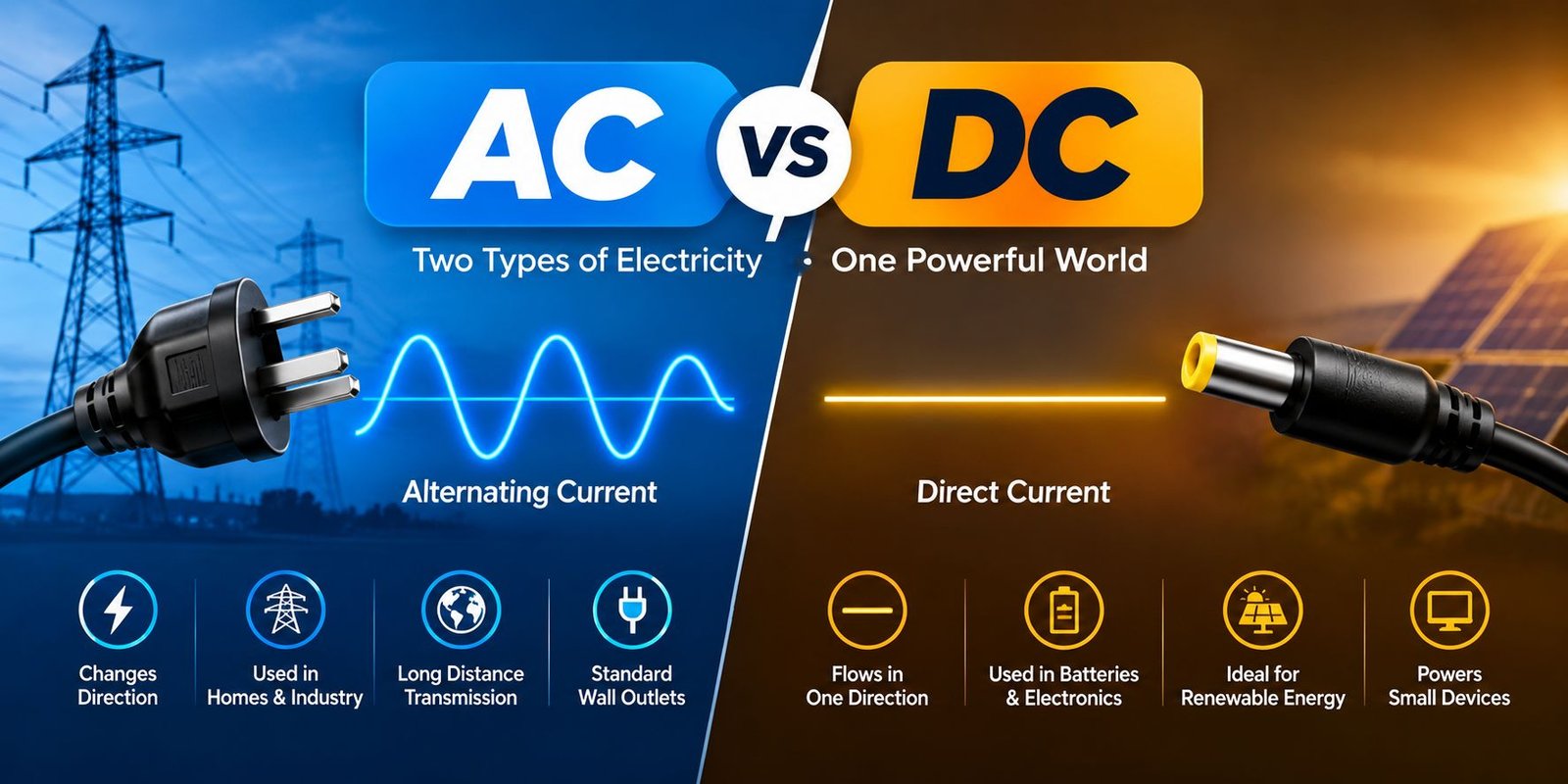
AC vs DC: Understanding the Two Types of Electric Current
Understanding AC vs DC helps explain why homes receive electricity through wall outlets while batteries store energy for portable devices. Although both types deliver electrical power, they behave differently and serve different purposes.
The main difference is simple: AC vs DC changes its direction periodically, while DC travels in one consistent direction. This difference affects how electricity is generated, transmitted, stored, and used in electronic equipment.
What Is AC (Alternating Current)?
Alternating current, commonly called AC, is a type of electricity that regularly changes direction. Instead of flowing continuously in one direction, its movement reverses at a particular frequency.
Most homes and commercial buildings receive AC vs DCelectricity through the public power grid. This supply operates household appliances such as air conditioners, washing machines, televisions, and refrigerators.
How Does AC Electricity Work?
Imagine water moving through a pipe. In a direct-current system, the water would move in one direction. In an alternating-current system, its movement would repeatedly change direction.
AC electricity behaves in a similar way. The voltage rises, falls, reverses polarity, and repeats this pattern.
A common way to represent AC is with a sine wave. This waveform shows how voltage changes over time.
The number of complete cycles occurring in one second is called frequency. It is measured in hertz (Hz).
For example:
- The standard electricity frequency in the United States is 60 Hz.
- Many countries, including Pakistan and the United Kingdom, use 50 Hz.
At 60 Hz, the electrical waveform completes 60 cycles every second. At 50 Hz, it completes 50 cycles per second.
Where Is AC Used?
AC is widely used in situations where electricity needs to be distributed across buildings or large areas.
Common examples include:
- Household electrical outlets
- Office lighting systems
- Refrigerators and washing machines
- Air conditioning systems
- Industrial motors
- Power distribution networks
One reason AC is useful for electrical grids is that transformers can change its voltage efficiently. This makes it practical to transmit electricity over long distances.
What Is DC (Direct Current)?
Direct current, or DC, is electricity that flows in one direction through a circuit. Unlike AC, its polarity does not repeatedly reverse during normal operation.
Batteries are familiar examples of DC power sources. A battery has positive and negative terminals, and current flows through an external circuit in a consistent direction when connected correctly.
Many electronic devices depend on DC because their internal components need a suitable, controlled power supply.
How Does DC Electricity Work?
Think about a flashlight powered by a battery. When you switch it on, electrical energy moves through the circuit and powers the bulb or LED.
The current maintains the same direction during normal operation. This is the basic behavior of DC.
DC voltage can remain relatively steady, although some sources produce changing DC voltage depending on their design and operating conditions.
For example, a rechargeable battery’s voltage may decrease as its stored energy is used.
Where Is DC Used?
DC electricity is common in equipment that stores energy or contains electronic circuits.
Examples include:
- Smartphone batteries
- Laptop batteries
- Power banks
- Flashlights
- Solar panels
- Battery-powered toys
- Electronic circuit boards
- Many automotive electrical systems
Solar panels also generate DC electricity. If the electricity needs to power standard AC household equipment, an inverter can convert it into AC.
AC vs DC: What Are the Main Differences?
AC vs DC The two current types differ in their direction, electrical behavior, common applications, and power-conversion requirements.
| Feature | AC | DC |
|---|---|---|
| Full form | Alternating Current | Direct Current |
| Current direction | Changes periodically | Flows in one direction |
| Voltage behavior | Usually varies periodically | Can be steady or variable |
| Frequency | Usually 50 or 60 Hz for grid power | Zero frequency in steady-state DC |
| Common source | Electrical power grid | Batteries and solar cells |
| Storage | Not directly stored in ordinary batteries | Commonly stored in batteries |
| Voltage conversion | Transformers | Electronic converters |
| Typical applications | Household and industrial supply | Electronics and battery systems |
1. Direction of Current
The most important difference between AC and DC is how current moves.
AC repeatedly changes direction. DC maintains one direction during normal operation.
This distinction is also visible when the two types are represented on electrical graphs. AC commonly appears as a waveform that crosses above and below zero, while steady DC appears as a constant level.
2. Voltage and Frequency
AC voltage changes over time, and its frequency describes how quickly the waveform repeats.
DC does not alternate between positive and negative directions. A steady DC supply has no alternating frequency.
However, DC voltage is not always perfectly constant. Batteries gradually lose voltage as they discharge, and electronic power supplies may produce controlled DC levels.
3. Power Transmission
AC has historically played a major role in public electricity networks because transformers make it convenient to increase or decrease voltage.
High-voltage transmission reduces current for a given amount of power. Lower current can reduce resistive energy losses in transmission lines.
DC is also used for long-distance electricity transmission. High-voltage direct current (HVDC) systems can be especially useful for certain long-distance connections and underwater cables.
Therefore, it would be inaccurate to say that AC is always better for transmission. The suitable choice depends on distance, network design, equipment costs, and operating conditions.
4. Energy Storage
Batteries store and release energy using electrochemical processes that provide DC electricity at their terminals.
AC is generally not stored directly in an ordinary battery. Instead, systems convert AC into DC before charging a battery.
When stored battery energy is needed for AC equipment, an inverter performs the reverse conversion.
Why Do Homes Use AC Instead of DC?
Most traditional electricity distribution systems supply AC to homes because it is convenient to change voltage using transformers.
Electricity travels through transmission networks at high voltages and is reduced to suitable levels before reaching homes and businesses.
This arrangement makes large-scale distribution practical.
However, household appliances do not all use AC internally. Many modern electronics require DC to operate their processors, displays, memory, and other components.
That is why phone chargers, laptop adapters, and other power supplies convert incoming AC electricity into DC.
For example, when you plug a phone charger into a wall socket, the charger changes the electrical supply into a suitable DC output for charging the phone.
Can AC Be Converted Into DC?
Yes. An electronic device called a rectifier converts alternating current into direct current.
Rectifiers are commonly found in power adapters, battery chargers, and electronic power supplies.
The conversion usually involves several stages.
Step 1: AC Input
The device receives alternating current from a wall outlet or another AC source.
Step 2: Rectification
A rectifier circuit, often built with diodes, allows current to pass in a controlled direction. This changes the AC waveform into pulsating DC.
Step 3: Smoothing
Capacitors and other circuit components reduce fluctuations in the rectified output.
Step 4: Voltage Regulation
A regulator or switching circuit adjusts the output to a suitable voltage for the connected device.
This process explains why a small phone charger can take electricity from a household outlet and deliver the DC power required by a phone.
Can DC Be Converted Into AC?
Yes. An inverter converts direct current into alternating current.
Inverters are important in solar power systems, backup electricity systems, and battery-based installations.
For example, a solar panel produces DC electricity. If a household appliance requires AC, an inverter changes the electricity into an appropriate AC output.
Inverters are also used in uninterruptible power supplies (UPS), allowing battery energy to operate equipment when the main electricity supply is unavailable.
The output must match the voltage, frequency, and other requirements of the equipment being powered.
AC vs DC: Real-Life Examples
Understanding the technical differences becomes easier when you look at familiar devices.
Smartphone Charging
A wall outlet supplies AC electricity, but a smartphone battery stores energy as DC.
The phone charger converts the incoming AC into DC and controls the output to meet the phone’s charging requirements.
Solar Energy Systems
Solar panels generate DC electricity when exposed to sunlight.
A solar installation may send this electricity to a battery, an inverter, or both, depending on the system design.
The inverter supplies AC when the electricity needs to operate conventional household appliances.
Electric Vehicles
Electric vehicles use batteries that store DC energy.
The vehicle’s battery system supplies electrical energy to its drive components. When charging from an AC outlet, the vehicle’s onboard charger converts AC into DC for the battery.
DC fast-charging stations provide DC power through specialized charging equipment.
Household Appliances
Many traditional household appliances use AC motors or AC-powered circuits.
Modern devices may contain electronic components that operate internally on DC. Some appliances therefore convert incoming AC into DC as part of their internal power supply.
Advantages and Disadvantages of AC
AC has several practical advantages, particularly in large electricity distribution networks.
Advantages:
- Transformers make voltage changes relatively straightforward.
- It works well with established public electricity grids.
- AC motors are widely used in industrial and household equipment.
- It is suitable for distributing electricity across buildings and cities.
Disadvantages:
- Many electronic devices need AC-to-DC conversion.
- Certain electrical systems require additional components to manage voltage and frequency.
- Transmission losses can occur, especially when equipment and network design are inefficient.
- Some specialized applications are better served by DC.
Advantages and Disadvantages of DC
DC is especially useful in battery-powered equipment and electronic systems.
Advantages:
- Batteries provide DC directly.
- Electronic circuits commonly require DC power.
- Solar panels naturally produce DC electricity.
- DC is convenient for many portable and low-voltage devices.
Disadvantages:
- Changing DC voltage generally requires electronic conversion equipment.
- Large DC transmission systems need specialized equipment.
- Battery-based systems require suitable charging and protection circuits.
- Converting between AC and DC can introduce energy losses.
Is AC More Dangerous Than DC?
Both AC and DC can cause serious electric shock, burns, injuries, or death. Neither type should be considered safe to touch.
The level of danger depends on several factors, including:
- Voltage
- Current through the body
- Duration of contact
- Path the current takes through the body
- Skin condition and environmental moisture
- Electrical source and protection equipment
The effects of AC and DC on the human body are not identical, but it is not useful to treat one as harmless.
Never experiment with exposed household wiring, batteries with damaged terminals, or electrical equipment without proper training and safety precautions.
For electrical repairs, switch off the appropriate supply and use a qualified electrician when necessary.
Which Is Better: AC or DC?
There is no universal winner because AC and DC solve different electrical problems.
AC is widely used for distributing electricity through public grids and powering many building systems. Its voltage can be changed conveniently with transformers.
DC is essential for batteries, many electronic devices, and solar energy systems. It also plays an important role in modern high-voltage transmission.
The right choice depends on what the electrical system needs to accomplish.
For example:
- A home electrical outlet generally supplies AC.
- A smartphone battery stores DC.
- A solar panel produces DC.
- An inverter changes DC into AC.
- A rectifier changes AC into DC.
Understanding these applications is more useful than assuming one current type is always superior.
Frequently Asked Questions About AC vs DC
What does AC stand for?
AC stands for Alternating Current. It is an electrical current that periodically changes direction. Household electricity supplies in many countries use AC.
What does DC stand for?
DC stands for Direct Current. It flows in one direction during normal operation and is commonly supplied by batteries and solar panels.
Is a battery AC or DC?
A typical battery supplies DC electricity. Its positive and negative terminals maintain their polarity during normal use.
Do phones use AC or DC?
Smartphones use DC internally and store energy in DC batteries. Their chargers convert electricity from AC wall outlets into suitable DC power.
Why is AC used in power lines?
AC has traditionally been useful for power distribution because transformers can change its voltage efficiently. However, HVDC technology is also used in certain long-distance transmission projects.
Can DC power run household appliances?
Yes, but the appliance must be designed to accept the supplied DC voltage and current. Many standard household appliances are designed for AC, so an appropriate inverter may be needed.
Do solar panels produce AC or DC?
Solar panels produce DC electricity. An inverter converts that electricity into AC when needed for conventional household equipment or grid connection.
What is the main difference between AC and DC?
The main difference is the direction of current flow. AC changes direction periodically, while DC flows in one direction during normal operation.
Conclusion
The difference between AC vs DC comes down to how electrical current behaves and where each type is useful. AC changes direction periodically and supports conventional electricity distribution, while DC provides the consistent direction of flow used by batteries, solar panels, and electronic equipment.
Both are essential to modern electrical systems. From charging a smartphone to powering a home or operating an electric vehicle, AC and DC work together to make everyday technology possible.




One Comment