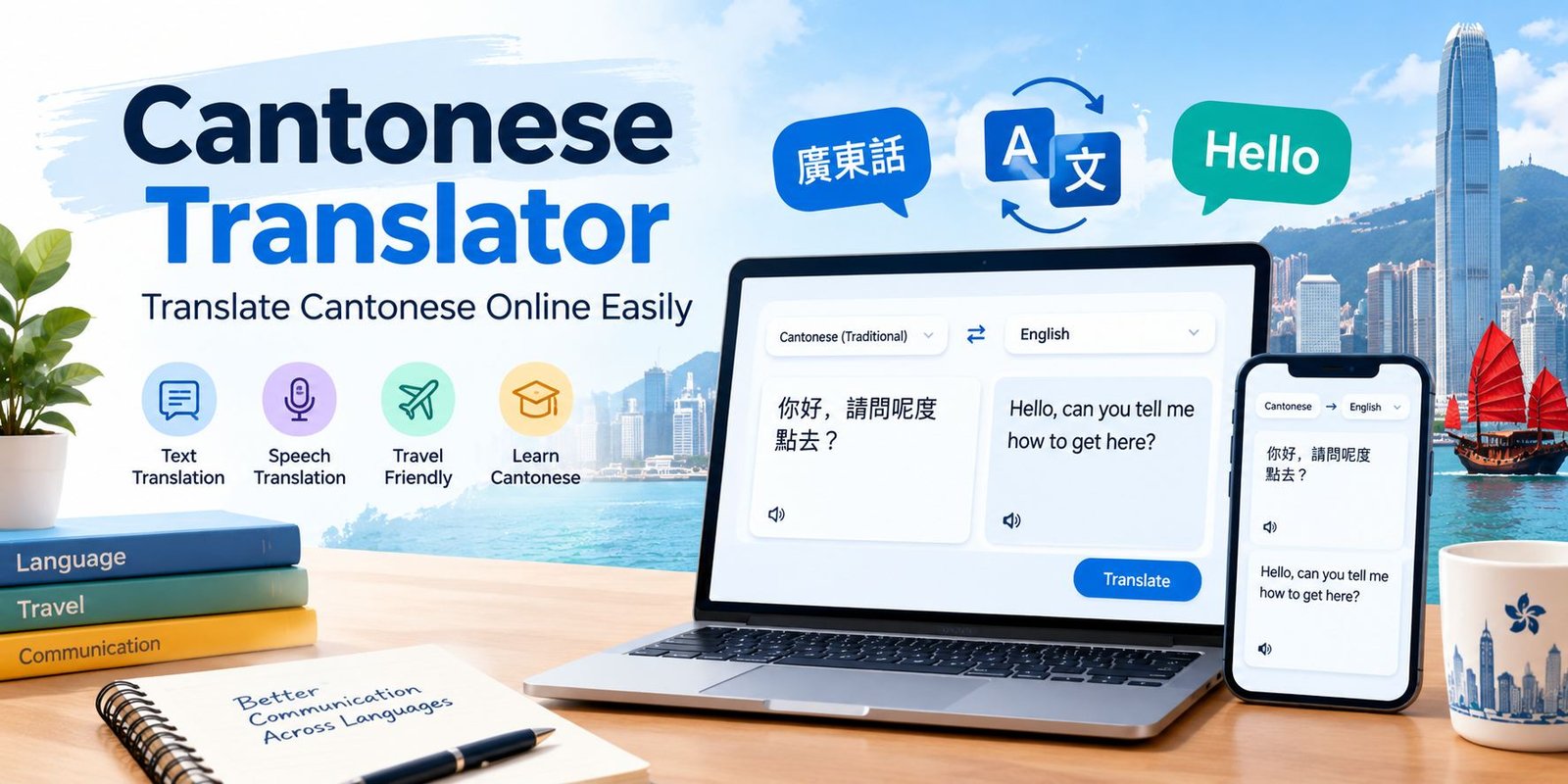
Cantonese Translator: Translate Cantonese Online Easily
Understanding another language can make communication easier, especially when you need to read messages, websites, documents, or everyday conversations. A Cantonese translator can help people convert Cantonese text into English or another supported language and can also be useful when learning basic Cantonese.
Cantonese is widely associated with Hong Kong and southern China and has its own pronunciation, vocabulary, expressions, and writing conventions. Because of these differences, translating Cantonese is not always the same as translating standard written Mandarin.
Modern translation tools can make the process much faster. For example, Microsoft Translator currently lists Cantonese (Traditional) as a supported language for text translation, speech translation, and text-to-speech.
What Is a Cantonese Translator?
A Cantonese translator is a digital tool that helps convert Cantonese words, phrases, or sentences into another language. Depending on the service, it may also provide speech, pronunciation, or other translation features.
For example, someone might use a translator to understand:
- A Cantonese message from a friend
- A short sentence found online
- A restaurant menu
- A social media post
- A business communication
- A travel-related phrase
- Basic Cantonese vocabulary
Some services work directly in a web browser, while others are available through mobile applications or translation APIs.
The main benefit is convenience. Instead of manually looking up every unfamiliar word, users can enter text and receive a translated result within seconds.
Why Is Cantonese Translation Different?
Cantonese and Mandarin are both varieties of Chinese, but they are not simply different pronunciations of the same spoken language.
Cantonese has its own spoken vocabulary and grammatical patterns. Written Cantonese can also contain characters and expressions that differ from formal written Chinese.
This means a translation tool needs to understand more than individual Chinese characters. The meaning of a sentence can depend on context, word choice, tone, and the way Cantonese is naturally expressed.
For casual communication, an online translator can be very useful. However, important legal, medical, academic, or professional material may require review by a qualified human translator.
How Does a Cantonese Translator Work?
Most online translation services use machine-learning systems to analyze the source text and generate an equivalent expression in the selected target language.
A basic workflow looks like this:
1. Enter the Cantonese Text
Start by entering or pasting the Cantonese text into the translation tool.
Some services may also support speech input or other forms of interaction.
2. Select the Target Language
Choose the language you want to understand, such as English.
The available languages depend on the translator you are using.
3. Review the Translation
The tool generates a translated version of the original content.
Read the complete result rather than relying on one translated word because context can affect meaning.
4. Check the Original Meaning
For important communication, compare the translated sentence with the original Cantonese text.
This can help identify unusual wording or meanings that may not transfer perfectly between languages.
What Can You Translate With an Online Tool?
A Cantonese translator can be useful for many everyday situations.
Short Messages
If you receive a Cantonese message and do not understand it, a translation tool can provide a quick explanation.
Websites and Online Content
Translation tools can help users understand webpages or online content written in another language.
Travel Information
Visitors may use translation tools to understand signs, instructions, menus, and basic communication while traveling.
Learning Materials
Language learners can use translations to understand unfamiliar vocabulary and sentence structures.
Business Communication
For simple business messages, a translator can help users understand the general meaning of Cantonese content.
For sensitive contracts or official documents, however, professional translation may be more appropriate.
Cantonese Translator for English
One of the common use cases is translating Cantonese into English.
This can be helpful for English speakers who receive Cantonese messages or need to understand Chinese-language content.
A simple process is:
- Open a translation service.
- Select Cantonese as the source language.
- Select English as the target language.
- Enter the Cantonese text.
- Review the translated result.
- Check the context before using the translation.
Microsoft’s current language documentation identifies Cantonese (Traditional) with the language code yue and lists it as supported for text translation.
Cantonese Text Translation vs Speech Translation
Not every translator offers the same features.
Text Translation
Text translation is useful when you already have written Cantonese. You can paste or type the content and receive a translated version.
Speech Translation
Speech translation can be useful when communicating with someone in real time.
Microsoft currently lists Cantonese (Traditional) as supported for speech translation in its Translator language list.
Text-to-Speech
Some services can also read translated text aloud. This can help language learners hear how the translated language sounds.
Microsoft lists text-to-speech support for Cantonese (Traditional) as well.
Cantonese Translator for Learning the Language
A translator can be more than a quick conversion tool. It can also support language learning.
For example, learners can use translated sentences to study:
- New vocabulary
- Common expressions
- Sentence patterns
- Everyday phrases
- Differences between formal and casual wording
However, translation should not be the only learning method.
If you are studying Cantonese seriously, combine translation tools with pronunciation practice, listening exercises, vocabulary study, and authentic Cantonese content.
How Accurate Are Cantonese Translators?
Translation quality can vary depending on the tool, sentence length, context, and type of content.
Short and straightforward sentences are generally easier for automated systems to process than complicated expressions containing slang, humor, cultural references, or ambiguous wording.
A translation can also lose some meaning when an expression does not have a direct equivalent in another language.
For this reason, treat machine translation as a useful starting point rather than assuming every result is perfect.
Things That Can Affect Translation Quality
Several factors can influence the result:
- Sentence context
- Slang
- Regional expressions
- Spelling
- Informal language
- Cultural references
- Names and proper nouns
- Technical vocabulary
- Very long sentences
If a translation sounds unnatural, try translating a shorter section or rewriting the original sentence more clearly.
Cantonese Translator for Travel
Travelers can find translation tools particularly useful.
Imagine visiting a Cantonese-speaking area and needing to understand a menu or communicate a basic request. A translation app can provide quick assistance when you do not know the language.
Useful situations may include:
Restaurants
You can use translation technology to understand food descriptions or communicate simple requests.
Directions
A translator can help explain short questions about locations and transportation.
Shopping
Users may translate product information or simple questions while shopping.
Everyday Conversations
For basic interactions, a translation tool can help bridge a language gap.
For emergencies or important instructions, however, users should seek reliable human assistance when possible rather than depending entirely on automated translation.
Cantonese Translator for Business Communication
Businesses working with Cantonese-speaking customers or partners may use translation tools for everyday communication.
They can be helpful for:
- Short emails
- Customer messages
- Product descriptions
- Basic questions
- Internal communication
- Simple online conversations
However, important contracts, financial documents, legal notices, and official materials deserve professional review.
A machine-generated translation may communicate the general idea while missing a subtle legal or commercial meaning.
How to Get Better Results From a Cantonese Translator
The quality of your input can affect the usefulness of the output.
Use Complete Sentences
Instead of entering random words, provide enough context for the translator to understand what you mean.
Avoid Unnecessary Abbreviations
Informal abbreviations can be difficult for automated systems to interpret correctly.
Translate Smaller Sections
If you have a very long passage, breaking it into logical sections can make the results easier to review.
Check Names Separately
Names, locations, brands, and specialized terms may not translate in the way you expect.
Compare Important Results
For important information, compare the translation with another reliable source or ask a fluent Cantonese speaker to review it.
Cantonese Translator vs Human Translator
Online translation and professional translation serve different purposes.
| Online Translator | Human Translator |
|---|---|
| Very fast | Usually takes more time |
| Convenient for everyday text | Better suited to complex material |
| Useful for quick understanding | Can consider detailed context |
| Often inexpensive or free | Professional services may cost more |
| Helpful for casual communication | Appropriate for sensitive documents |
For everyday messages, a digital translator may be sufficient. For legal, medical, financial, or highly specialized content, professional human review can be important.
Common Mistakes When Using a Cantonese Translator
Even a powerful translation tool can produce confusing results if it is used incorrectly.
Translating Without Context
A single word can have different meanings depending on the sentence.
Assuming Every Chinese Variety Is Cantonese
Traditional Chinese characters do not automatically mean that a sentence is written in Cantonese. Cantonese and Mandarin can use overlapping writing systems while differing in vocabulary and spoken language.
Trusting Every Result Blindly
Machine translation is useful, but it should not replace careful review for important information.
Ignoring Cultural Meaning
Some expressions carry cultural meaning that may not have a direct equivalent in English or another language.
Is a Cantonese Translator Free?
Many online translation services offer translation features without requiring users to hire a professional translator.
The exact features, limits, account requirements, and pricing can vary between services.
Some tools may provide basic text translation while offering additional features such as speech, image translation, document translation, or developer APIs separately.
Before choosing a service, check what languages and features it currently supports.
Choosing a Cantonese Translator
When comparing translation tools, consider the features that matter to you.
Language Support
Make sure the service specifically supports Cantonese rather than only generic Chinese.
Text Translation
Check whether the service supports the type of written Cantonese you need to translate.
Speech Features
If you need spoken communication, look for speech recognition and speech translation support.
Pronunciation or Audio
Audio output can be useful when learning pronunciation or communicating verbally.
Mobile Access
A mobile app can be more convenient for travel and everyday conversations.
Privacy
Avoid entering sensitive personal, financial, medical, or confidential business information into a translation service unless you understand its privacy and data-handling practices.
Frequently Asked Questions
What is a Cantonese translator?
A Cantonese translator is a tool that converts Cantonese text or speech into another supported language and may also provide pronunciation or audio features.
Can Cantonese be translated into English?
Yes. Translation services can support Cantonese-to-English translation. Microsoft currently lists Cantonese (Traditional) among its supported languages for text translation.
Is Cantonese the same as Mandarin?
No. Cantonese and Mandarin are distinct varieties of Chinese with differences in pronunciation, vocabulary, and spoken usage.
Can a translator translate Cantonese speech?
Some services support Cantonese speech translation. Microsoft currently lists Cantonese (Traditional) for speech translation.
Are online Cantonese translators accurate?
They can be useful for everyday communication, but results may vary with context, slang, regional expressions, and specialized terminology. Important translations should be reviewed carefully.
Can I use a Cantonese translator for learning?
Yes. It can help learners understand vocabulary, sentences, and everyday expressions. It works best when combined with listening and pronunciation practice.
Final Thoughts
A Cantonese translator can make communication across languages much easier. Whether you are trying to understand a message, explore Cantonese content, travel, learn vocabulary, or communicate with Cantonese speakers, an online translation tool can save time.
Modern translation platforms support Cantonese in different ways, including text and, depending on the service, speech and audio features.
The key is to use translation technology according to the situation. For casual conversations and quick understanding, it can be extremely convenient. For contracts, medical information, legal documents, and other high-stakes content, human review remains an important safeguard.