
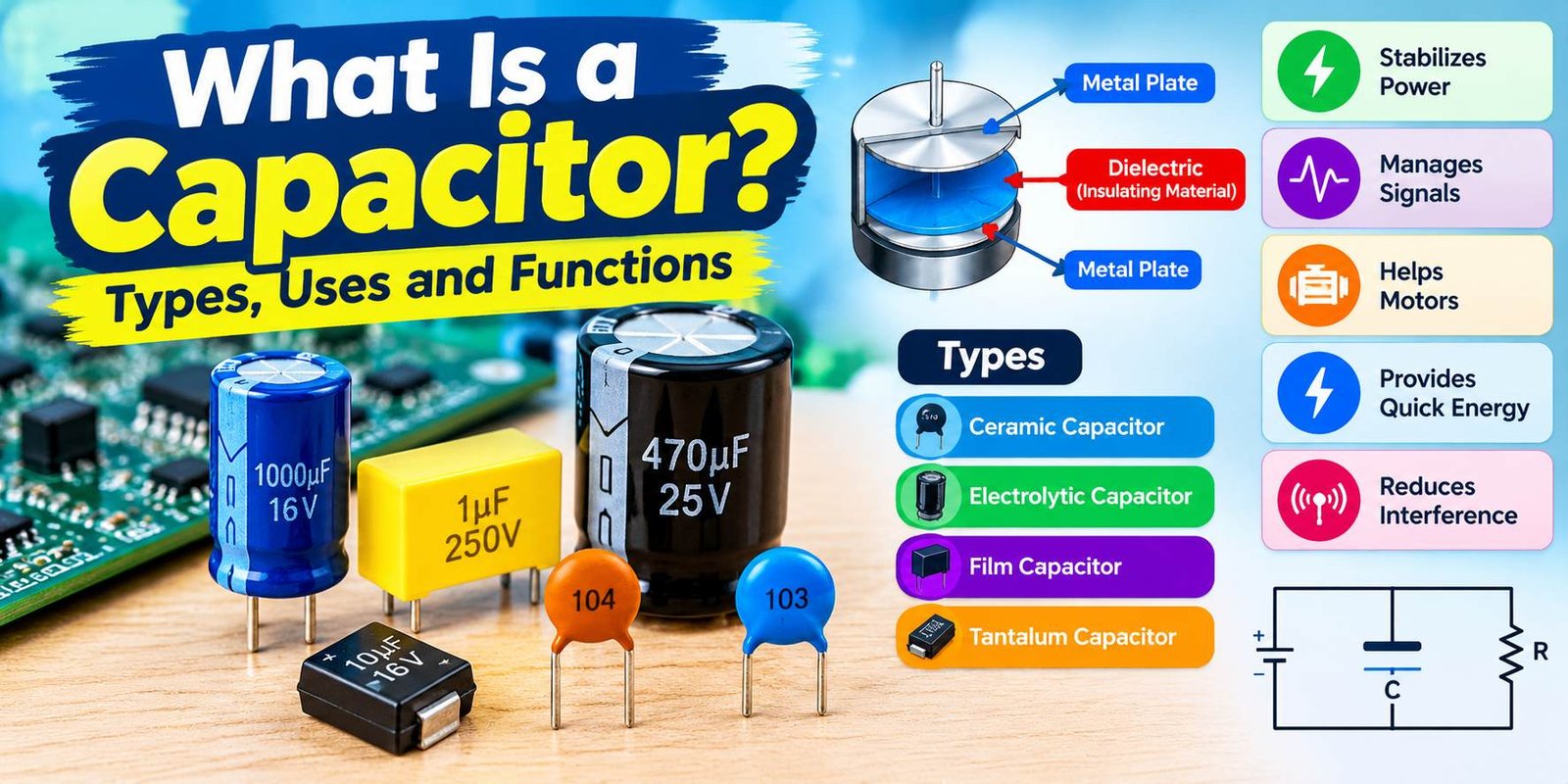
What Is a Capacitor? A Simple Guide to Types, Uses and Functions
Electronic devices contain many small parts that perform very specific jobs. One of these parts is the capacitor. If you have ever looked at a circuit board, you may have noticed small round, flat, or cylinder-shaped components attached to it.
But what is a capacitor, and why does a circuit need one?
A capacitor helps manage electrical energy inside a circuit. It can take in charge, hold it briefly, and give it back when the circuit requires a quick change. Engineers use capacitors for many tasks, from cleaning up power to handling signals and helping motors operate.
What Is a Capacitor?
A capacitor is a component that temporarily holds electrical charge.
Its construction normally includes two conductive sections with an insulating material between them. When voltage is applied, electrical charge builds up within the component and creates an electric field around the insulating layer.
Once the circuit provides a suitable path, the stored energy can move back into the circuit.
This simple behavior makes capacitors useful in both basic electronic projects and complex devices.
How Does a Capacitor Behave in a Circuit?
A capacitor does not act like a permanent power source. Its electrical behavior changes as the circuit around it changes.
When Voltage Is Applied
At the beginning, the capacitor accepts charge. The current can be relatively high during this stage.
As the capacitor’s voltage gets closer to the voltage supplied by the circuit, the charging process slows.
When the Circuit Needs the Stored Energy
If the circuit creates a suitable path, the capacitor can give up some of its stored energy.
How quickly this happens depends on the surrounding components. A resistor, for example, can affect how fast the capacitor charges or releases energy.
Why This Matters
Because a capacitor reacts to changes in a circuit, engineers can use it to control short electrical events rather than simply treating it as a source of continuous power.
What Does Capacitance Mean?
Capacitance describes the electrical storage capability of a capacitor.
The official measurement is the farad, written as F. In practical electronics, much smaller units appear more often.
These include:
- µF: microfarad
- nF: nanofarad
- pF: picofarad
The capacitance value is only one part of choosing a suitable component. The circuit may also require a specific voltage rating, temperature range, tolerance, and physical size.
What Are Capacitors Used For?
Capacitors have many jobs. Their purpose depends on the circuit where engineers install them.
Keeping Power More Stable
Electronic circuits often need a cleaner and steadier supply. Capacitors can help deal with short changes in voltage and reduce some unwanted fluctuations.
Managing Electrical Signals
Some circuits use capacitors to influence which parts of an electrical signal pass through. This makes them useful in audio, radio, communication, and other signal-based systems.
Helping Electric Motors
Certain motors need additional electrical support during startup or normal operation. Capacitors can provide that support in equipment such as fans, pumps, and cooling systems.
Handling Short Energy Demands
A capacitor can provide a quick burst of stored energy when a circuit needs it. This is useful when an electrical load changes suddenly.
Controlling Unwanted Interference
Electronic equipment can produce or receive electrical noise. Proper capacitor placement can help reduce some of these unwanted effects.
Common Capacitor Types
Capacitors are not all built the same way. Manufacturers produce different designs for different jobs.
Ceramic Capacitors
Ceramic capacitors are usually small and lightweight. They work well in many electronic circuits and are especially common where compact components are useful.
You can find them on circuit boards inside computers, phones, appliances, and other electronic products.
Electrolytic Capacitors
Electrolytic capacitors are useful when a circuit requires relatively high capacitance.
They are often found in power-related sections of electronic equipment. Many electrolytic models have polarity, which means the positive and negative connections must be respected.
Film Capacitors
Film capacitors use a thin insulating film in their construction. They are valued for stable electrical behavior and appear in filtering, audio, power, and timing circuits.
Tantalum Capacitors
Tantalum capacitors can provide useful capacitance without taking up much board space. They are often selected for compact electronic designs.
Their polarity must be checked before installation.
Capacitor Ratings You Should Know
A capacitor’s printed markings provide important information about how it should be used.
Capacitance
This tells you the intended electrical capacity of the component.
For example, a marking such as 10 µF indicates the component’s nominal capacitance.
Maximum Voltage
Every capacitor has a voltage limit specified by its manufacturer.
A circuit should not expose the component to voltage beyond its rated limit. Choosing an unsuitable voltage rating can damage the capacitor.
Temperature Range
Temperature affects electronic components. Some capacitors are designed for ordinary indoor electronics, while others can handle much hotter or colder environments.
Tolerance
The actual capacitance may not be exactly the number printed on the component. Tolerance describes the permitted difference from its stated value.
Capacitor and Battery: Are They the Same?
No. Although both can store electrical energy, they are designed for different roles.
A battery normally supplies power over a longer period. A capacitor generally works better when a circuit needs quick electrical response.
A capacitor can often charge and release energy much faster than a battery. However, it usually cannot provide the same long-duration energy supply.
That is why you will find both components in many electronic systems rather than using one as a universal replacement for the other.
Why Do Electronic Devices Need Capacitors?
Modern electronics constantly deal with changing electrical conditions. Capacitors give designers another way to manage those changes.
A single circuit may use several capacitors, with each one handling a different task.
For example, one may support the power section while another helps manage a signal. A third could assist with noise reduction.
You can find capacitors in:
- Computers
- Smartphones
- TVs
- Chargers
- Audio equipment
- Cars
- Gaming systems
- Home appliances
- Industrial machines
- Communication equipment
How Can You Identify a Capacitor?
Start by checking the information printed on the component.
Depending on its type, you may see:
- Capacitance
- Voltage
- Polarity symbols
- Temperature information
- Series markings
- Manufacturer codes
The physical shape can also provide a clue.
A small ceramic component may look like a tiny disk or rectangle. An electrolytic model often has a cylindrical body. However, visual appearance alone cannot tell you every electrical specification.
If you need an exact replacement, compare the markings with the original component’s specifications.
What Are the Signs of a Bad Capacitor?
A failed capacitor can create different problems depending on where it is installed.
A device may show symptoms such as:
- Random shutdowns
- Unstable operation
- Startup problems
- Unusual electrical noise
- Power fluctuations
- Reduced performance
- Swelling or leakage
Some failed capacitors show physical damage, but others do not.
For this reason, a component that looks normal should not automatically be considered healthy. Proper testing equipment may be required to confirm a fault.
How to Pick the Correct Capacitor
Replacing a capacitor requires more than matching its size.
Check these points before selecting one:
1. Match the Capacitance
Use the capacitance value required by the circuit or manufacturer.
2. Check the Voltage
The replacement should have a suitable voltage rating for the application.
3. Select the Correct Type
Ceramic, electrolytic, film, and tantalum capacitors do not have identical characteristics.
4. Check Polarity
If the design is polarized, connect the component according to its positive and negative markings.
5. Consider Temperature
Make sure the capacitor can operate within the temperatures expected in the device.
6. Check Physical Dimensions
A component with the correct electrical value may still be unsuitable if it does not fit the available space.
Where Can You Find Capacitors?
Capacitors appear in almost every area of electronics.
Inside a computer, they can support power circuits and signal sections. In household appliances, they may assist motors or control electrical behavior.
Automotive systems also use many types of capacitors. Audio equipment, televisions, chargers, industrial controllers, and communication hardware rely on them as well.
Their exact size and design depend on the job they perform.
Frequently Asked Questions
What is a capacitor in easy words?
A capacitor is a small electronic component that can collect electrical charge for a short time and release it later.
What is a capacitor mainly used for?
Its applications include power support, signal control, filtering, motor operation, and reducing certain types of electrical noise.
Is a capacitor a power source?
Not in the same way as a battery. A capacitor can provide stored energy for a short event, but it normally does not serve as a long-term power source.
What does µF mean on a capacitor?
The symbol µF means microfarad. It is a unit used to describe capacitance.
Can a capacitor work without polarity?
Some can. Many ceramic and film capacitors are non-polarized, while certain electrolytic and tantalum designs require correct orientation. Always check the manufacturer’s markings.
Can a larger capacitor always replace a smaller one?
No. The correct replacement depends on the circuit. Capacitance, voltage, type, tolerance, physical size, and other characteristics can all matter.
Final Thoughts
So, what is a capacitor? It is a small but important electronic component that helps circuits handle electrical charge and changing voltage conditions.
Capacitors come in many forms, from tiny ceramic parts on computer boards to larger components used in power equipment. Their jobs can include power smoothing, signal control, motor support, and short-term energy delivery.
Understanding the component’s capacitance, voltage rating, type, and polarity can help you choose the right capacitor for an electronic application.
SEO Details
SEO Title: What Is a Capacitor? Types, Uses & Functions
Meta Description: What is a capacitor? Discover how capacitors work, their types, common uses, ratings, and key differences from batteries.
Focus Keyphrase: What Is a Capacitor
Slug: what-is-a-capacitor
Related Keywords: capacitor types, capacitor uses, capacitance, how capacitors work, ceramic capacitor, electrolytic capacitor, film capacitor
Image Alt Text: What is a capacitor electronic component