
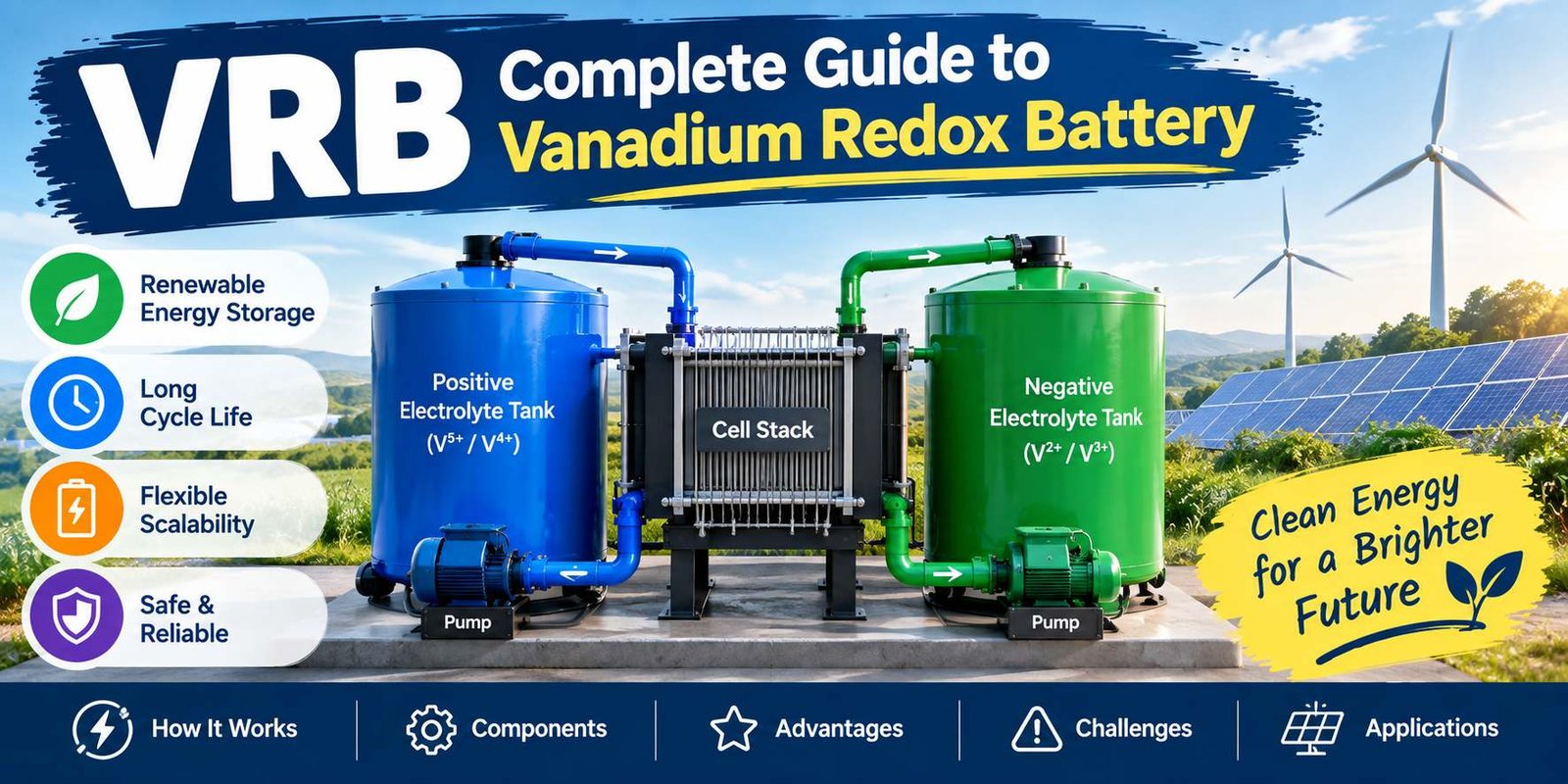
VRB: Complete Guide to Vanadium Redox Battery Technology
As renewable energy becomes more important, reliable energy storage is needed to keep electricity available when solar or wind generation changes. VRB, short for Vanadium Redox Battery, is a type of rechargeable flow battery designed primarily for stationary energy storage.
Unlike conventional batteries that keep most of their active materials inside solid electrodes, a VRB stores its active energy-bearing materials in liquid electrolytes held in external tanks. Pumps circulate these liquids through a cell stack, where electrochemical reactions allow the system to store or release electrical energy.
This design gives VRB technology several interesting characteristics, including flexible sizing, long operating life, and suitability for applications where energy may need to be stored for several hours. It is particularly relevant to grid storage, renewable-energy projects, and other large stationary systems.
What Is VRB?
VRB stands for Vanadium Redox Battery. It is also commonly described as a vanadium redox flow battery or vanadium flow battery.
The word “redox” comes from reduction and oxidation, the two types of chemical reactions involved when the battery charges and discharges. Vanadium is used in different oxidation states within the two electrolyte circuits.
A typical system contains:
- Two electrolyte storage tanks
- Pumps for circulating the liquids
- A cell stack
- Electrodes
- An ion-exchange membrane
- Piping and control equipment
- Power conversion equipment
One of the distinctive features of this technology is that vanadium is used on both sides of the battery system. This can reduce some of the cross-contamination problems associated with flow batteries that use different active chemical elements.
How Does a Vanadium Redox Battery Work?
A VRB operates by moving liquid electrolytes between storage tanks and an electrochemical cell stack.
During charging, electrical energy causes vanadium ions in the electrolytes to change oxidation state. During discharge, those reactions proceed in the opposite direction and electricity is produced for an external load.
The basic process can be understood in four steps.
1. Energy Enters the System
When the battery is connected to a charging source, electrical power is supplied to the cell stack.
The electrical energy changes the chemical state of the vanadium ions in the electrolytes.
2. Electrolytes Circulate
Pumps move the electrolyte solutions from their storage tanks through the cell stack.
The tanks act as the energy-storage reservoir, while the stack provides the location where electrochemical reactions take place.
3. The Membrane Separates the Two Sides
An ion-selective membrane separates the two electrolyte circuits.
The membrane allows appropriate ions to move between the two sides while helping prevent the bulk electrolyte solutions from mixing directly.
4. Electricity Is Produced During Discharge
When electricity is needed, the chemical reactions reverse.
Electrons travel through the external electrical circuit, providing usable electrical power to connected equipment.
This separation between the energy-storage medium and the power-producing stack is one of the most important characteristics of flow-battery technology.
What Makes VRB Different From Traditional Batteries?
Traditional rechargeable batteries commonly store their active materials within electrodes. Increasing the energy capacity of such a system often means increasing the amount or size of the battery cells.
A flow battery takes a different approach.
In a VRB, the electrolyte is stored in external tanks. The amount of stored electrolyte influences the available energy capacity, while the size and number of cells in the stack influence power capability.
This creates a useful distinction between energy capacity and power capacity.
For example, a project may need to deliver a certain amount of power while storing energy for a much longer period. A flow-battery design can provide flexibility by adjusting the tank and stack portions of the system separately.
Main Components of a VRB System
Understanding the major components makes the technology easier to visualize.
Electrolyte Tanks
The tanks hold the liquid vanadium electrolytes. Increasing the amount of electrolyte can increase the system’s energy-storage capacity.
Pumps
Pumps circulate the electrolytes between the storage tanks and the cell stack.
Reliable fluid circulation is essential because the electrochemical reactions depend on the electrolyte reaching the appropriate parts of the stack.
Cell Stack
The cell stack is where the main electrochemical reactions occur.
It contains multiple cells arranged to provide the required electrical output.
Electrodes
Electrodes provide surfaces where the electrochemical reactions occur. Carbon-based materials are commonly associated with vanadium flow-battery systems.
Ion-Exchange Membrane
The membrane separates the positive and negative electrolyte circuits while permitting selected ions to pass through.
Membrane performance is important because it affects efficiency, durability, and system cost.
Power Conversion Equipment
Large installations generally need power electronics to convert and control electricity between the battery system and the electrical network.
Advantages of VRB Technology
VRB technology has several characteristics that make it useful for stationary energy storage.
Long Cycle Life
Flow batteries can be designed for repeated charging and discharging over long periods. Vanadium chemistry is attractive partly because the active material can remain in solution rather than being repeatedly deposited and removed from conventional solid electrodes.
Flexible Energy Capacity
Because energy is stored in external electrolyte tanks, the storage capacity can be increased by using larger tanks and more electrolyte.
This provides a different scaling approach from many conventional battery technologies.
Independent Power and Energy Scaling
One of the key advantages of flow batteries is the ability to design power and energy portions with greater independence.
The cell stack primarily determines power, while the quantity of electrolyte and tank capacity influence stored energy.
Suitable for Long-Duration Storage
VRB systems can be useful when electricity needs to be stored for extended periods rather than only for short bursts.
This characteristic makes them relevant to applications involving renewable generation and grid balancing.
Reduced Cross-Contamination Concerns
Using vanadium-based chemistry on both sides can provide an advantage if electrolyte species cross the membrane.
Instead of introducing two unrelated active elements, the system uses different oxidation states of vanadium.
Stationary Energy Storage
VRB systems are particularly suited to stationary applications where physical size and weight are less restrictive than they would be in portable electronics.
Limitations and Challenges of VRB
Although the technology has important benefits, it is not suitable for every battery application.
Lower Energy Density
Compared with some compact battery technologies, VRB systems generally require larger physical infrastructure for a given amount of stored energy.
This makes them less attractive for applications where small size and low weight are essential.
Higher Initial System Cost
A complete system requires tanks, pumps, membranes, piping, a cell stack, control equipment, and power electronics.
The overall installation can therefore be more complex than a simple battery pack.
Vanadium Cost and Availability
Vanadium is a valuable material, and its price can affect the economics of large storage projects.
The electrolyte is one of the important cost considerations when designing a large-scale system.
Membrane Requirements
The membrane must allow the necessary ionic movement while limiting unwanted transport between the two electrolyte circuits.
Membrane performance and durability can strongly influence the system’s efficiency and lifetime.
Pumping and Auxiliary Equipment
Because electrolytes have to circulate through the system, pumps and other supporting components consume energy and add mechanical complexity.
Where Is VRB Technology Used?
VRB systems are mainly associated with stationary energy-storage applications.
Renewable Energy Storage
Solar and wind generation can vary throughout the day. A storage system can absorb electricity when production is high and release it when additional electricity is needed.
A VRB can therefore be integrated into renewable-energy projects where several hours of storage are useful.
Grid Support
Large energy-storage systems can help electrical networks manage changing demand and generation.
VRB technology has been studied and demonstrated for grid-related services, including applications involving renewable integration and energy management.
Commercial and Industrial Facilities
Businesses with significant electricity demand may use large-scale storage to shift energy use or provide backup and operational flexibility.
The suitability depends on electricity tariffs, required storage duration, site conditions, and project economics.
Remote and Microgrid Applications
Energy storage can be valuable in locations where electricity generation and demand must be balanced locally.
A VRB can be considered for microgrids that combine renewable generation with stationary storage.
VRB vs Lithium-Ion Batteries
VRB and lithium-ion batteries serve different types of applications.
Lithium-ion technology is widely used where compact size, high power, and high energy density are important. It is common in smartphones, laptops, electric vehicles, and many stationary systems.
VRB technology is more focused on stationary storage.
A VRB can offer an advantage when a project needs large energy capacity and long-duration operation, particularly when physical size is less important.
The two technologies should therefore be compared according to the actual application rather than assuming that one chemistry is suitable for every situation.
Is VRB Safe?
Safety depends on the complete system design, installation, operating conditions, and electrolyte chemistry.
One characteristic of vanadium flow batteries is that the active materials are stored in aqueous electrolyte solutions rather than in a conventional lithium-ion battery architecture.
The U.S. Department of Energy has highlighted the potential safety characteristics of VRBs, including their lack of the highly reactive materials associated with some other battery systems.
However, this does not mean that a VRB installation is completely risk-free. Pumps, electrical equipment, acidic electrolyte, piping, and other components still require proper engineering, monitoring, maintenance, and safety procedures.
VRB and Renewable Energy
The growth of solar and wind power has increased interest in technologies that can store electricity for later use.
Solar generation, for example, may be strongest during daylight hours while electricity demand can continue after sunset. A long-duration storage system can help move some of that generated energy to a later period.
VRB technology can be useful in this type of application because its storage capacity can be scaled through the electrolyte tanks.
Research continues to focus on improving energy density, operating temperature ranges, membranes, electrolytes, system efficiency, and overall project economics.
How Long Can a VRB Last?
The useful life of a flow-battery system depends on its design, operating conditions, maintenance, electrolyte management, and other factors.
One important characteristic of vanadium chemistry is its potential for a long cycle life. Because the energy-storage medium is liquid and the system relies on reversible electrochemical reactions, it can be designed for repeated cycling.
Actual lifetime should not be assumed from a single specification. Project owners should examine the manufacturer’s cycle-life testing, warranty conditions, operating limits, and maintenance requirements.
Is VRB the Same as VRFB?
The terms are closely related.
VRB commonly means Vanadium Redox Battery, while VRFB means Vanadium Redox Flow Battery.
Both terms refer to the same general vanadium-based flow-battery concept. Different companies, researchers, and technical documents may use slightly different terminology.
When researching the technology, it is useful to search for all three terms:
- VRB
- Vanadium Redox Battery
- Vanadium Redox Flow Battery
This helps locate technical studies, manufacturer information, and energy-storage resources using different naming conventions.
What Should You Consider Before Choosing VRB?
A project should be evaluated using several factors rather than battery chemistry alone.
Consider:
- Required storage duration – Determine how many hours of energy storage are needed.
- Power requirement – Establish the maximum output required from the system.
- Available space – Tanks and supporting equipment require significant physical space.
- Project budget – Include electrolyte, tanks, stack, pumps, controls, installation, and maintenance.
- Operating environment – Temperature and site conditions can affect system performance.
- Cycling requirements – Estimate how frequently the battery will charge and discharge.
- Maintenance needs – Pumps, membranes, controls, and other components require appropriate servicing.
- Electricity-market conditions – The financial value of storage depends heavily on the application and local energy market.
Frequently Asked Questions About VRB
What does VRB stand for?
VRB commonly stands for Vanadium Redox Battery, a rechargeable flow-battery technology that uses vanadium-based electrolytes.
Is VRB rechargeable?
Yes. A VRB is designed as a rechargeable energy-storage system. Its electrochemical reactions can operate in both charging and discharging directions.
What is VRB mainly used for?
VRB technology is mainly associated with stationary energy storage, including renewable-energy integration, grid support, and other large-scale applications.
Does VRB use lithium?
No. A vanadium redox battery uses vanadium-based electrolytes rather than lithium as its primary active element.
Can VRB store solar energy?
Yes. A VRB can be connected to a solar-energy system to store electricity and release it later when required.
Is VRB suitable for electric cars?
VRB technology is generally more suitable for stationary storage than vehicles because its tanks, pumps, and supporting equipment make the system relatively bulky.
What is the biggest advantage of VRB?
A major advantage is the ability to separate power and energy capacity more flexibly than many conventional battery designs. This can be useful for large and long-duration stationary storage.
Final Thoughts
VRB is an important type of flow-battery technology designed for large-scale and stationary energy storage. Its use of liquid vanadium electrolytes, external storage tanks, and a separate cell stack gives it a different architecture from conventional rechargeable batteries.
The technology offers several potential advantages, including flexible scaling, long cycling capability, and suitability for renewable-energy and grid-storage applications. At the same time, its physical size, system complexity, electrolyte cost, and energy-density limitations must be considered.
As electricity systems incorporate more variable renewable generation, long-duration storage technologies will continue to receive attention. VRB remains one of the established approaches being studied and deployed for this type of energy-storage challenge.