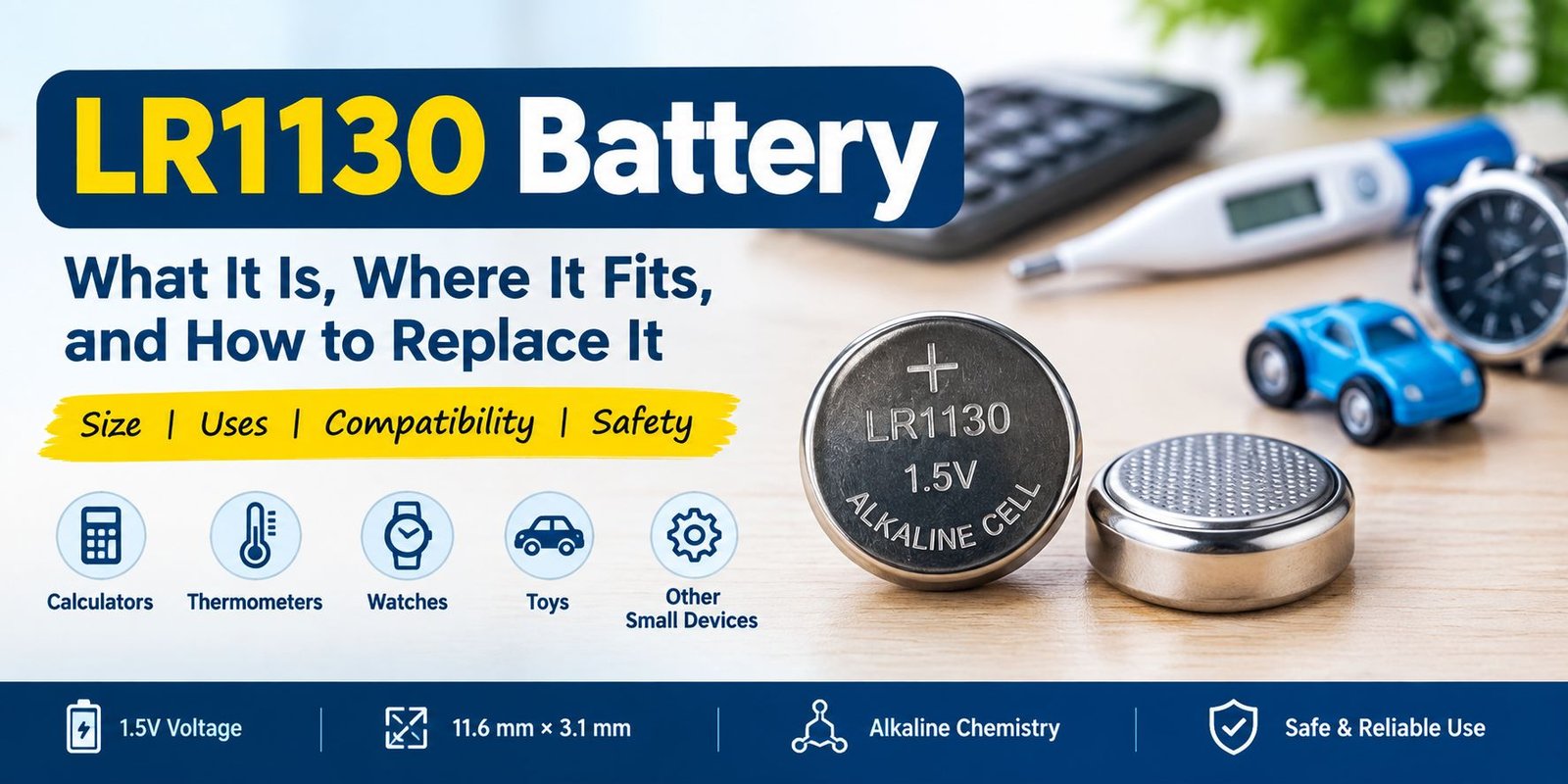
LR1130 Battery: What It Is, Where It Fits, and How to Replace It
Finding a tiny battery inside an old calculator, thermometer, watch, toy, or electronic accessory can be confusing when the label is unfamiliar. One of the markings you may come across is LR1130. Although the cell is small, its identification code provides useful information about the battery’s chemistry, size, and electrical characteristics.
The important thing is not simply to find another battery that looks similar. Button cells can have nearly identical appearances while differing in thickness, chemistry, voltage behavior, or capacity. Choosing the right replacement therefore starts with understanding what the LR1130 designation actually represents.
This guide explains the LR1130 battery in practical terms, including its dimensions, voltage, common applications, alternative names, compatibility concerns, replacement process, storage, and safety considerations.
What Does LR1130 Mean?
LR1130 is a designation used for a small button-style alkaline battery. The letters and numbers identify characteristics of the cell rather than acting as a simple product name.
The “L” is associated with alkaline chemistry, while the “R” indicates the round shape of the cell. The numerical portion relates to the battery’s physical dimensions.
An LR1130 normally provides a nominal voltage of 1.5 volts. Its compact round construction makes it suitable for devices that have very limited space for a power source.
Because different manufacturers may print different commercial codes on batteries with similar dimensions, it is useful to check the complete specification before purchasing a substitute.
LR1130 Battery Dimensions
Physical size is one of the most important parts of battery compatibility.
A typical LR1130 cell is approximately:
- Diameter: 11.6 mm
- Height: 3.1 mm
- Nominal voltage: 1.5V
- Shape: Round button cell
- Typical chemistry: Alkaline
Small differences can occur between manufacturers, so these measurements should be treated as approximate rather than as a manufacturing tolerance for every brand.
The low height is particularly important. A battery compartment designed for a thin cell may not close properly when a thicker button battery is inserted.
Why Battery Size Matters
Two button cells may both produce 1.5 volts but still fail to work as replacements for each other.
Imagine a compartment designed around a cell that is only a few millimeters thick. A replacement with the same diameter but greater height could prevent the cover from closing. In another device, a cell with different dimensions might not make reliable contact with the terminals.
For this reason, compatibility involves more than checking the voltage.
You should consider:
- Battery diameter
- Battery thickness
- Nominal voltage
- Chemistry
- Device requirements
- Terminal arrangement
A correct physical fit is especially important in small electronic products because their battery holders are often designed around very specific dimensions.
Electrical Characteristics of an LR1130
The LR1130 has a nominal rating of 1.5 volts.
That number describes the battery’s rated voltage under normal conditions. It does not mean that the cell will remain at exactly 1.5V throughout its entire service life.
As the battery is used, its available energy decreases and its electrical behavior changes. How quickly that happens depends on the device, current demand, battery quality, storage conditions, and other factors.
A simple low-power device may use an LR1130 differently from another product that requires more frequent current delivery.
This is why there is no single guaranteed operating time that applies to every LR1130 battery.
Where Is the LR1130 Battery Used?
The small dimensions of this cell make it useful in compact products.
Depending on the manufacturer and device design, LR1130-size batteries may be found in products such as:
Small Calculators
Some basic calculators use button cells because their electronics require relatively little space and power.
Digital Thermometers
Compact thermometers can use small button batteries to keep the device lightweight and portable.
Watches and Small Clocks
Certain inexpensive or compact timekeeping products may use this battery size.
Toys and Small Electronic Accessories
Lightweight electronic toys, novelty products, and other accessories can sometimes use LR1130-type cells.
Small Measuring Devices
Some compact instruments and electronic gadgets may rely on a button cell with these dimensions.
The exact battery required always depends on the product’s design. The fact that an item is small does not automatically mean it uses LR1130.
How to Check Whether Your Device Uses LR1130
Before ordering a replacement, look for information from more than one source.
Start by checking the old battery. The designation may be printed directly on its surface.
If the marking is difficult to read, inspect the battery compartment. Some devices include the required battery number beside the contacts or underneath the cover.
You can also check:
- The product manual
- Manufacturer specifications
- A label inside the battery compartment
- The original packaging
- The model number of the device
If none of these sources identifies the cell, compare the dimensions of the old battery with the specifications of the replacement.
Avoid choosing a battery solely because it looks similar in an online photograph.
Is AG10 the Same as LR1130?
AG10 is a commonly used alternative designation for batteries that correspond to the LR1130 size and general alkaline type.
However, naming practices can vary between manufacturers and sellers. Before treating AG10 as a direct replacement, compare the voltage and physical dimensions listed for the particular battery.
This is especially important when purchasing generic button cells online, because product listings do not always use standardized naming consistently.
A useful approach is to compare:
- Voltage
- Diameter
- Height
- Chemistry
- Manufacturer specifications
If these characteristics correspond to what your device requires, the alternative designation may be suitable.
LR1130 vs. LR44
LR1130 and LR44 are often confused because both are small alkaline button cells.
They are not the same size.
The LR44 is considerably thicker than an LR1130. Even when the voltage is similar, that difference in physical dimensions can make the two batteries unsuitable as direct substitutes.
Using a battery simply because it has the same nominal voltage can create a fitting problem.
For that reason, check the complete size specification before considering LR44 as an alternative.
LR1130 vs. SR1130
The SR1130 designation is commonly associated with a silver-oxide button battery.
An SR1130 can have dimensions similar to an LR1130, but its chemistry is different.
Silver-oxide cells are often chosen for applications where a more stable voltage profile is desirable. That does not automatically mean an SR1130 should replace an LR1130 in every device.
The safest choice is to follow the battery type specified by the device manufacturer.
If the manual specifically calls for an LR1130, replacing it with another chemistry should not be treated as an automatic one-for-one substitution.
Why Similar-Looking Button Batteries Can Be Misleading
Button cells create a common identification problem: many of them look almost identical.
A shiny silver disc with a positive marking does not tell you enough about its specifications.
Several batteries can share:
- A round shape
- Similar diameter
- Similar voltage
- Similar packaging
- Similar appearance
Yet their thickness or internal chemistry can differ.
This is why the printed code on the original cell is valuable. It gives you a starting point for identifying the intended replacement.
How to Replace an LR1130 Battery
Replacing an LR1130 is usually straightforward when the device has an accessible battery compartment.
Step 1: Turn the Device Off
If possible, switch the device off before opening the battery compartment.
Step 2: Open the Battery Area
Use the appropriate latch, screw, or cover mechanism. Avoid forcing a cover because small plastic tabs can break.
Step 3: Observe the Existing Battery
Before removing it, look at its orientation. Note which side faces upward.
Step 4: Remove the Old Cell
Carefully lift the battery from its holder. If a retaining clip is present, avoid bending it unnecessarily.
Step 5: Check the Replacement
Confirm the marking, voltage, size, and polarity before inserting the new cell.
Step 6: Install It Correctly
Place the replacement in the same orientation as the original. The positive and negative sides must contact the appropriate terminals.
Step 7: Test the Device
Close the compartment and turn the product on. If it does not operate, check the battery orientation and contacts before assuming the new cell is defective.
What If a New LR1130 Does Not Work?
A replacement battery that fails to power a device does not necessarily mean the battery itself is bad.
Several other issues can be responsible.
Incorrect Orientation
The most basic possibility is that the cell was installed upside down.
Wrong Battery Size
A battery that looks close to an LR1130 may not have the correct dimensions.
Dirty Contacts
Dust, oxidation, or residue on the metal contacts can interfere with electrical connection.
Damaged Battery Holder
A bent terminal or broken retaining clip can prevent proper contact.
Device Fault
If the device has another electrical problem, installing a fresh battery will not necessarily restore operation.
Checking these possibilities one by one can save time and prevent unnecessary battery purchases.
How Long Does an LR1130 Battery Last?
There is no universal lifespan for every LR1130 cell.
Battery life depends on several factors, including:
- Device power consumption
- How frequently the device is used
- Battery quality
- Storage conditions
- Temperature
- Electrical design of the product
A lightly used device may operate for a long period, while a product with higher energy demands can consume the same type of cell much faster.
Manufacturers may publish capacity information, but real-world performance can vary according to the application.
Choosing an LR1130 Replacement
When buying a replacement, avoid relying only on the product title.
Instead, check the technical information provided by the seller or manufacturer.
A practical checklist is:
1. Confirm the code
Look for LR1130 or the approved equivalent listed for your device.
2. Check voltage
A standard LR1130 has a nominal voltage of 1.5V.
3. Compare dimensions
Look at both diameter and height.
4. Check chemistry
Do not assume that every similarly sized button cell has the same internal chemistry.
5. Buy from a reliable source
Fresh, properly stored batteries are preferable to cells of unknown age or origin.
This approach is more dependable than choosing a replacement based on appearance alone.
Storing LR1130 Batteries Properly
Unused button cells should be kept in a dry location away from excessive heat and moisture.
It is also a good idea to keep batteries in their original packaging until they are needed. Loose batteries can come into contact with metal objects such as coins, keys, or other batteries.
Avoid storing button cells where children can easily access them.
Proper storage helps reduce the chance of accidental short circuits and keeps unused batteries protected until installation.
LR1130 Battery Safety
Small button batteries require special care because of their size.
If swallowed, a button battery can become a serious medical emergency, particularly for children. It can cause severe internal injury even when it does not appear to cause immediate symptoms.
For that reason:
- Keep unused batteries away from children.
- Never leave loose button cells on tables or floors.
- Store them in secure packaging.
- Do not allow children to handle loose batteries.
- Seek urgent medical help if a button battery is swallowed.
- Follow local rules when disposing of used cells.
Used batteries should not simply be scattered into household waste where local regulations require separate collection.
Can an LR1130 Be Rechargeable?
A standard LR1130 is a primary alkaline cell, meaning it is designed for single-use rather than routine recharging.
Do not place a conventional LR1130 in a charger unless the battery is specifically identified by its manufacturer as rechargeable and the charger is designed for that battery chemistry.
Trying to recharge a non-rechargeable button cell can create safety risks.
If a device is designed for rechargeable power, use the rechargeable battery type specified by the manufacturer instead.
Common Mistakes When Buying LR1130 Batteries
A few purchasing mistakes appear repeatedly with small button cells.
Choosing by Voltage Alone
Two batteries can have the same voltage but different dimensions or chemistry.
Assuming Every “Equivalent” Is Identical
Alternative codes can refer to similar battery formats, but the specifications should still be checked.
Ignoring Thickness
A replacement that is too thick may not fit into the compartment.
Buying Old Stock
Battery age and storage conditions can influence performance.
Mixing Different Batteries
Avoid combining cells with different types, ages, or charge conditions in a device unless the manufacturer specifically permits it.
A Simple LR1130 Identification Method
If you have an unknown button battery and want to determine whether it is an LR1130, use this sequence:
Look → Measure → Compare → Replace
First, look for the code printed on the cell.
Next, measure its diameter and thickness if the marking is unclear.
Then compare those details with the specifications required by your device.
Finally, replace the battery only after confirming the voltage, size, chemistry, and polarity.
This method reduces the chance of purchasing a visually similar but incompatible cell.
Frequently Asked Questions
What voltage is an LR1130 battery?
An LR1130 has a nominal voltage of 1.5 volts.
Is LR1130 the same as AG10?
AG10 is commonly used as an alternative designation for an LR1130-size alkaline button cell. Always verify the specifications of the particular product before purchasing.
Can LR44 replace LR1130?
Not automatically. Although both are small alkaline button cells and commonly have a 1.5V rating, their physical dimensions differ.
Is SR1130 the same battery as LR1130?
They can have similar physical dimensions, but SR1130 commonly refers to a silver-oxide battery while LR1130 is generally alkaline. Chemistry should therefore be considered before making a substitution.
How big is an LR1130 battery?
A typical LR1130 is approximately 11.6 mm across and 3.1 mm high.
Can I recharge an LR1130?
A conventional LR1130 is a non-rechargeable alkaline cell. It should not be recharged.
What devices use LR1130 batteries?
They can be found in some calculators, thermometers, watches, toys, and other compact electronic products. The exact requirement depends on the device.
Final Thoughts
The LR1130 is easy to overlook because of its tiny size, but identifying it correctly can prevent a lot of unnecessary trial and error. Its 1.5V rating, compact dimensions, alkaline chemistry, and button-cell design make it suitable for many low-power electronic products.
The most reliable way to choose a replacement is to begin with the original battery marking and then confirm the physical and electrical specifications. Names such as AG10 may point toward a compatible option, while batteries such as LR44 or SR1130 require closer examination because their dimensions or chemistry can differ.
When installing or storing these batteries, safety matters just as much as compatibility. Keeping button cells away from children, handling them carefully, and disposing of used cells responsibly are simple steps that can prevent serious problems.
If you treat the battery code as a specification rather than just a product name, finding the correct LR1130 replacement becomes much easier.