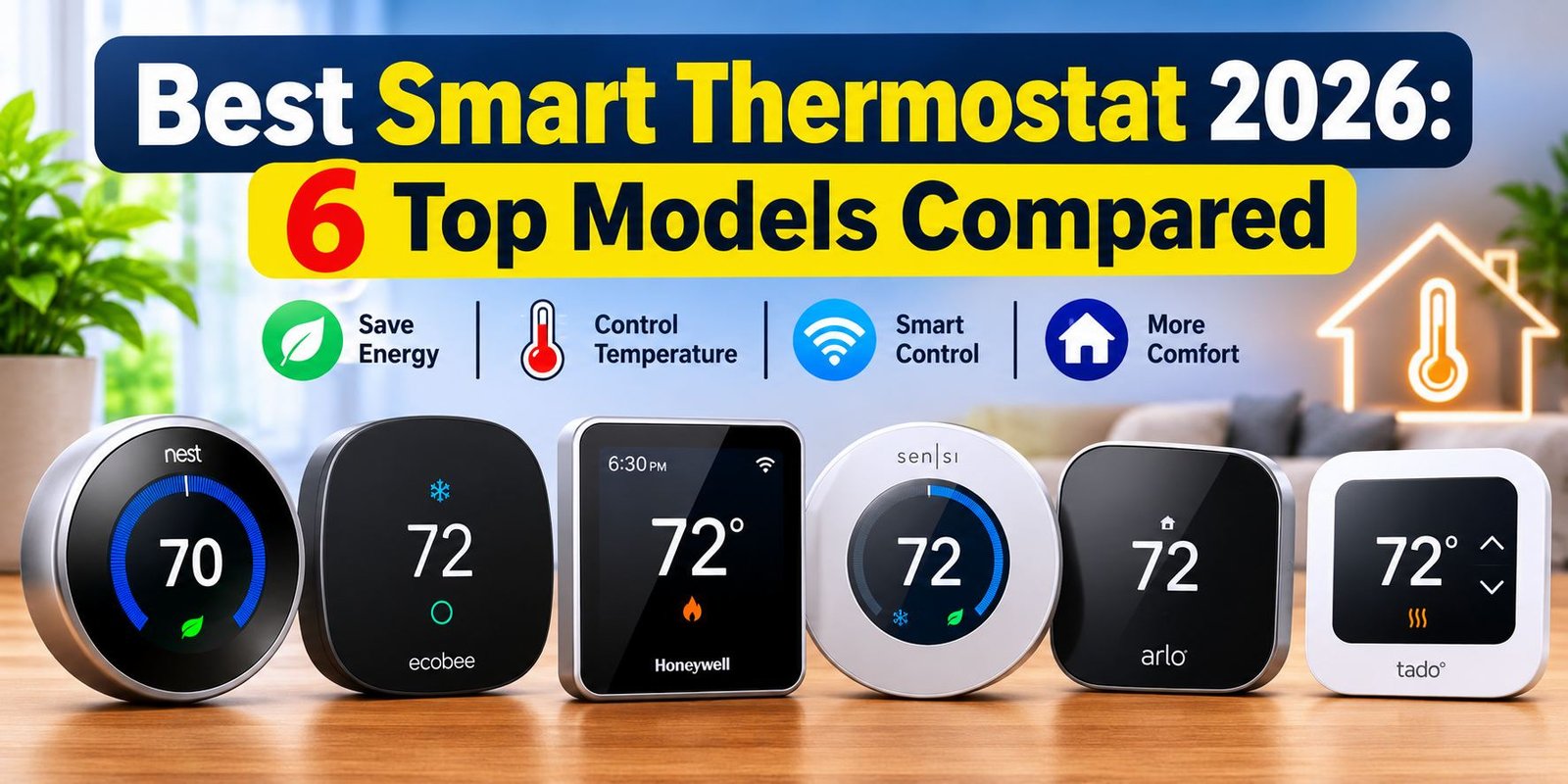
Best Smart Thermostat 2026: 6 Top Models Compared
Choosing the Best Smart Thermostat 2026 can make managing your home’s heating and cooling much easier. Modern smart thermostats do more than display the room temperature. They connect to Wi-Fi, allow remote adjustments through smartphone apps, support automatic schedules, and can help households use energy more efficiently. Some advanced models can even learn your daily habits and adjust indoor temperatures based on occupancy.
However, not every smart thermostat is suitable for every home. Some models work better with Google Home, while others offer stronger support for Amazon Alexa, Apple Home, or multiple smart home platforms. Wiring requirements, HVAC compatibility, room sensors, installation costs, and available features can also influence your decision.
In this guide, we explore some of the most interesting smart thermostats available in Best Smart Thermostat 2026. We compare their features, explain what makes each model useful, and discuss the factors you should consider before purchasing one. Whether you want advanced automation, simple smartphone controls, or a more affordable upgrade, this guide will help you make an informed choice.
What Is a Smart Thermostat?
A smart thermostat is a connected temperature-control device that manages your home’s heating and cooling system. Unlike a traditional thermostat, which usually depends on manual adjustments or basic schedules, a smart thermostat can communicate with your smartphone through a wireless internet connection.
Most models allow users to monitor and change indoor temperatures through a dedicated mobile application. This means you can adjust your heating or cooling settings without standing next to the thermostat.
For example, imagine leaving your home in the morning and forgetting to change the temperature. With a compatible smart thermostat, you may be able to adjust the settings remotely using your phone.
Some advanced devices also include additional capabilities, such as:
- Automatic temperature scheduling.
- Learning features that recognize daily routines.
- Occupancy and motion detection.
- Remote temperature sensors.
- Energy usage reports.
- Voice assistant compatibility.
- Geofencing and home-away automation.
- Smart home platform integration.
These features make smart thermostats useful for people who want more control over their indoor environment.
Best Smart Thermat 2026: Top Models to Consider
Best Smart Thermostat 2026 There are several smart thermostat brands on the market, but a few models stand out because of their combination of automation, compatibility, and everyday convenience.
Here are six options worth considering in 2026.
1. Google Nest Learning Thermostat (4th Generation) – Best for Automatic Learning
The Google Nest Learning Thermostat (4th Generation) is a premium option for homeowners who want a more automated temperature-control experience.
Its most interesting feature is its ability to learn household temperature preferences. Instead of relying entirely on manually created schedules, the thermostat can study how you adjust the temperature and use that information to develop an automatic schedule.
The fourth-generation model also features an updated display and a modern design that can complement different interior styles.
Key Features
- Automatic schedule learning.
- Smartphone temperature control.
- Occupancy detection.
- Remote temperature sensor included.
- Google Home integration.
- Matter support.
- Energy-saving scheduling features.
One useful feature is its remote temperature sensor. A thermostat installed in a hallway may not accurately represent the temperature in a bedroom or living room. A compatible sensor can help the system prioritize the temperature in a particular room.
The fourth-generation Nest also supports Matter, allowing integration with compatible smart home platforms.
Advantages
- Attractive and modern design.
- Learns household temperature patterns.
- Convenient smartphone controls.
- Includes a remote temperature sensor.
- Supports Matter-enabled smart home integration.
Disadvantages
- More expensive than basic smart thermostats.
- Some advanced features work best within Google’s ecosystem.
- Compatibility should be checked before installation.
Who Should Consider It?
This thermostat is worth considering if you already use Google Home devices and want automatic temperature scheduling with minimal manual adjustments.
2. Ecobee Smart Thermostat Premium – Best for Advanced Features
The Ecobee Smart Thermostat Premium is another strong choice for homeowners looking for advanced smart home functionality.
Unlike basic connected thermostats, this model combines temperature management with additional home-monitoring features. It includes an indoor air-quality sensor, built-in occupancy detection, and support for compatible smart home assistants.
One of its biggest advantages is its included SmartSensor. This additional sensor helps monitor temperatures in different areas of your home.
For example, if your living room feels comfortable but your bedroom remains too warm, a remote sensor can provide additional temperature information to help the system manage comfort more effectively.
Key Features
- Built-in occupancy detection.
- Indoor air-quality monitoring.
- Included SmartSensor.
- Smartphone app control.
- Amazon Alexa compatibility.
- Apple Home and Google Home support.
- Voice control capabilities.
- Compatible with additional room sensors.
The thermostat also offers scheduling and automation features. You can create different temperature settings for various times of the day and make adjustments remotely.
Its smart home integration makes it particularly interesting for households that use devices from multiple manufacturers.
Advantages
- Advanced temperature management.
- Includes a room sensor.
- Indoor air-quality monitoring.
- Supports several major smart home platforms.
- Useful automation options.
Disadvantages
- Premium pricing.
- Some advanced features may not be necessary for smaller homes.
- Additional room sensors increase the overall cost.
Who Should Consider It?
The Ecobee Smart Thermostat Premium is a good option for people who want more than basic temperature control. It is particularly useful for larger homes where temperatures can vary between rooms.
3. Ecobee Smart Thermostat Enhanced – Best Value for Advanced Control
The Ecobee Smart Thermostat Enhanced offers many useful features without including every extra found in the Premium version.
It focuses on the essentials of connected temperature management, including remote access, occupancy detection, scheduling, and smart home integration.
The model can work with compatible external temperature sensors, allowing users to improve temperature management in different rooms.
One important difference between the Enhanced and Premium versions is that the Enhanced model does not include the same indoor air-qualitymonitoring and built-in voice-control features.
However, many households may not need those additional capabilities.
Key Features
- Wi-Fi connectivity.
- Smartphone temperature control.
- Occupancy detection.
- Smart scheduling.
- Compatible with Ecobee SmartSensors.
- Amazon Alexa support.
- Google Home and Apple Home compatibility.
Its Power Extender Kit is another useful feature. It can help with installation in certain homes that do not have a C-wire, although compatibility must still be checked.
Advantages
- Useful smart scheduling.
- Supports additional room sensors.
- Broad smart home compatibility.
- Lower-cost alternative to the Premium model.
- Power Extender Kit included.
Disadvantages
- No included remote SmartSensor.
- Fewer premium features than the Premium version.
- Requires compatibility checks before installation.
Who Should Consider It?
Choose this model if you want advanced temperature controls and smart home integration but do not need built-in air-quality monitoring.
4. Honeywell Home T9 Smart Thermostat – Best for Room Temperature Monitoring
The Honeywell Home T9 Smart Thermostat is designed for people who want better temperature management across different areas of their homes.
A common problem with traditional thermostats is that they measure temperature in only one location. If the thermostat is installed in a cool hallway, it may not accurately represent conditions in a sunny bedroom.
The Honeywell Home T9 addresses this problem through compatible wireless room sensors.
These sensors help the thermostat understand temperature differences in different parts of the house. Users can select the areas they want to prioritize.
Key Features
- Wireless remote temperature sensor included.
- Smartphone application control.
- Occupancy detection.
- Geofencing support.
- Programmable schedules.
- Vacation scheduling.
- Compatible with major smart home assistants.
The T9 can be useful for households where certain rooms regularly become warmer or cooler than others.
For example, you may want to prioritize your bedroom at night and your living room during the day.
Advantages
- Includes a remote room sensor.
- Helps address temperature differences.
- Useful scheduling features.
- Smartphone control.
- Supports multiple smart home platforms.
Disadvantages
- Additional sensors may increase costs.
- Requires compatible HVAC wiring.
- Some features depend on regional availability and system compatibility.
Who Should Consider It?
This model is worth considering if your home has noticeable temperature differences between rooms and you want more flexible temperature monitoring.
5. Amazon Smart Thermostat – Best for Alexa Users
The Amazon Smart Thermostat is designed for users who want a relatively straightforward connected thermostat, especially those who already use Amazon Alexa.
It offers basic smart temperature management through the Alexa ecosystem. Users can control compatible settings through the Alexa app and create routines for different situations.
For example, you could create an Alexa routine that adjusts the temperature at a particular time or connects thermostat settings with other compatible smart home devices.
The device does not have the same advanced learning features as some premium models, but its straightforward functionality can be sufficient for many households.
Key Features
- Alexa app temperature control.
- Smart scheduling.
- Voice control through compatible Alexa devices.
- Home and away routines.
- Energy-related automation.
- Connected temperature management.
Installation requirements are important to understand. The Amazon Smart Thermostat generally requires a C-wire or a compatible power adapter arrangement.
It is also designed around the Alexa ecosystem, so users should check whether its integrations meet their requirements.
Advantages
- Straightforward controls.
- Convenient Alexa integration.
- Useful daily schedules.
- Suitable for basic smart home automation.
- Often positioned as a more affordable option.
Disadvantages
- Limited appeal for households that do not use Alexa.
- Requires compatible wiring or a suitable adapter.
- Fewer advanced features than premium competitors.
Who Should Consider It?
The Amazon Smart Thermostat is worth considering if you already use Alexa and want convenient smartphone-based temperature control without paying for unnecessary extras.
6. Honeywell Home X2S Smart Thermostat – Best for Simple Smart Home Control
The Honeywell Home X2S Smart Thermostat is another option for people who want connected temperature management without purchasing a premium device.
Its appeal comes from its relatively simple approach to smart heating and cooling.
It supports compatible smart home platforms, including Amazon Alexa, Google Home, and Apple Home. It also supports Matter, making it an interesting option for people who want greater flexibility when connecting compatible smart home products.
Key Features
- Wi-Fi connectivity.
- Matter support.
- Compatible with selected smart home platforms.
- Remote temperature adjustments.
- Programmable temperature schedules.
- Modern thermostat interface.
However, it is important to remember that Matter compatibility does not automatically guarantee compatibility with every HVAC system.
You should check the manufacturer’s wiring and equipment requirements before purchasing.
Advantages
- Matter-enabled smart home integration.
- Straightforward temperature controls.
- Useful scheduling features.
- Supports compatible voice assistants.
- Suitable for basic connected home automation.
Disadvantages
- Requires a compatible C-wire.
- Does not offer all the advanced features of premium thermostats.
- Availability varies by region.
Who Should Consider It?
Consider the Honeywell Home X2S if you want a straightforward smart thermostat with modern smart home connectivity.
Smart Thermostat Comparison Table
The following table provides a quick comparison of the six models discussed above.
| Smart Thermostat | Best For | Main Feature |
|---|---|---|
| Google Nest Learning Thermostat Gen 4 | Automatic learning | Adaptive schedules |
| Ecobee Smart Thermostat Premium | Advanced features | Air-quality monitoring and SmartSensor |
| Ecobee Smart Thermostat Enhanced | Value and flexibility | Smart scheduling |
| Honeywell Home T9 | Room temperature monitoring | Wireless room sensor |
| Amazon Smart Thermostat | Alexa households | Alexa integration |
| Honeywell Home X2S | Simple smart home control | Matter support |
The best choice depends on your HVAC equipment, preferred smart home platform, budget, and the features you actually need.
How Does a Smart Thermostat Work?
A smart thermostat communicates with your heating and cooling equipment through compatible electrical connections.
It monitors indoor temperature and uses programmed settings to control when heating or cooling should operate.
Many modern models also connect to your home Wi-Fi network. This connection allows you to access thermostat controls through a smartphone application.
The process generally involves several steps.
1. Temperature Monitoring
The thermostat uses built-in sensors to measure indoor temperature.
Some models also support additional wireless sensors that monitor other rooms.
2. Connection to HVAC Equipment
After installation, the thermostat communicates with your compatible heating or cooling equipment.
When the temperature moves outside your selected range, it can activate the appropriate system.
3. Wi-Fi Connectivity
The thermostat connects to your wireless network, allowing you to access supported controls remotely.
You can use the manufacturer’s application to adjust temperatures and schedules.
4. Automatic Scheduling
You can create schedules based on your daily routine.
For example, you might select a lower heating setting while everyone is away and a more comfortable temperature before returning home.
5. Smart Automation
More advanced models may use occupancy detection, geofencing, or learning features to adjust temperatures automatically.
These functions can reduce unnecessary heating and cooling when configured appropriately.
Benefits of Using a Smart Thermostat
Smart thermostats offer several practical advantages beyond simply changing the temperature through a phone.
1. Remote Temperature Control
One of the most convenient features is remote access.
You can adjust compatible thermostat settings from your smartphone without physically interacting with the device.
This is particularly useful when your daily plans change unexpectedly.
2. Better Temperature Scheduling
Traditional thermostats may require manual adjustments throughout the day.
Smart thermostats allow you to create schedules that match your household routine.
For example, you can configure different settings for mornings, afternoons, evenings, and nighttime.
3. Potential Energy Savings
Smart thermostats may help reduce unnecessary heating and cooling by using schedules, occupancy information, and automatic adjustments.
However, energy savings are not guaranteed.
Actual results depend on your climate, insulation, HVAC equipment, household habits, and previous thermostat settings.
The U.S. Department of Energy also recommends using appropriate temperature setbacks when heating or cooling a home.
4. Smart Home Integration
Many modern thermostats work with popular smart home ecosystems.
Depending on the model, you may be able to control temperature settings through Alexa, Google Home, or Apple Home.
This can make temperature management easier when you already use connected devices.
5. Improved Room Comfort
Models with remote sensors can help monitor temperature differences between rooms.
This is especially useful in larger homes where one thermostat reading may not represent the entire property.
6. Energy Monitoring and Reports
Some manufacturers provide energy reports that help users understand their heating and cooling habits.
These reports may show usage patterns, temperature adjustments, and opportunities to improve scheduling.
Important Features to Check Before Buying a Smart Thermostat
Before choosing a model, consider the following features carefully.
HVAC Compatibility
This is the most important factor.
Not every smart thermostat works with every heating and cooling system.
Some models support conventional central air conditioning and furnaces, while others also support heat pumps or specific heating configurations.
Check the manufacturer’s compatibility information before ordering.
C-Wire Requirements
Many smart thermostats require a common wire, commonly called a C-wire, to receive continuous electrical power.
Some models include an adapter or power extender kit for certain installations without a C-wire.
However, an adapter does not make every wiring configuration compatible.
If you are unsure about your existing wiring, consult a qualified HVAC technician.
Wi-Fi Connectivity
A reliable Wi-Fi connection is important for remote access and cloud-based features.
Check which wireless network bands and connection requirements your chosen model supports.
Smart Home Compatibility
Think about which smart home ecosystem you already use.
If your home relies on Alexa, choose a model with suitable Alexa support.
If you use Apple Home or Google Home, verify compatibility with the specific thermostat generation.
Matter can improve cross-platform connectivity, but it does not replace HVAC compatibility requirements.
Remote Sensors
Remote temperature sensors can be useful if different rooms have different heating and cooling needs.
Check whether sensors are included or sold separately.
Mobile Application
A good smartphone application should make it easy to:
- Adjust temperatures.
- Create schedules.
- Check indoor conditions.
- Manage home and away settings.
- Review available energy reports.
An easy-to-use app can make a significant difference in everyday convenience.
Installation Requirements
Some smart thermostats are designed for DIY installation, while others may require professional assistance.
Always follow the manufacturer’s installation instructions and switch off the appropriate electrical supply before working with thermostat wiring.
Smart Thermostat vs. Traditional Thermostat
Both devices control indoor temperatures, but their capabilities are different.
| Feature | Traditional Thermostat | Smart Thermostat |
|---|---|---|
| Manual temperature control | Yes | Yes |
| Smartphone access | Usually no | Yes |
| Wi-Fi connectivity | Usually no | Yes |
| Automatic schedules | Some models | Most models |
| Learning features | Rare | Available on selected models |
| Voice control | Usually no | Available on compatible models |
| Remote sensors | Limited | Supported by selected models |
| Energy reports | Usually no | Available on selected models |
A traditional thermostat may be sufficient if you only need basic temperature adjustments.
However, a smart thermostat provides additional flexibility for people who want remote access and more advanced scheduling.
Are Smart Thermostats Worth Buying in 2026?
For many households, smart thermostats can be a useful upgrade.
Their biggest advantage is convenience. You can manage temperatures remotely, create schedules, and automate certain adjustments without constantly changing settings manually.
They can also help users identify inefficient heating and cooling habits.
However, buying an expensive thermostat does not automatically reduce energy bills.
For example, if you already use an effective programmable schedule, switching to a premium smart thermostat may provide fewer additional savings than expected.
You should also consider the cost of installation, additional sensors, adapters, and any subscription-based services.
A good purchasing decision should focus on the features you will actually use rather than choosing the most expensive device.
Common Smart Thermostat Problems and Their Solutions
Although Best Smart Thermostat 2026 are designed to make temperature management easier, users can occasionally experience technical problems.
Here are some common issues and possible solutions.
Thermostat Is Not Connecting to Wi-Fi
Check whether your internet connection is working properly.
Restarting your router and following the manufacturer’s network setup instructions may resolve temporary connection issues.
Also confirm that your thermostat supports your router’s wireless configuration.
Thermostat Display Is Blank
A blank display may indicate a power supply problem.
Possible causes include incorrect wiring, a tripped HVAC safety switch, or an issue with the heating and cooling equipment.
Do not attempt electrical repairs unless you have the necessary qualifications.
Temperature Readings Are Incorrect
A thermostat installed near direct sunlight, windows, heating vents, or other heat sources may produce inaccurate readings.
Check its installation location and compare the reading with a reliable thermometer.
If supported, a remote temperature sensor may help monitor another area.
Heating or Cooling Is Not Working
First, check the thermostat’s selected mode and temperature settings.
If the system still does not operate, investigate whether the HVAC equipment has a separate fault.
Check the manufacturer’s troubleshooting instructions or contact a qualified technician.
Frequently Asked Questions (FAQs)
1. What Is the Best Smart Thermostat 2026?
The best model depends on your requirements. The Google Nest Learning Thermostat (4th Generation) is worth considering for automatic learning, while the Ecobee Best Smart Thermostat 2026 Premium offers advanced features and room-temperature monitoring.
2. Do Smart Thermostats Actually Save Money?
They can help reduce unnecessary heating and cooling through scheduling and automation. However, savings depend on your existing habits, climate, insulation, and HVAC system.
3. Can I Install a Smart Thermostat Myself?
Some models support DIY installation, but you must first confirm compatibility with your HVAC equipment and wiring. Professional installation is recommended if you are unfamiliar with electrical connections.
4. Do Smart Thermostats Require Wi-Fi?
Most connected Best Smart Thermostat 2026 use Wi-Fi for remote smartphone access and online features. Some basic functions may continue working without an internet connection, depending on the model.
5. What Is a C-Wire?
A C-wire, or common wire, provides continuous electrical power to compatible thermostats. Many smart thermostats require one, while certain models support alternative power arrangements.
6. Does Google Nest Work With Alexa?
Selected Google Nest models support Alexa integration through compatible smart home arrangements. However, features and setup requirements vary by model and platform.
7. Is Ecobee Better Than Nest?
Neither is automatically better for every household. Ecobee offers strong multi-platform support and useful room sensors, while Nest is attractive for people who prefer Google’s ecosystem and automatic learning features.
8. Can a Smart Thermostat Control Different Rooms?
Some models support additional wireless temperature sensors. These sensors help monitor different areas and can influence temperature management, although they do not necessarily provide independent heating and cooling control for every room.
9. Are Smart Thermostats Compatible With Heat Pumps?
Some smart thermostats support compatible heat pump systems, but not all models do. Always check the manufacturer’s equipment compatibility information before purchasing.
10. Can I Use a Smart Thermostat Without a Smartphone?
Many Best Smart Thermostat 2026 include physical controls that allow local temperature adjustments. However, some advanced setup and remote features require a smartphone application.
Final Thoughts
Finding the right smart thermostat in 2026 is about choosing a device that fits your home rather than simply purchasing the model with the most features.
The Google Nest Learning Best Smart Thermostat 2026 (4th Generation) is an interesting choice for people who want automatic temperature scheduling. The Ecobee Smart Thermostat Premium is worth considering for households interested in room sensors and additional monitoring features. Meanwhile, the Ecobee Enhanced and Amazon Smart Thermostat offer alternatives for people who want useful connected controls without paying for every premium feature.
Before purchasing, check HVAC compatibility, C-wire requirements, smart home support, and regional availability. These details are just as important as the thermostat’s design and advertised features.
Ultimately, a well-chosen Best Smart Thermostat 2026 can make everyday temperature management more convenient and help you develop more efficient heating and cooling habits.