
Fujifilm X100F Review: Features, Specs & Image Quality
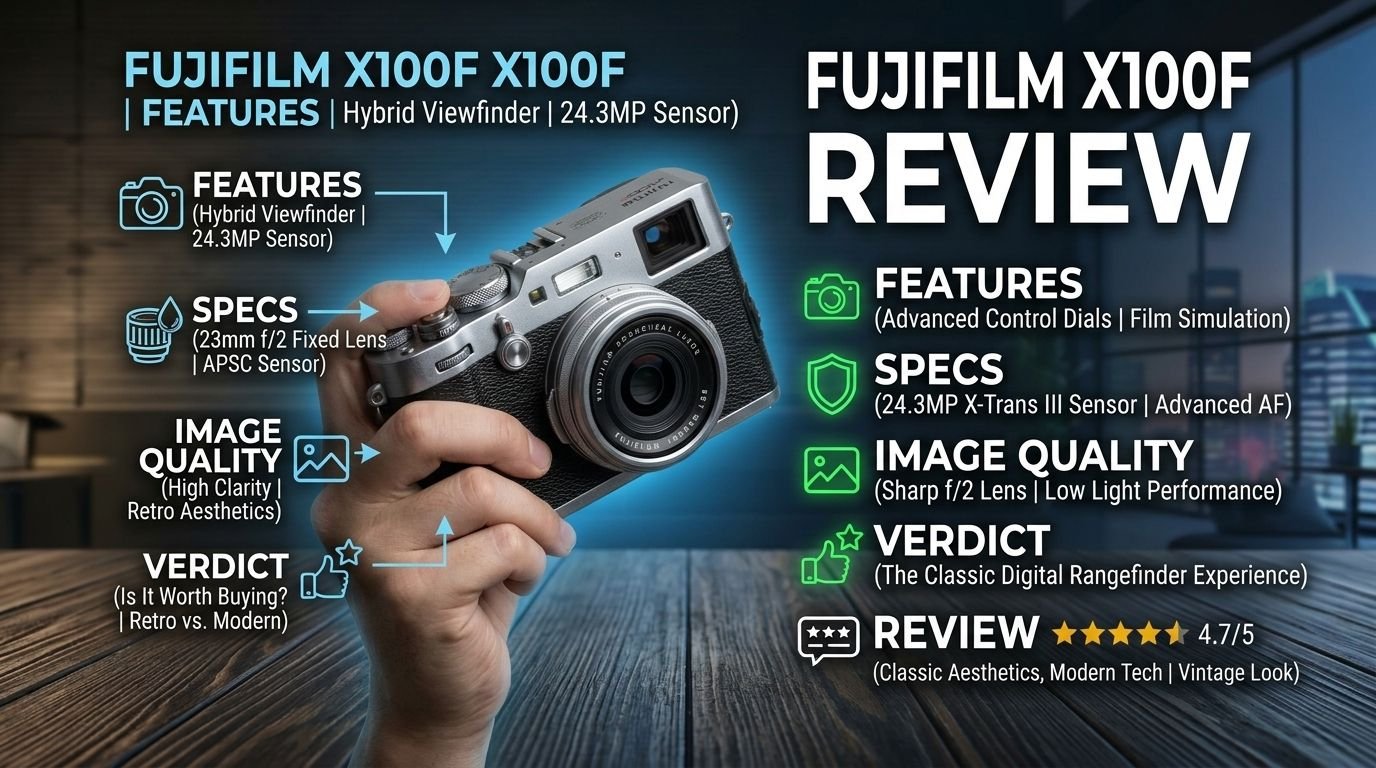
The Fujifilm X100F is a premium compact digital camera designed for photographers who value image quality, traditional camera controls, and a simple shooting experience. Although Fujifilm introduced this model in 2017, it remains an interesting camera for photography enthusiasts who appreciate its classic design and dedicated photography features.
Unlike modern interchangeable-lens cameras, the X100F uses a fixed Fujinon 23mm f/2 lens. This gives photographers a 35mm-equivalent field of view, making it suitable for street photography, travel, portraits, and everyday photography. Its 24.3-megapixel APS-C X-Trans CMOS III sensor also delivers detailed images with attractive color reproduction.
One of the most recognizable parts of this camera is its hybrid viewfinder, which combines optical and electronic viewing options. Photographers can choose between a traditional optical experience and an electronic preview depending on their shooting preferences.
The Fujifilm X100F also includes physical exposure controls, film simulation modes, manual focusing options, and wireless connectivity. These features make it appealing to people who want a camera that encourages a more thoughtful approach to photography.
In this guide, we explore its design, sensor, lens, autofocus, viewfinder, film simulations, video recording, battery performance, advantages, disadvantages, and buying considerations. We will also explain whether this older Fujifilm camera is still a good choice in 2026.
1. Fujifilm X100F Overview
The Fujifilm X100F is the fourth-generation camera in Fujifilm‘s original X100 series. It followed the X100, X100S, and X100T, bringing improvements to image quality, controls, processing performance, and overall usability.
The camera was announced in January 2017 and became known for combining a relatively compact body with a large APS-C image sensor.
Its design follows a traditional rangefinder-inspired style. Instead of relying entirely on touchscreen controls, it offers physical dials and buttons that allow photographers to adjust important settings directly.
Main Features at a Glance
Here are some of the most important Fujifilm X100F features:
- 24.3MP APS-C X-Trans CMOS III sensor
- Fujinon 23mm f/2 fixed lens
- 35mm full-frame equivalent focal length
- Hybrid optical and electronic viewfinder
- 3-inch LCD display
- Fujifilm Film Simulation modes
- Full HD video recording
- Built-in Wi-Fi connectivity
- Mechanical and electronic shutter options
- Replaceable NP-W126S battery
These specifications make it a photography-focused compact camera rather than a general-purpose multimedia device.
2. Fujifilm X100F Design and Build Quality
The design is one of the reasons photographers continue to appreciate the X100F.
Fujifilm uses a classic camera-inspired appearance with a combination of physical controls, a textured body, and a relatively compact construction.
The top plate contains important exposure controls, including shutter speed and exposure compensation. The aperture can also be adjusted through the lens ring.
This arrangement makes it possible to change several important settings without repeatedly navigating through menus.
Dimensions and Weight
The official camera dimensions are approximately:
- Width: 126.5 mm
- Height: 74.8 mm
- Depth: 52.4 mm
- Weight: Approximately 469 grams with battery and memory card
Its dimensions make it smaller than many traditional DSLR and interchangeable-lens camera systems.
However, it is not as pocket-friendly as a typical smartphone or ultra-compact point-and-shoot camera.
Physical Controls
The X100F offers dedicated controls for several photography settings.
These include:
- Shutter speed dial
- Exposure compensation dial
- Aperture ring
- Focus mode selector
- Rear command controls
- Customizable buttons
Photographers can adjust exposure without relying entirely on automatic settings.
For beginners, this arrangement may require some practice. However, people who enjoy learning manual photography often appreciate having important controls directly available.
Is the Fujifilm X100F Weather-Sealed?
No. The standard X100F body does not offer the same weather-sealing protection found on some newer professional camera models.
Photographers should take care when using it in rain, dusty locations, or environments with excessive moisture.
Optional accessories do not automatically make the entire camera weather-resistant.
3. Fujifilm X100F Sensor and Image Quality
The image sensor is one of the most important components of any digital camera.
Fujifilm equipped the X100F with a 24.3-megapixel APS-C X-Trans CMOS III sensor.
This sensor provides enough resolution for detailed photographs, cropping, printing, and everyday digital use.
24.3MP APS-C Sensor
The APS-C sensor measures approximately 23.5 x 15.6 mm.
Its size allows the camera to capture more image information than many small-sensor compact cameras.
The 24.3MP resolution produces images with a maximum standard size of 6000 x 4000 pixels.
This is useful for photographers who want to crop photographs or create larger prints.
X-Trans Color Filter Technology
Fujifilm uses its X-Trans color filter arrangement rather than a conventional Bayer color filter pattern.
The X-Trans design uses a different arrangement of color filters across the sensor.
It is intended to help control moiré and false color while supporting detailed image reproduction.
Combined with Fujifilm’s image processing, the sensor gives the X100F its distinctive photographic character.
Low-Light Photography
The camera offers standard ISO settings from ISO 200 to ISO 12800, with extended options of ISO 100, ISO 25600, and ISO 51200.
A higher ISO setting can help when photographing in darker environments, but it can also introduce visible image noise.
The fixed f/2 lens is useful in low-light situations because it allows more light to reach the sensor than a slower lens.
However, image quality still depends on exposure, shutter speed, subject movement, and lighting conditions.
4. Fujifilm X100F 23mm f/2 Fujinon Lens
The fixed lens is a defining part of the X100F experience.
Unlike interchangeable-lens cameras, users cannot remove the built-in lens and replace it with another focal length.
Fujifilm includes a Fujinon 23mm f/2 lens that provides a 35mm-equivalent field of view.
What Does 35mm Equivalent Mean?
The actual focal length is 23mm, but the camera’s APS-C sensor produces a field of view similar to a 35mm lens on a full-frame camera.
This is a versatile perspective for many photography situations.
It works well for:
- Street photography
- Travel photography
- Everyday pictures
- Environmental portraits
- Architecture
- Documentary photography
- Food photography
f/2 Maximum Aperture
The maximum aperture of f/2 helps the camera perform in lower-light conditions.
It also provides some background separation when photographing subjects at suitable distances.
Although it cannot create the same framing flexibility as a zoom lens, the fixed focal length encourages photographers to think more carefully about composition and camera position.
Close-Focusing Ability
The X100F supports close focusing from approximately 10 cm to infinity, depending on the selected focusing mode and conditions.
This allows users to photograph smaller objects, food, flowers, and other nearby subjects.
For close-up work, proper focusing technique is important because depth of field becomes narrower at shorter distances.
5. Hybrid Viewfinder Technology
One of the most interesting Fujifilm X100F features is its hybrid viewfinder.
Instead of offering only an electronic viewfinder, Fujifilm combines optical and electronic viewing systems.
This gives photographers more flexibility when composing photographs.
Optical Viewfinder
The optical viewfinder provides a direct view of the scene.
It offers a traditional shooting experience and allows photographers to observe more of their surroundings outside the captured frame.
This can be particularly useful for street photography, where watching activity around the subject matters.
Electronic Viewfinder
The electronic viewfinder uses a high-resolution display to show an electronic preview of the image.
It can provide information about exposure, focus, and other shooting settings.
Photographers can use this preview to understand how adjustments affect the final photograph.
Electronic Rangefinder
The X100F also includes an electronic rangefinder display option within the hybrid viewfinder system.
This provides additional focusing assistance for photographers who prefer manual focus or want to combine optical viewing with electronic information.
Why Is the Hybrid Viewfinder Useful?
Different photography situations benefit from different viewing methods.
For example, an optical viewfinder can feel natural when photographing people on the street. An electronic viewfinder can be more useful when checking exposure and focus before taking a picture.
Having both options makes the X100F more flexible than a camera with only one type of viewfinder.
6. Fujifilm X100F Autofocus Performance
Autofocus is another important part of the camera’s performance.
The X100F uses an Intelligent Hybrid AF system that combines phase-detection and contrast-detection autofocus.
This system helps the camera focus on subjects in different shooting conditions.
Single Autofocus
Single AF is useful when photographing stationary subjects.
The camera focuses once when the shutter button is pressed halfway.
This mode works well for:
- Buildings
- Landscapes
- Food photography
- Everyday objects
- Portraits of stationary subjects
Continuous Autofocus
Continuous AF adjusts focus as the subject moves.
It can be useful for photographing people walking, children playing, or other moving subjects.
However, the X100F is an older camera, so its subject tracking should not be compared with the advanced autofocus systems found in newer mirrorless cameras.
Manual Focus
The camera also supports manual focusing.
Photographers can adjust the focus themselves using the available controls.
Manual focus is useful when photographing scenes where autofocus struggles, such as low-contrast subjects or certain close-up compositions.
7. Fujifilm Film Simulation Modes
Film Simulation is one of the most recognizable features of Fujifilm cameras.
Instead of relying entirely on post-processing software, photographers can choose different image styles directly in the camera.
The X100F includes several Film Simulation modes inspired by the appearance of traditional Fujifilm photographic films.
Popular Film Simulation Options
The available options include:
Provia: A versatile standard look designed for everyday photography.
Velvia: Produces stronger colors and contrast, making it suitable for colorful landscapes.
Astia: Offers a softer color appearance that can work well for portraits.
Classic Chrome: Creates a more muted look with controlled color and contrast.
Acros: Provides black-and-white images with detailed tonal separation.
Pro Neg. Hi: Offers a contrast-rich look designed for portrait photography.
Pro Neg. Std: Produces softer tonal transitions and a more restrained portrait appearance.
Why Are Film Simulations Useful?
Film Simulation modes allow photographers to create different visual styles without extensive editing.
Someone photographing a colorful travel scene may prefer Velvia, while another photographer may choose Classic Chrome for a more subdued street-photography appearance.
These settings are especially useful for people who prefer ready-to-share JPEG photographs.
8. Fujifilm X100F LCD Screen
The X100F includes a 3-inch rear LCD display with approximately 1.04 million dots.
It provides a clear viewing area for image composition, menu navigation, and photograph playback.
Display Experience
The LCD screen is useful for reviewing images after taking photographs.
Users can zoom into photographs to check focus and inspect details.
The display also provides access to shooting information, exposure settings, and menu options.
Fixed Screen Design
One limitation is that the screen does not tilt or rotate.
This can make certain shooting angles less convenient.
For example, photographers who frequently take low-angle or overhead photographs may prefer a camera with an articulated display.
The X100F also does not offer a touchscreen interface.
9. Video Recording Capabilities
Although the X100F is mainly designed for still photography, it also supports video recording.
It can record Full HD video at resolutions up to 1920 x 1080.
Supported frame rates include 59.94p, 50p, 29.97p, 25p, 24p, and 23.98p.
Full HD Video
The camera can capture video suitable for:
- Everyday clips
- Travel recordings
- Short personal videos
- Basic creative projects
- Simple documentary footage
However, its video capabilities are limited compared with modern cameras designed specifically for video creators.
Is the X100F Good for YouTube?
The X100F can record basic Full HD footage, but it is not the ideal choice for people who prioritize video production.
It lacks several modern video-focused conveniences and does not record 4K video.
Creators who regularly produce professional video content may prefer a newer camera with stronger video specifications, improved autofocus, and dedicated recording features.
10. Battery Life and Charging
The Fujifilm X100F uses an NP-W126S rechargeable lithium-ion battery.
Battery life depends on the selected viewfinder, display usage, shooting settings, and operating conditions.
According to Fujifilm’s specifications, approximate battery performance varies by performance mode.
Estimated Battery Performance
| Shooting Mode | Approximate Shots |
|---|---|
| High Performance with LCD | 260 |
| High Performance with EVF | 250 |
| High Performance with OVF | 390 |
| Economy with OVF | 730 |
These figures are based on Fujifilm’s testing conditions and should not be treated as guaranteed real-world results.
Frequent image playback, wireless communication, and continuous shooting can reduce the number of photographs available from a full charge.
Battery Replacement
One benefit of the X100F is its removable battery.
Users can carry a spare NP-W126S battery and replace it when the original battery runs low.
This is particularly helpful during travel or longer photography sessions.
11. Connectivity and Storage Options
The Fujifilm X100F includes built-in Wi-Fi connectivity.
This allows users to connect the camera to compatible smartphones and tablets through Fujifilm’s supported wireless application.
Wireless Image Transfer
Wireless connectivity can help users transfer selected photographs to a compatible mobile device.
This is useful when someone wants to share travel photographs or personal images without first connecting the camera to a computer.
Compatibility and application availability can depend on the smartphone operating system and software support.
Memory Card Support
The X100F uses SD, SDHC, and SDXC memory cards with UHS-I support.
Photographers can choose storage capacity according to their shooting habits.
RAW files generally require more storage space than JPEG photographs, so people who shoot RAW regularly may benefit from a larger memory card.
RAW and JPEG Recording
The camera supports JPEG, 14-bit RAW, and RAW+JPEG recording.
JPEG is convenient for immediate sharing, while RAW files provide more flexibility when adjusting exposure, white balance, and other image settings during editing.
12. Fujifilm X100F Specifications
Here is a summary of the main technical specifications.
| Specification | Fujifilm X100F |
|---|---|
| Camera Type | Premium Compact Digital Camera |
| Effective Resolution | 24.3MP |
| Sensor | APS-C X-Trans CMOS III |
| Lens | Fujinon 23mm f/2 |
| Equivalent Focal Length | 35mm |
| Maximum Aperture | f/2 |
| Viewfinder | Hybrid Optical/Electronic |
| LCD Screen | 3-inch |
| LCD Resolution | Approx. 1.04 million dots |
| Autofocus | Intelligent Hybrid AF |
| ISO Range | 200–12800 |
| Extended ISO | 100, 25600, 51200 |
| Video | Full HD 1080p |
| Connectivity | Wi-Fi |
| Battery | NP-W126S |
| Weight | Approx. 469g with battery and card |
| Weather Sealing | No |
Specifications are based on Fujifilm’s official product information.
13. Fujifilm X100F Advantages and Disadvantages
Before purchasing the camera, it is important to understand what it does well and where it falls behind newer models.
Advantages
1. Excellent Image Quality
The 24.3MP APS-C sensor provides detailed photographs with good flexibility for editing.
2. Fast f/2 Lens
The fixed lens helps in low-light situations and offers a versatile 35mm-equivalent perspective.
3. Hybrid Viewfinder
Photographers can switch between optical and electronic viewing options.
4. Film Simulation Modes
Built-in image styles make it easier to create attractive JPEG photographs without extensive editing.
5. Physical Camera Controls
Dedicated dials and rings provide a traditional photography experience.
6. Compact Camera System
The fixed-lens design removes the need to carry multiple lenses.
7. RAW Photography Support
Photographers can capture RAW files for more detailed post-processing.
Disadvantages
1. Fixed Lens
The lens cannot be replaced, which limits framing flexibility.
2. No 4K Video
The camera is limited to Full HD recording.
3. No Weather Sealing
Additional care is needed in rain, dust, and wet environments.
4. Fixed LCD Screen
The display cannot tilt or rotate.
5. Older Autofocus Technology
Its autofocus system is less advanced than those in newer mirrorless cameras.
6. No Built-In Image Stabilization
The camera does not provide in-body image stabilization.
7. Discontinued Product
Finding a new unit may be difficult, and many available examples are used or refurbished.
14. Fujifilm X100F vs Fujifilm X100T
The X100F introduced several improvements over its predecessor, the X100T.
The most noticeable upgrade is the move from a 16.3MP sensor to a 24.3MP APS-C sensor.
| Feature | Fujifilm X100T | Fujifilm X100F |
|---|---|---|
| Resolution | 16.3MP | 24.3MP |
| Sensor Generation | X-Trans CMOS II | X-Trans CMOS III |
| Processor | EXR Processor II | X-Processor Pro |
| Lens | 23mm f/2 | 23mm f/2 |
| Viewfinder | Hybrid | Improved Hybrid |
| Film Simulation | Earlier selection | Expanded selection |
| Battery | Earlier battery system | NP-W126S |
| Autofocus | Earlier hybrid AF | Improved hybrid AF |
The X100F offers better resolution, improved processing, and a more refined shooting experience.
However, the basic photography concept remains similar: a compact APS-C camera with a fixed 35mm-equivalent lens.
15. Fujifilm X100F vs Newer X100 Cameras
The X100F belongs to an older generation of Fujifilm’s X100 family.
Newer models introduce improvements in processing, autofocus, video recording, and other features.
For example, the X100V introduced a redesigned lens and a tilting touchscreen, while the X100VI added a higher-resolution sensor and in-body image stabilization.
The X100F still has advantages for photographers who prefer its simpler design and are comfortable with its older specifications.
However, anyone purchasing a camera primarily for advanced video, modern autofocus, or stabilization should compare newer models before deciding.
16. Is Fujifilm X100F Worth Buying in 2026?
The Fujifilm X100F can still be a worthwhile camera in 2026, but its value depends heavily on its condition and second-hand price.
It remains capable of producing detailed photographs, and its fixed 23mm f/2 lens offers a useful perspective for everyday photography.
Its film simulations and physical controls also provide a shooting experience that many photography enthusiasts enjoy.
However, the X100F is officially discontinued, so buyers should generally expect to find used or previously owned units rather than regular new-stock products.
Who Should Buy the X100F?
It may be suitable for:
- Street photographers
- Travel photography enthusiasts
- People who enjoy classic camera designs
- Photographers who prefer fixed focal lengths
- Users interested in Fujifilm Film Simulation
- Beginners who want to learn manual exposure
Who Should Consider Another Camera?
You may prefer a different model if you need:
- 4K video recording
- Modern subject-tracking autofocus
- A zoom lens
- Weather sealing
- A tilting or touchscreen display
- Built-in image stabilization
What to Check Before Buying a Used X100F
Since many available units are second-hand, inspect the camera carefully.
- Check the lens glass for scratches, fungus, and dust.
- Test the autofocus in different lighting conditions.
- Check whether the optical and electronic viewfinders work.
- Inspect the LCD for marks and display problems.
- Test the shutter at different speeds.
- Check the battery condition.
- Test the memory card slot and Wi-Fi connection.
- Inspect the body for physical damage.
- Take sample photographs and review them on a larger screen.
- Ask about the camera’s repair and service history.
Buying from a trusted camera seller and testing the equipment before payment can help reduce the risk of purchasing a damaged unit.
17. Frequently Asked Questions About Fujifilm X100F
1. When was the Fujifilm X100F released?
Fujifilm announced the X100F in January 2017. It is the fourth generation of the original X100 camera series.
2. How many megapixels does the Fujifilm X100F have?
The X100F features a 24.3-megapixel APS-C X-Trans CMOS III sensor.
3. Does the Fujifilm X100F have a zoom lens?
No. It uses a fixed 23mm f/2 Fujinon lens, equivalent to approximately 35mm on a full-frame camera.
4. Is the Fujifilm X100F good for street photography?
Yes. Its compact design, 35mm-equivalent lens, hybrid viewfinder, and physical controls make it suitable for street photography.
5. Does the Fujifilm X100F record 4K video?
No. The camera supports Full HD video recording up to 1920 x 1080 pixels.
6. Does the X100F have image stabilization?
No. It does not include in-body image stabilization or optical image stabilization in its fixed lens.
7. Is the Fujifilm X100F weather-sealed?
No. The standard X100F does not have weather sealing, so users should protect it from rain, dust, and moisture.
8. What battery does the Fujifilm X100F use?
It uses the NP-W126S rechargeable lithium-ion battery.
9. Can the Fujifilm X100F shoot RAW images?
Yes. It supports 14-bit RAW recording in Fujifilm’s RAF file format, as well as JPEG and RAW+JPEG options.
10. Is the Fujifilm X100F discontinued?
Yes. Fujifilm lists the X100F as a discontinued product on its official website.
11. Is the X100F suitable for beginners?
Yes. Beginners can use its automatic settings while gradually learning aperture, shutter speed, ISO, manual focus, and composition.
12. Is the Fujifilm X100F still worth buying?
It can be a good option for photographers who want strong image quality and a fixed-lens shooting experience. However, the used price, camera condition, and availability of newer alternatives should be considered.
Conclusion
The Fujifilm X100F remains an appealing compact camera for photographers who value image quality, traditional controls, and a straightforward shooting experience. Its 24.3MP APS-C sensor, Fujinon 23mm f/2 lens, hybrid viewfinder, and Film Simulation modes provide a useful combination for street photography, travel, and everyday shooting.
It does have limitations, including the fixed lens, lack of weather sealing, Full HD video recording, and older autofocus technology. These limitations become more important when comparing it with newer cameras.
Nevertheless, the X100F still offers a distinctive photography experience. For someone who enjoys working with a fixed focal length and wants a dedicated camera rather than relying entirely on a smartphone, it can remain an interesting choice in 2026.
Before purchasing one, check its condition, battery performance, and second-hand price carefully. A well-maintained X100F can still be a capable photography companion.