
Cornhole Distance: Official Rules & Measurements
Cornhole is a popular outdoor game that combines simple equipment, friendly competition, and basic throwing skills. It is commonly played at family gatherings, backyard parties, sporting events, community celebrations, and recreational activities. Although the game is easy to understand, setting up the playing area correctly is important for a fair and enjoyable experience.
One of the most common questions beginners ask is about cornhole distance. Players want to know how far apart the boards should be, where the throwing line belongs, and whether the measurements change for children or casual backyard games.
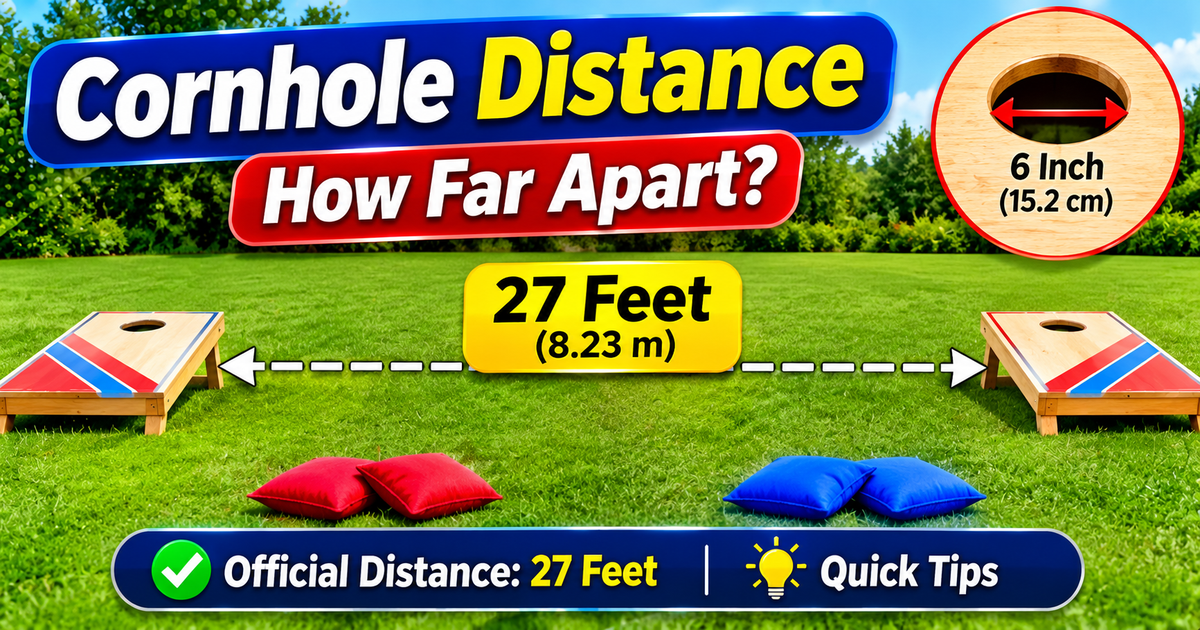
In standard regulation play, the distance between the front edges of two cornhole boards is 27 feet. This measurement provides a consistent playing arrangement for adult competitors. However, recreational games may use shorter distances depending on the players’ ages, available space, and skill levels.
Understanding cornhole distance helps players prepare a suitable court, position their equipment, and follow commonly accepted playing standards. It also prevents confusion when switching between casual games and organized competitions.
This guide explains standard cornhole measurements, board placement, throwing distances, court dimensions, setup instructions, common mistakes, and useful tips for creating a comfortable playing area.
What Is Cornhole?
cornhole distanceCornhole is a throwing game in which players attempt to toss small fabric bags toward a raised board containing a circular hole.
Each board is positioned at an angle, with its upper section elevated by built-in legs. Players stand behind a designated throwing area and take turns throwing bags toward the opposite board.
The objective is to score points by landing bags on the board or getting them through the hole.
A bag that remains on the board generally earns one point, while a bag that passes through the hole earns three points under commonly used scoring rules.
Players or teams compete over multiple rounds until someone reaches the agreed winning score.
Cornhole is popular because it does not require complicated equipment or advanced athletic abilities. A basic setup includes two boards and a set of throwing bags.
However, the distance between the boards has a significant effect on the difficulty of the game. A shorter distance may make throwing easier, while a longer distance requires greater control and consistency.
What Is the Official Cornhole Distance?
The commonly recognized regulation cornhole distance is 27 feet from the front edge of one board to the front edge of the opposite board.
This is the standard arrangement used in adult competitive play under American Cornhole League-style regulations.
The measurement is taken between the front edges rather than the centers of the boards or the back edges.
This distinction is important because measuring from the wrong reference points can produce an incorrectly arranged playing area.
A regulation cornhole board is generally 24 inches wide and 48 inches long. When both boards are positioned correctly, the playing distance provides enough room for players to throw bags from one end toward the opposite target.
Why Is 27 Feet Used?
The 27-foot distance creates a consistent challenge for adult players.
It provides enough separation to require control, accuracy, and a repeatable throwing technique.
If boards are positioned too close together, players may find it easier to land bags on the target. On the other hand, an unnecessarily long distance can make the game more difficult than intended.
Standard measurements allow players from different locations to compete under similar conditions.
How Should the Distance Be Measured?
To measure cornhole distance correctly, use the front edge of each board as the reference point.
Place one board in its intended playing position. Position the second board opposite it, making sure both boards face each other.
Measure a straight line from the front edge of the first board to the front edge of the second board.
The result should be 27 feet for standard adult regulation play.
A measuring tape is useful because it provides a more reliable result than estimating the distance by walking between the boards.
Cornhole Board Dimensions
The distance between boards is only one part of a proper cornhole setup.
Board dimensions also influence how the game feels and how players approach their throws.
A commonly used regulation board has the following measurements:
- Length: 48 inches.
- Width: 24 inches.
- Hole diameter: 6 inches.
- Hole position: Centered across the width.
- Front height: Approximately 3 to 4 inches.
- Rear height: Approximately 12 inches.
These dimensions provide a standard target surface for recreational and competitive play.
Board Length
A regulation board measures four feet in length.
This gives players a suitable surface for landing bags before they reach the hole.
Board Width
The standard width is two feet.
A consistent width helps maintain the same target dimensions across different playing locations.
Hole Size
The circular hole generally measures six inches in diameter.
Its position is measured from the upper portion of the board according to standard equipment specifications.
Board Height
The front of the board is lower than the rear.
This angled design allows bags to slide toward the hole after landing on the playing surface.
A regulation-style board generally has a front height of three to four inches and a rear height of twelve inches.
Cornhole Distance for Different Players
Although 27 feet is the commonly recognized adult regulation distance, not every player needs to begin at that measurement.
Children, beginners, and casual participants may benefit from shorter distances.
The most suitable distance depends on age, physical ability, experience, and the purpose of the game.
Adult Players
For standard adult competitive play, the usual distance is 27 feet between the front edges of the boards.
Players who participate in organized tournaments should follow the specific event rules.
Beginners
New players may find the full regulation distance challenging.
A shorter practice distance can make it easier to learn the basic throwing motion and understand how bags behave after landing.
Once players become more comfortable, they can gradually practice from the standard distance.
Children
Children may need a shorter throwing distance because of their age, height, and throwing strength.
There is no single recreational distance that works for every child.
Parents and organizers can adjust the setup to make the activity comfortable and enjoyable.
The priority should be safe participation and learning rather than immediately following adult competition measurements.
Older Adults
Some older adults may prefer a shorter distance during casual games.
This can make the activity more comfortable without removing its basic competitive element.
The important point is to choose a distance that allows everyone to participate safely.
Cornhole Court Dimensions
A cornhole court needs enough space for the boards, players, throwing areas, and movement around the playing lane.
A standard playing lane is generally designed around a width of approximately eight feet.
The exact amount of surrounding space depends on whether the game is being played casually or in a tournament environment.
Playing Lane Width
An eight-foot-wide lane provides room for players to stand and throw without interfering with another playing area.
For multiple courts, organizers should consider additional space between lanes.
This helps prevent players from crossing into neighboring games.
Board Placement
Both boards should be aligned directly opposite each other.
Their centerlines should match so that the throwing distance is consistent across the playing area.
Boards should also rest on a stable surface.
An uneven arrangement can affect how bags slide and make the game less predictable.
Player Area
Players generally throw from behind the front edge of the board at their end of the court.
The designated throwing area should remain clear of unnecessary equipment and obstacles.
What Is the Cornhole Foul Line?
The foul line is the boundary that players must respect when throwing bags.
In standard cornhole play, a player must throw from behind the front edge of the board at their end of the court.
The area behind this boundary is the legal throwing position.
Stepping beyond the line while delivering a bag can result in a foul under the applicable rules.
Why Does the Foul Line Matter?
The foul line helps maintain fairness.
Without a consistent throwing boundary, players could move closer to the target and gain an advantage.
A clearly defined line ensures that everyone throws from an equivalent position.
Singles and Doubles Play
In singles play, one player competes against another.
In doubles play, two players form each team.
The arrangement of the throwing positions depends on the applicable rules, but the same basic board measurements remain important.
Players should understand the throwing boundaries before starting a competitive game.
How to Set Up a Cornhole Court
Setting up a cornhole court does not require complicated tools.
However, careful measurement and proper board placement can improve the overall experience.
Step 1: Select a Suitable Location
Choose a flat and open area.
A backyard, recreational field, or suitable indoor space may work depending on the available room.
Avoid areas with unnecessary obstacles or heavy foot traffic.
Step 2: Check the Playing Surface
The ground should be reasonably level.
Grass, concrete, and suitable indoor flooring can all be used for recreational games.
However, uneven ground may affect board stability.
Step 3: Position the First Board
Place the first board at one end of the playing area.
Make sure its legs are fully positioned and the board remains stable.
Step 4: Measure 27 Feet
Use a measuring tape to establish the standard distance.
Measure from the front edge of the first board to the front edge of the second board.
Step 5: Position the Second Board
Place the opposite board at the measured location.
Check that both boards face each other and that their centerlines are aligned.
Step 6: Mark the Throwing Areas
Identify the legal throwing boundaries.
Players should understand where they can stand before the first round begins.
Step 7: Check the Surrounding Space
Make sure participants have enough room to move safely.
Remove unnecessary objects from the playing area.
Step 8: Test the Setup
Before starting a competitive game, check that both boards remain stable and the distance is correct.
A brief practice round can help identify any setup problems.
Cornhole Distance for Backyard Games
Backyard cornhole does not always require strict tournament measurements.
Many families and casual players prefer adjusting the distance to suit their available space.
A smaller yard may not provide enough room for the full 27-foot arrangement.
In that situation, players can use a shorter distance for recreation.
The important thing is to agree on the measurement before the game starts.
Choosing a Comfortable Distance
Consider the following factors:
- Available outdoor space.
- Players’ ages.
- Throwing experience.
- Physical comfort.
- Whether the game is casual or competitive.
A shorter distance can make the game more accessible to beginners.
However, players who want to practice for organized competition should become familiar with the standard 27-foot arrangement.
Keeping the Game Fair
When adjusting the distance, all participants should use the same throwing arrangement.
Changing the distance for one player but not another can create an unfair advantage.
For mixed-age groups, organizers may agree on suitable arrangements before playing.
Cornhole Distance for Tournaments
Competitive cornhole requires greater attention to measurements and equipment.
Tournament organizers generally use established rules to maintain consistency between courts.
The commonly recognized adult board spacing is 27 feet from front edge to front edge.
Consistent Measurements
All courts should use the same reference points when measuring the distance.
This prevents differences between playing lanes.
Equipment Standards
Tournament equipment generally follows recognized dimensions for board length, width, hole size, and height.
Using consistent boards helps make competition more predictable.
Court Organization
Organizers should also consider lane width, player movement, spectator areas, and equipment placement.
A properly organized court makes it easier for participants to focus on the game.
Checking Event Rules
Different organizations and competitions may publish their own equipment and playing requirements.
Players should review the official rules for the specific event rather than assuming that every tournament uses identical arrangements.
How Distance Affects Cornhole Gameplay
Distance plays an important role in the difficulty of cornhole.
It affects throwing power, accuracy, bag movement, and the amount of control required.
Throwing Accuracy
At a longer distance, players need to control the direction and strength of each throw.
Small changes in throwing technique can influence where a bag lands.
Throwing Power
Players must generate enough force to reach the opposite board.
However, throwing too forcefully can cause a bag to slide beyond the intended landing area.
Bag Movement
The angle of the board and the material of the bag influence how it moves after landing.
A bag may stop on the surface, slide toward the hole, or move beyond the board.
Player Consistency
Using a standard distance allows players to develop a repeatable throwing routine.
Practicing from the same position can help improve familiarity with the target.
Common Cornhole Distance Mistakes
Incorrect measurements can make a game inconsistent.
Fortunately, most setup mistakes are easy to prevent.
Measuring From the Back Edges
One common mistake is measuring between the back edges of the boards.
The standard 27-foot measurement uses the front edges.
Using the wrong reference points changes the actual playing distance.
Measuring Between Board Centers
Another mistake is measuring from the center of one board to the center of the other.
This does not produce the standard front-edge measurement.
Misaligning the Boards
Boards should face each other in a straight line.
If one board is positioned at an angle, players may have different throwing conditions.
Ignoring the Throwing Boundary
Players should understand the legal throwing position.
Failing to establish the foul line can create disagreements during competitive games.
Using an Uneven Surface
An unstable board may move during play.
Uneven surfaces can also affect how bags travel after landing.
Changing the Distance During a Game
The board arrangement should remain consistent throughout a normal match.
Changing the distance without agreement can make scoring and competition unfair.
Tips for Improving Your Cornhole Game
A correctly measured court provides a good starting point, but throwing technique also matters.
Players can improve their consistency through regular practice and attention to basic fundamentals.
Develop a Comfortable Throwing Style
Choose a throwing movement that feels natural.
Consistency is generally more useful than trying to copy another player’s exact technique.
Focus on the Target
Pay attention to the board rather than rushing the throw.
A steady routine can help players maintain concentration.
Practice at the Standard Distance
Once comfortable with shorter practice sessions, players can practice from the regulation 27-foot distance.
This helps them become familiar with the standard playing arrangement.
Learn Bag Control
Different bags may slide differently depending on their materials and surface conditions.
Understanding how the bags behave can help players make better decisions during a game.
Maintain a Consistent Routine
Using a similar stance and throwing motion for each attempt can help reduce unnecessary variation.
Play Friendly Practice Games
Casual matches provide opportunities to learn the rules and become comfortable with the equipment.
Players can focus on accuracy and control without worrying too much about winning.
What Equipment Is Needed for Cornhole?
A basic cornhole game requires only a few items.
Cornhole Boards
Two boards are needed for a standard game.
They should have suitable dimensions and stable construction.
Cornhole Bags
The game commonly uses eight bags, with four assigned to each player or team.
Traditional bags may contain corn-based filling, while modern products often use synthetic materials.
Measuring Tape
A measuring tape helps establish the correct distance between boards.
It is especially useful when setting up a competitive court.
Court Markers
Optional markers can identify the playing lane and throwing boundaries.
They may be useful for tournaments or larger recreational events.
Suitable Playing Surface
A stable surface helps keep boards in position.
Outdoor grass and suitable indoor flooring are common choices.
Indoor vs. Outdoor Cornhole Distance
Cornhole can be played indoors or outdoors when enough space is available.
The standard adult board distance does not automatically change because the game is moved indoors.
However, available room may influence recreational arrangements.
Outdoor Cornhole
Outdoor games are commonly played in backyards, parks, and open recreational areas.
Grass and other suitable surfaces can provide a comfortable playing environment.
Weather conditions may influence the playing experience.
Indoor Cornhole
Indoor play can be useful when outdoor conditions are unsuitable.
A gymnasium, large recreation room, or other open indoor space may provide enough room.
Organizers should check ceiling height, surrounding furniture, and pedestrian movement before arranging the boards.
Choosing Between Both Options
Outdoor games may offer more space, while indoor arrangements can provide better protection from weather.
The correct choice depends on the location and the available playing area.
How to Maintain a Cornhole Playing Area
Maintaining the playing area helps protect the equipment and improve safety.
Keep Boards Stable
Check that both boards remain securely positioned.
Loose or damaged legs should be inspected before use.
Protect the Playing Surface
Remove unnecessary objects from the area.
A clear playing lane reduces the chance of people tripping over equipment.
Store Equipment Properly
When the game is finished, store the boards and bags in a suitable location.
Protection from moisture and excessive weather exposure can help extend their useful life.
Inspect the Bags
Check the bags for damaged stitching or worn material.
Replace damaged equipment when necessary.
Frequently Asked Questions About Cornhole Distance
1. What is the official cornhole distance?
The commonly recognized adult regulation distance is 27 feet, measured from the front edge of one board to the front edge of the opposite board.
2. Is cornhole distance measured from the front or back?
The standard distance is measured from the front edge of each board, not the back edges.
3. How far apart should cornhole boards be for adults?
For standard adult competitive play, boards should be positioned 27 feet apart from front edge to front edge.
4. What is the standard cornhole board size?
A commonly used regulation board measures 48 inches long and 24 inches wide.
5. How big is a cornhole hole?
A standard cornhole hole measures six inches in diameter.
6. Can beginners play cornhole at a shorter distance?
Yes. Beginners can use a shorter distance during practice and gradually work toward the standard adult measurement.
7. Is cornhole distance different for children?
Children may use shorter distances during recreational games. The appropriate measurement depends on their age, abilities, and comfort.
8. How wide should a cornhole court be?
A commonly used playing lane is approximately eight feet wide. Tournament arrangements may include additional surrounding space.
9. Does indoor cornhole use the same distance?
Standard adult play generally uses the same 27-foot front-edge measurement indoors and outdoors. Casual games may use shorter distances when space is limited.
10. Where is the cornhole foul line?
The throwing boundary is generally the front edge of the board at the player’s end. Players should remain behind the legal throwing boundary when delivering a bag.
11. How many bags are used in cornhole?
A standard game generally uses eight bags, with four bags assigned to each player or team.
12. How many points is a bag on the board worth?
A bag that remains on the board generally earns one point under standard scoring rules.
13. How many points does a bag through the hole earn?
A bag that passes through the hole generally earns three points.
14. Can cornhole boards be placed closer together?
Yes, for casual recreational games. However, organized adult competition generally follows the standard 27-foot measurement.
15. What is the best way to measure cornhole distance?
Use a measuring tape and measure a straight line between the front edges of both boards.
16. Do both cornhole boards need to be aligned?
Yes. Proper alignment helps create a consistent playing arrangement and prevents differences in throwing conditions.
17. Can cornhole be played on grass?
Yes. Grass is a common playing surface, provided the boards remain stable and the ground is reasonably level.
18. Is cornhole suitable for beginners?
Yes. Its basic rules are easy to understand, and players can practice at comfortable distances before using standard competitive measurements.
Conclusion
Cornhole distance is one of the most important parts of preparing a fair and enjoyable game. The commonly recognized adult regulation measurement is 27 feet from the front edge of one board to the front edge of the opposite board.
Correct board dimensions, proper alignment, and a clearly defined throwing area also contribute to a consistent playing experience.
Although competitive games generally follow established measurements, casual players can adjust the distance to suit children, beginners, and available space.
Whether playing in a backyard, recreational facility, or organized tournament, understanding cornhole distance makes it easier to arrange the equipment and follow the basic rules.
With a suitable playing area and properly positioned boards, players can enjoy a more organized and comfortable cornhole experience