iPhone 15 Features: Camera, Battery, Specs & Review
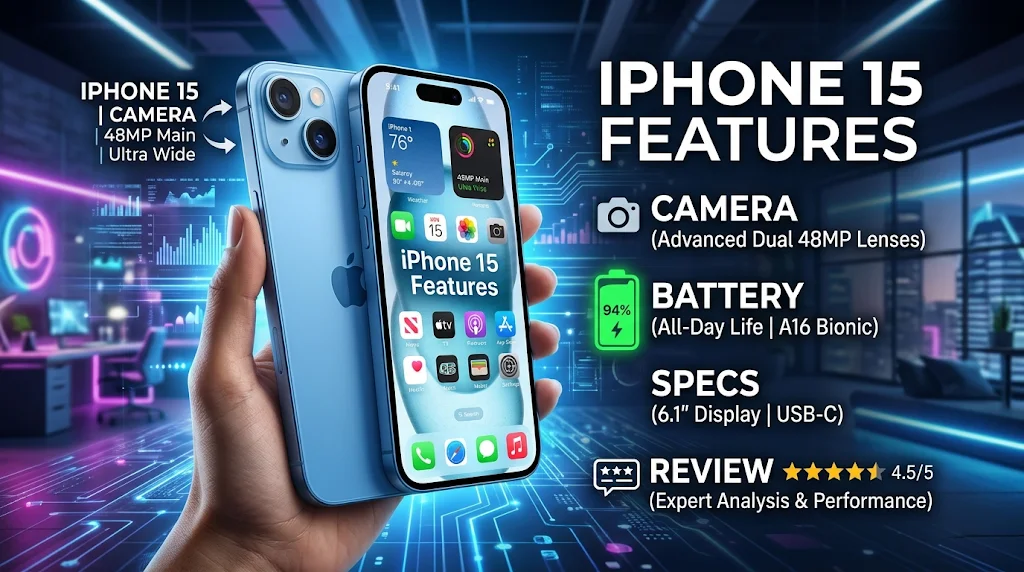
The iPhone 15 features make this smartphone an interesting choice for people who want a modern Apple experience without purchasing a Pro model. Introduced in September 2023, the iPhone 15 brought several important improvements over its predecessor, including a 48MP main camera, Dynamic Island, USB-C charging, a brighter OLED display, and the powerful A16 Bionic chip.
Apple also refreshed the phone’s appearance with a color-infused glass back and slightly curved aluminum edges. These changes give the device a more modern look while keeping it comfortable to hold.
Although newer iPhone generations have arrived since its release, the iPhone 15 remains worth considering for people interested in Apple’s design, camera quality, and software experience. However, understanding its strengths and limitations is important before making a purchase.
In this guide, we explore the iPhone 15 design, display, camera system, processor, battery, charging options, connectivity, security features, and everyday performance. We will also explain how it compares with older iPhones and whether it is still a sensible option.
1. iPhone 15 Design and Build Quality
Apple introduced a refreshed design with the iPhone 15. Instead of making major changes to the overall shape, the company focused on improving the materials, finish, and comfort.
The phone features an aluminum frame, a Ceramic Shield front, and a color-infused glass back. Its matte finish gives the rear panel a softer appearance than the glossy glass used on some earlier iPhone models.
The slightly contoured edges also make the device comfortable to hold. This small design change can make a difference when using the phone for extended periods.
Available Colors
The standard iPhone 15 comes in five colors:
- Black
- Blue
- Green
- Yellow
- Pink
These colors offer different styles, from the understated black finish to brighter options such as pink and yellow.
Dimensions and Weight
The iPhone 15 has the following physical measurements:
- Height: 147.6 mm
- Width: 71.6 mm
- Thickness: 7.80 mm
- Weight: 171 grams
Its relatively light construction makes it convenient for everyday use. Users can carry it comfortably in a pocket or use it with one hand in many situations.
Ceramic Shield Protection
The front of the device uses Apple’s Ceramic Shield material. It is designed to provide better drop resistance than conventional smartphone glass.
However, Ceramic Shield does not make the display impossible to break. A protective case and screen protector can still help reduce the risk of accidental damage.
The phone also carries an IP68 rating for water and dust resistance. Under controlled laboratory conditions, it can withstand submersion in water up to six meters deep for as long as 30 minutes.
This rating does not mean the device is waterproof. Water resistance can decrease through normal wear, and liquid damage may not be covered by Apple’s warranty.
2. iPhone 15 Display Features
The display is one of the most noticeable iPhone 15 features. Apple included a 6.1-inch Super Retina XDR OLED screen that provides sharp details, rich colors, and deep blacks.
OLED technology allows individual pixels to control their own light. As a result, dark scenes look more natural, and images can appear more vibrant than they do on many traditional LCD displays.
Screen Resolution and Brightness
The display has a resolution of 2556 x 1179 pixels at approximately 460 pixels per inch.
This resolution makes text, photographs, videos, and app interfaces look detailed. Whether someone is reading articles, browsing social media, or watching movies, the screen provides a clear viewing experience.
The brightness specifications include:
- Typical maximum brightness: 1,000 nits
- HDR peak brightness: 1,600 nits
- Outdoor peak brightness: 2,000 nits
The higher outdoor brightness helps users view content in bright environments. It is especially useful when taking photographs outside or checking messages in direct sunlight.
HDR and True Tone
The iPhone 15 supports HDR content, allowing compatible videos and images to display a wider range of brightness and contrast.
True Tone adjusts the display’s color temperature according to surrounding lighting. This can make the screen look more natural when moving between indoor and outdoor environments.
The phone also supports P3 wide color, which helps display a broad range of colors.
Does the iPhone 15 Have a 120Hz Display?
No. The standard iPhone 15 uses a 60Hz refresh rate.
This is an important detail for people who regularly use smartphones with high-refresh-rate displays. Scrolling and animations remain smooth, but they do not have the same fluid appearance as the 120Hz ProMotion displays found on supported Pro models.
The standard iPhone 15 also does not include an Always-On display.
3. Dynamic Island: A Major Interface Upgrade
One of the most recognizable iPhone 15 features is Dynamic Island.
Apple introduced this interactive display area on the iPhone 14 Pro models before bringing it to the standard iPhone 15.
Dynamic Island replaces the traditional static notch-style presentation with a flexible area that can display useful information around the front camera and sensor cutout.
How Does Dynamic Island Work?
Dynamic Island changes its appearance depending on the activity taking place on the phone.
For example, it can display:
- Music playback information
- Incoming and ongoing calls
- Timers
- Navigation directions
- Certain background activities
- Compatible app notifications
Users can interact with supported activities by tapping or pressing the Dynamic Island area.
For example, someone listening to music can check playback information without opening the full music application.
Why Is Dynamic Island Useful?
The main benefit is convenience. Instead of constantly switching between applications, users can access selected background activities directly from the top of the display.
It also makes the interface feel more interactive. However, the features displayed depend on iOS support and the applications being used.
4. iPhone 15 Camera Features
The camera system is one of the biggest improvements over the iPhone 14 standard model.
Apple upgraded the main camera from 12MP to 48MP, giving users more detail and additional flexibility when capturing photographs.
The rear camera system includes a 48MP main camera and a 12MP Ultra Wide camera.
48MP Main Camera
The main camera uses a 48MP sensor with an f/1.6 aperture and sensor-shift optical image stabilization.
It is designed to capture detailed photographs in different lighting conditions.
By default, the camera can produce 24MP images, balancing detail and file size. Users can also capture 48MP photographs when they want more image information.
This is useful for photography enthusiasts who want additional flexibility when cropping or editing pictures.
2x Telephoto Option
Although the standard iPhone 15 has two physical rear cameras, its 48MP sensor also enables a 2x telephoto option.
This gives users another useful framing choice without requiring a dedicated third rear camera.
The 2x option is particularly helpful when photographing people, pets, buildings, or objects from a moderate distance.
However, it should not be confused with the dedicated telephoto hardware available on certain Pro models.
12MP Ultra Wide Camera
The second rear camera is a 12MP Ultra Wide lens with a 120-degree field of view.
It allows users to capture a larger area in a single photograph.
This camera is helpful for:
- Group photographs
- Landscape pictures
- Architecture photography
- Indoor photographs
- Travel photography
The wider perspective can make it easier to include more subjects without moving too far away.
Night Mode Photography
The iPhone 15 supports Night mode, which helps improve photographs in darker environments.
When the camera detects low lighting, it can use longer exposure processing to capture more visible detail.
Night mode can be useful when photographing city streets, restaurants, indoor spaces, and evening scenes.
For the best results, users should keep the phone steady while the camera captures the image.
Portrait Mode Improvements
Apple also improved the portrait experience.
The camera can capture depth information in supported situations, allowing users to adjust the focus point and background blur after taking a photograph.
This is useful when photographing people, pets, and other subjects.
Portrait Lighting also provides several effects that change how the subject appears in the photograph.
Smart HDR 5 and Photographic Styles
Smart HDR 5 helps balance bright and dark areas in photographs. It is particularly useful when a scene contains strong sunlight and shadows.
Photographic Styles let users customize the appearance of images while maintaining natural-looking skin tones.
These options give users more creative control without requiring advanced editing knowledge.
5. Video Recording Capabilities
The iPhone 15 is also a capable device for recording videos.
Its camera system supports 4K video recording at different frame rates, including 24, 25, 30, and 60 frames per second.
Users can select a suitable recording option depending on the type of content they want to create.
Cinematic Mode
Cinematic mode creates a depth effect that keeps the main subject visually prominent while softening the background.
It can be useful for short films, social media content, interviews, and creative recordings.
The phone supports Cinematic mode recording up to 4K at 30 frames per second.
Action-Friendly Recording
Optical image stabilization helps reduce unwanted movement in photographs. Video stabilization features also help produce more usable footage when recording handheld clips.
However, the quality of the final video still depends on lighting, movement, and recording conditions.
Dolby Vision HDR Video
The iPhone 15 supports Dolby Vision HDR video recording up to 4K at 60 frames per second.
This allows compatible displays to reproduce a wider range of brightness and color information.
For people who create travel videos or social media content, this can be a useful creative feature.
6. A16 Bionic Chip and Performance
Another important part of the iPhone 15 features list is the A16 Bionic processor.
Apple previously introduced this chip in the iPhone 14 Pro lineup. It later became the processor used in the standard iPhone 15.
The A16 Bionic is built using a 4-nanometer process and includes a six-core CPU, five-core GPU, and 16-core Neural Engine.
Everyday Performance
The processor is designed to handle common smartphone activities efficiently.
These include:
- Opening and switching between applications
- Browsing websites
- Watching videos
- Editing photographs
- Using navigation applications
- Managing messages and emails
- Playing mobile games
For typical users, the A16 Bionic provides a responsive experience.
Gaming Performance
The five-core GPU helps the phone handle graphics-intensive games.
Popular mobile games can run well when their system requirements are compatible with the device.
However, gaming performance can depend on graphics settings, software updates, temperature, and the requirements of individual games.
Users who regularly play demanding games for long periods should also consider heat and battery consumption.
Neural Engine
The 16-core Neural Engine supports machine-learning tasks and computational photography features.
It helps process certain activities directly on the device, including image-related functions and other supported software features.
This combination of hardware and software helps make the iPhone 15 more capable than older models using earlier processors.
7. iPhone 15 Battery Life
Battery life is an important consideration when purchasing any smartphone.
Apple rates the iPhone 15 for up to 20 hours of video playback, up to 16 hours of streamed video playback, and up to 80 hours of audio playback.
These are laboratory-based estimates rather than guaranteed results for every user.
What Affects Battery Performance?
Actual battery life depends on several factors:
- Screen brightness
- Mobile network strength
- Wi-Fi usage
- Gaming sessions
- Video streaming
- Background applications
- Camera usage
- Battery condition
For example, someone who mainly sends messages and browses websites may experience different battery life from someone who records 4K videos and plays games regularly.
Battery Health
Like other rechargeable lithium-ion batteries, the iPhone 15 battery gradually loses capacity over time.
Apple provides battery health information in iOS settings, allowing users to check the battery’s condition.
To maintain battery performance, users should avoid unnecessary exposure to extreme temperatures and use reliable charging accessories.
8. USB-C Charging and Connectivity
One of the most significant hardware changes is the introduction of USB-C.
Earlier standard iPhone models used Apple’s Lightning connector. With the iPhone 15 lineup, Apple moved to USB-C.
This makes it easier for users who already own compatible USB-C cables and accessories.
USB-C Benefits
The USB-C port supports:
- Charging the smartphone
- Connecting compatible accessories
- Transferring data
- DisplayPort video output with compatible equipment
It also allows users to use compatible USB-C cables across multiple devices, including supported laptops, tablets, and smartphones.
USB 2 Transfer Speeds
There is an important limitation to understand.
The standard iPhone 15 USB-C port supports USB 2 data transfer speeds of up to 480 Mbps.
It does not offer the faster USB 3 transfer speeds available on certain Pro models.
This difference matters most to people who regularly transfer large video files to a computer.
Charging Other Devices
The USB-C port can also provide power to certain smaller accessories.
For example, users can charge compatible AirPods or an Apple Watch using an appropriate cable.
This feature can be helpful when traveling without carrying multiple charging accessories.
9. Wireless Charging and MagSafe
The iPhone 15 supports several wireless charging options.
These include MagSafe charging up to 15W, Qi2 charging up to 15W, and standard Qi charging up to 7.5W.
MagSafe uses built-in magnets to help compatible chargers and accessories align with the back of the device.
Benefits of MagSafe
MagSafe supports a range of compatible accessories, including:
- Wireless chargers
- Magnetic phone stands
- Compatible wallets
- Car mounts
- Battery accessories
Fast wired charging is also supported. Apple states that the phone can reach approximately 50% charge in around 30 minutes when using a 20W or higher adapter with a suitable USB-C cable.
The power adapter is sold separately.
10. Storage Options
The iPhone 15 is available in three internal storage capacities:
| Storage | Suitable For |
|---|---|
| 128GB | Everyday use and moderate app storage |
| 256GB | Frequent photography and video recording |
| 512GB | Larger media libraries and heavier storage needs |
Choosing the correct capacity depends on how someone uses their phone.
For example, users who take many high-resolution photographs or record 4K videos may benefit from 256GB or 512GB.
People who mainly use messaging applications, social media, and cloud storage may find 128GB sufficient.
The iPhone 15 does not include a microSD card slot, so users cannot expand its internal storage with a memory card.
11. Front Camera and Face ID
The front camera is another important part of the iPhone 15 experience.
Apple includes a 12MP TrueDepth front camera with an f/1.9 aperture.
It supports features such as autofocus, Portrait mode, and Cinematic mode video recording.
Selfie Photography
The front camera is designed for selfies, video calls, and social media content.
Its image processing helps produce detailed photographs with balanced exposure in suitable lighting conditions.
Portrait effects also allow users to create photographs with a softer background.
Face ID Security
Face ID uses the TrueDepth camera system to recognize the user’s face.
It can be used to:
- Unlock the phone
- Authorize supported payments
- Sign in to compatible applications
- Authenticate certain protected actions
Face ID provides a convenient alternative to entering a passcode repeatedly.
12. Software and iOS Experience
The iPhone 15 runs Apple’s iOS operating system.
Its software experience includes Apple’s built-in applications, security features, privacy controls, accessibility options, and compatibility with a wide range of third-party applications.
Supported iOS updates can also introduce new functions and improvements over time.
Useful iOS Features
Some of the useful software features include:
Focus Mode: Helps users manage notifications during work, sleep, or personal time.
FaceTime: Allows users to make video and audio calls with compatible Apple devices.
iCloud: Provides cloud storage and synchronization for supported content.
Find My: Helps users locate supported Apple devices and share their location with selected people.
Siri: Apple’s voice assistant can perform supported tasks, answer questions, and control compatible features.
Does the iPhone 15 Support Apple Intelligence?
The standard iPhone 15 does not support Apple Intelligence.
This is an important distinction for buyers who specifically want Apple’s newer built-in AI features. The standard iPhone 15 uses the A16 Bionic chip, while Apple Intelligence requires supported newer hardware.
Therefore, buyers should not assume that every modern iOS feature is available on this model.
13. Safety and Emergency Features
Apple includes several safety-related capabilities in the iPhone 15.
These features are designed to provide assistance in certain emergency situations.
Emergency SOS via Satellite
In supported countries and regions, Emergency SOS via satellite can help users contact emergency services when cellular and Wi-Fi connections are unavailable.
Availability depends on location, service support, and Apple’s regional requirements.
Crash Detection
Crash Detection can identify certain severe car crashes and automatically contact emergency services if the user does not respond to the alert.
It is designed as an additional safety feature, not a replacement for careful driving or emergency preparation.
Precision Finding
The iPhone 15 also supports Precision Finding for compatible Find My friends and supported devices.
This can make locating someone in a crowded environment easier when both devices and the relevant features are supported.
14. iPhone 15 Connectivity Features
The iPhone 15 includes modern connectivity options for everyday communication and accessory support.
Its connectivity features include:
- 5G cellular connectivity
- Wi-Fi 6
- Bluetooth 5.3
- NFC
- GPS and other location services
- USB-C
- Dual SIM support through supported configurations
The exact SIM configuration varies by country and region.
Some models support a physical nano-SIM and eSIM, while certain regional versions use different SIM arrangements.
5G Connectivity
5G support allows the iPhone 15 to connect to compatible fifth-generation mobile networks.
Actual speeds depend on network coverage, carrier support, signal strength, and the user’s mobile plan.
In areas where 5G is unavailable, the phone can use supported older cellular networks.
15. iPhone 15 vs iPhone 14
People upgrading from an older iPhone often want to understand whether the iPhone 15 offers meaningful improvements.
Here is a comparison of some important differences.
| Feature | iPhone 14 | iPhone 15 |
|---|---|---|
| Processor | A15 Bionic | A16 Bionic |
| Main Camera | 12MP | 48MP |
| Display | Super Retina XDR | Super Retina XDR |
| Dynamic Island | No | Yes |
| Charging Port | Lightning | USB-C |
| Main Camera Zoom | 1x | 2x option |
| Front Design | Notch | Dynamic Island |
The iPhone 15 offers a more noticeable camera upgrade, a newer processor, Dynamic Island, and USB-C connectivity.
For people using an iPhone 14, these improvements may make upgrading attractive, especially if photography and USB-C compatibility are important.
However, someone whose current phone still works well may not need to upgrade immediately.
16. Advantages and Disadvantages of iPhone 15
Before purchasing the phone, it is helpful to consider both its positive and negative points.
Advantages
1. Excellent OLED Display
The Super Retina XDR display provides detailed images, strong contrast, and impressive brightness.
2. Improved Main Camera
The 48MP camera offers greater flexibility and higher-resolution photography.
3. Dynamic Island
This interactive feature makes selected notifications and background activities easier to access.
4. A16 Bionic Performance
The processor handles everyday applications, photography, and many mobile games effectively.
5. USB-C Connectivity
The new connector improves compatibility with modern charging cables and accessories.
6. Lightweight Design
At 171 grams, the phone is relatively easy to carry and handle.
7. Strong Software Ecosystem
Apple’s software, privacy controls, and application ecosystem provide a familiar experience for existing iPhone users.
Disadvantages
1. No 120Hz Refresh Rate
The display is limited to 60Hz, which may disappoint users who prefer high-refresh-rate screens.
2. No Dedicated Telephoto Camera
The 2x option is useful, but it is not the same as a separate telephoto lens.
3. USB 2 Transfer Speeds
The USB-C connector does not provide the faster data transfer speeds available on the Pro models.
4. No Apple Intelligence Support
The standard iPhone 15 does not support Apple Intelligence.
5. Charging Adapter Sold Separately
Users may need to purchase a compatible charging adapter if they do not already own one.
17. Is the iPhone 15 Worth Buying in 2026?
Whether the iPhone 15 is worth buying in 2026 depends on its price, condition, storage capacity, and your expectations.
Although it is not Apple’s newest smartphone, it still offers a capable processor, a high-quality OLED display, a useful camera system, and USB-C connectivity.
It can be a reasonable choice for people who want to enter the Apple ecosystem without paying for a newer premium model.
Who Should Buy the iPhone 15?
The phone may suit:
- People upgrading from older iPhones
- Students who need a reliable everyday smartphone
- Users who enjoy photography and video recording
- People who prefer a compact smartphone
- Users who already own USB-C accessories
- People who want Apple’s software experience
Who Should Consider Another Model?
You may want to compare other models if you need:
- A 120Hz ProMotion display
- Dedicated optical telephoto hardware
- Faster wired data transfers
- Apple Intelligence support
- The newest available processor
The iPhone 15 Pro or newer supported models may be more suitable for people who prioritize these features.
What Should You Check Before Buying?
If you are purchasing a used or refurbished iPhone 15, inspect the following:
- Battery health and battery performance.
- Face ID functionality.
- Display condition and touch response.
- Main and Ultra Wide camera operation.
- USB-C charging and data connection.
- Speaker and microphone quality.
- IMEI and device activation status.
- PTA approval if purchasing a phone for use in Pakistan.
- Storage capacity and physical condition.
Buying from a trusted seller and checking the device carefully can help reduce the risk of purchasing a damaged or misrepresented phone.
18. Frequently Asked Questions About iPhone 15 Features
1. What are the main iPhone 15 features?
The main features include a 6.1-inch OLED display, Dynamic Island, A16 Bionic processor, 48MP main camera, 12MP Ultra Wide camera, USB-C connector, Face ID, and MagSafe wireless charging.
2. Does the iPhone 15 have a 48MP camera?
Yes. It has a 48MP main rear camera that supports high-resolution photography, including 24MP and 48MP image options.
3. Does the iPhone 15 have Dynamic Island?
Yes. Dynamic Island is included on the standard iPhone 15. It displays supported alerts, background activities, and useful information.
4. Is the iPhone 15 waterproof?
No smartphone should be considered completely waterproof. The iPhone 15 has an IP68 rating and is tested for water resistance up to six meters for 30 minutes under controlled conditions.
5. Does the iPhone 15 use USB-C?
Yes. Apple replaced the Lightning connector with USB-C on the iPhone 15.
6. How long does the iPhone 15 battery last?
Apple rates it for up to 20 hours of video playback, up to 16 hours of streamed video playback, and up to 80 hours of audio playback. Actual battery life varies with usage.
7. Does the iPhone 15 support 5G?
Yes. It supports 5G connectivity on compatible networks and with supported mobile plans.
8. Does the iPhone 15 have a 120Hz display?
No. The standard iPhone 15 has a 60Hz display. ProMotion with a 120Hz refresh rate is available on supported Pro models.
9. Does the iPhone 15 support Apple Intelligence?
No. The standard iPhone 15 uses the A16 Bionic chip and does not support Apple Intelligence.
10. Is the iPhone 15 good for gaming?
Yes. Its A16 Bionic processor and five-core GPU can handle many popular mobile games. Performance varies depending on the game, graphics settings, and temperature.
11. What storage options are available?
Apple offers 128GB, 256GB, and 512GB storage options for the iPhone 15.
12. Is the iPhone 15 still worth buying?
It can still be a good option for everyday use, photography, communication, and entertainment. However, buyers should compare its price with newer models before making a final decision.
Conclusion
The iPhone 15 features provide a useful combination of design, performance, photography, and connectivity. Its 48MP main camera, Dynamic Island, A16 Bionic processor, Super Retina XDR display, and USB-C port make it a meaningful improvement over several older standard iPhone models.
It is not a perfect smartphone. The 60Hz display, lack of a dedicated telephoto camera, USB 2 data speeds, and absence of Apple Intelligence support are important limitations.
Nevertheless, the iPhone 15 remains a capable everyday smartphone for people who value Apple’s ecosystem, camera quality, and comfortable design. Before purchasing one in 2026, compare its price, battery condition, and features with newer alternatives to decide whether it offers the right value for your needs.