
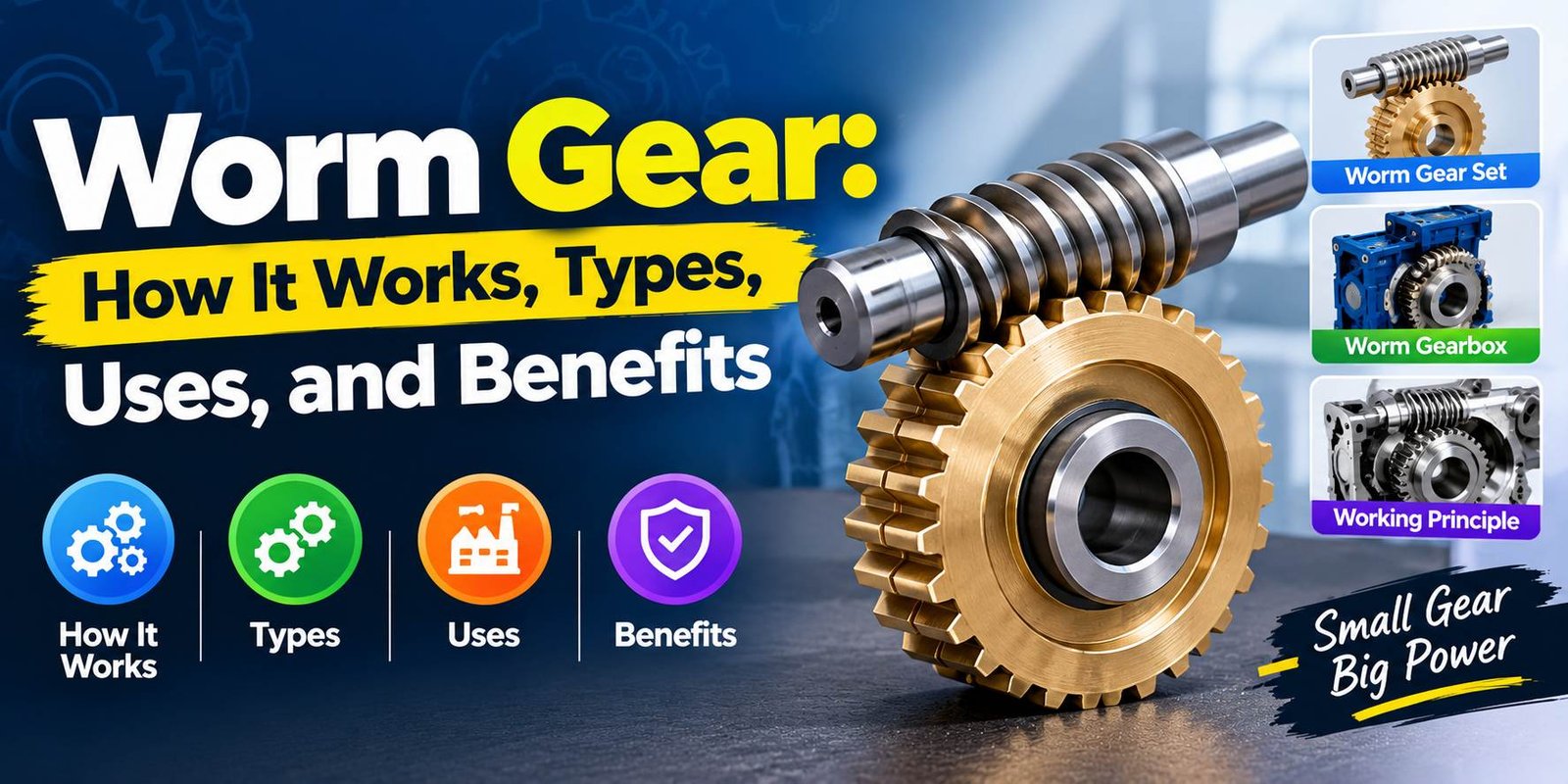
Worm Gear: How It Works, Types, Uses, and Benefits
A worm gear is a mechanical component used to transmit rotary motion between two shafts, usually positioned at right angles to each other. It is widely used in machinery that needs a large speed reduction, controlled movement, or increased output torque in a compact space. You can find worm gear mechanisms in lifting equipment, conveyor systems, industrial machines, and many other applications.
Understanding how a worm gear works helps engineers, technicians, students, and machine owners choose the right mechanism for their needs. This guide explains its design, working principle, common types, advantages, disadvantages, and practical applications in simple language.
What Is a Worm Gear?
A worm gear is a gear arrangement consisting of two main components: a worm and a worm wheel. The worm resembles a threaded screw, while the worm wheel looks like a gear with teeth designed to engage with the worm.
When the worm rotates, its threads push against the teeth of the wheel, causing the wheel to turn. Depending on the design, this arrangement can reduce rotational speed significantly while increasing the available output torque.
One important feature of a worm gear is its ability to transfer motion between shafts that are generally perpendicular and do not intersect. This makes it useful when a machine requires a compact transmission system.
How Does a Worm Gear Work?
The working principle of a worm gear depends on contact between the worm’s threads and the teeth of the worm wheel.
Step 1: The Worm Receives Input Motion
A motor or another power source rotates the worm. The worm’s helical thread moves against the teeth of the wheel as it turns.
Step 2: The Worm Wheel Starts Rotating
The contact between the worm and the wheel transfers motion to the wheel. The wheel usually rotates more slowly than the worm, depending on the number of thread starts and the number of teeth.
Step 3: Speed Decreases and Torque Increases
The gear arrangement reduces output speed and can increase output torque. However, some input energy is lost through friction, so the actual output torque depends on the gearbox’s efficiency and operating conditions.
Step 4: The Machine Performs Its Task
The slower, controlled rotation can operate a lifting mechanism, adjust equipment, move a conveyor, or drive another mechanical component.
Main Parts of a Worm Gear System
A typical worm gear mechanism contains several components that work together.
1. Worm
The worm is the screw-shaped component that provides the input motion. Its thread design affects the gear ratio, contact conditions, and transmission performance.
2. Worm Wheel
The worm wheel is the toothed gear that receives motion from the worm. Its tooth geometry is designed to engage correctly with the worm’s thread.
3. Shafts
The shafts support the worm and wheel and transfer rotational motion to and from the gearbox. Their alignment is important for reliable operation.
4. Bearings
Bearings support the rotating shafts, help maintain alignment, and reduce unwanted friction in the supported parts.
5. Housing and Lubrication System
The housing holds the components in position and protects them from contamination. Lubrication helps control friction, heat, and wear between the contacting surfaces.
Types of Worm Gears
Worm gear systems come in different designs to suit particular loads, speeds, and installation requirements.
1. Single-Thread Worm Gear
A single-thread, or single-start, worm has one continuous helical thread. With a compatible worm wheel, it can provide a relatively high reduction ratio in a compact arrangement.
This design is useful when an application requires slow output rotation.
2. Multi-Thread Worm Gear
A multi-thread worm has two or more thread starts. For the same wheel tooth count, adding thread starts generally reduces the gear ratio and may improve efficiency under suitable operating conditions.
These designs can be appropriate when the application needs a higher output speed than a comparable single-start arrangement.
3. Cylindrical Worm Gear
A cylindrical worm has a screw-like shape along its main body. It is commonly used in worm gearboxes because it offers a practical design for many industrial transmission systems.
4. Globoidal Worm Gear
A globoidal worm has a curved profile designed to provide a broader contact pattern with a compatible wheel. Depending on its geometry and manufacturing quality, this arrangement can support demanding transmission applications.
Correct design, alignment, lubrication, and material selection remain essential for reliable operation.
Common Applications of Worm Gears
Worm gears are useful in machines that need compact speed reduction or controlled movement. Their applications vary according to the load, efficiency requirements, and safety needs of the equipment.
Industrial Machinery
Factories use worm gearboxes in selected production machines, positioning systems, and equipment that requires reduced rotational speed.
Conveyor Systems
Some conveyor systems use worm gear reducers to deliver slower output rotation and suitable torque for moving materials along a production line.
Lifting Equipment
Worm gear mechanisms can be found in certain hoists, lifting systems, and mechanical positioning devices. However, a worm gear should never be assumed to hold a suspended load safely without an appropriately rated braking or load-holding system.
Gates and Door Mechanisms
Certain powered gates, industrial doors, and adjustment mechanisms use worm drives to provide compact motion control.
Automotive and Steering Mechanisms
Some steering systems and vehicle-related mechanisms use worm gearing. The exact design depends on the vehicle, mechanical requirements, and safety standards.
Packaging and Processing Equipment
Worm gearboxes can also drive selected packaging machines, mixers, and processing equipment where a suitable reduction ratio and compact arrangement are beneficial.
Advantages of Worm Gears
Worm gear mechanisms offer several practical benefits when properly selected.
High Speed Reduction
A worm gear can provide a substantial reduction ratio in a single gear stage. This helps produce slow output motion without requiring a long series of gears.
Compact Design
The arrangement can fit into relatively small spaces, especially when the input and output shafts need to be positioned at right angles.
Smooth Operation
Properly designed and lubricated worm gears can operate smoothly and produce controlled movement in many applications.
Useful Torque Characteristics
A worm gearbox can increase output torque by reducing speed. The actual torque available depends on input power, gear ratio, efficiency, and operating limits.
Flexible Installation Options
Worm gearboxes are available in different sizes, mounting configurations, and ratios, making them suitable for a variety of machines.
Disadvantages of Worm Gears
Although worm gears offer useful benefits, they are not ideal for every application.
Lower Efficiency in Some Designs
Sliding contact between the worm and wheel creates friction. This can reduce efficiency compared with some other gear arrangements, particularly at high reduction ratios or under unsuitable operating conditions.
Heat Generation
Friction can produce heat during operation. Correct lubrication, suitable loading, and adequate cooling help control operating temperature.
Wear Over Time
The contacting surfaces can wear, especially when lubrication is insufficient, contamination enters the gearbox, or the system operates beyond its rated capacity.
Maintenance Requirements
Regular inspection and appropriate lubricant maintenance may be necessary to keep the gearbox operating reliably.
Self-Locking Is Not Guaranteed
Some worm gear designs resist being driven backward, but this depends on factors such as lead angle, friction, lubrication, wear, and vibration. Never rely on a worm gear alone as a safety device for holding a load.
Worm Gear vs. Spur Gear
Worm gears and spur gears both transmit rotational motion, but they work differently.
A worm gear uses a screw-like worm to drive a wheel and is often selected for large speed reductions or right-angle shaft arrangements. A spur gear uses straight teeth on parallel shafts and generally provides more direct, efficient power transmission.
Spur gears are often preferred when efficiency and speed are important. Worm gears may be more suitable when compact packaging, substantial reduction, and a particular shaft arrangement are priorities.
The best choice depends on the machine’s required speed, torque, operating hours, space limitations, and maintenance budget.
How to Choose the Right Worm Gear
Before purchasing a worm gear or gearbox, consider the following factors.
Required Gear Ratio
Calculate the difference between the desired input speed and output speed. The selected ratio should meet the machine’s operating requirements.
Torque and Load
Determine the torque needed at the output shaft, including starting loads and possible shock loads. Choose equipment rated for the actual duty.
Efficiency and Operating Temperature
Check the manufacturer’s efficiency data and thermal ratings. Continuous operation may require a different gearbox size from intermittent operation.
Materials and Lubrication
Worms and wheels may use different materials depending on the application. Confirm that the materials and lubricant are compatible with the expected load, speed, and environment.
Space and Mounting
Check shaft orientation, mounting dimensions, available clearance, and connection requirements before installation.
Maintenance and Safety
Review inspection intervals, lubricant recommendations, and any braking or load-holding requirements. Follow the manufacturer’s instructions and applicable safety standards.
Frequently Asked Questions
What is the main purpose of a worm gear?
The main purpose of a worm gear is to transmit rotational motion while providing speed reduction and suitable output torque. It can also transfer motion between shafts arranged at approximately right angles.
Does a worm gear increase torque?
Yes, a worm gear can increase output torque by reducing rotational speed. However, friction and other losses mean that the actual output torque is lower than an ideal, loss-free calculation would suggest.
Are worm gears always self-locking?
No. Some worm gear arrangements resist reverse motion, but self-locking is not guaranteed. Applications involving suspended loads or safety-critical positioning need an appropriate, independently rated holding or braking system.
Why does a worm gearbox become hot?
Heat can result from friction, excessive loading, unsuitable lubricant, poor alignment, or insufficient cooling. Check the manufacturer’s temperature limits and investigate unusual overheating before continuing operation.
Are worm gears suitable for heavy loads?
Some worm gearboxes are designed for demanding loads, but suitability depends on the model’s torque rating, thermal capacity, duty cycle, and operating environment. Always check the manufacturer’s specifications.
Conclusion
A worm gear is a useful mechanical transmission system for applications that require speed reduction, controlled movement, and a compact arrangement. Its main components—the worm and worm wheel—work together to transfer rotational motion while changing output speed and torque.
Although worm gears offer advantages such as compact construction and substantial reduction ratios, friction, heat, and efficiency must be considered when selecting a design. Comparing operating requirements and following the manufacturer’s maintenance and safety guidance can help you choose a suitable worm gearbox for your machine.






One Comment