
LR41 Battery Equivalent: AG3, 192, LR736 and More
The LR41 battery equivalent question is important because using the wrong button cell can lead to poor performance, an incorrect fit, or damage to a sensitive device. The safest approach is to compare the battery code, voltage, physical dimensions, and chemistry before installing a replacement.
This guide explains the common LR41 alternatives, how they compare, where the battery is used, and what to check before buying a replacement.
What Is an LR41 Battery?
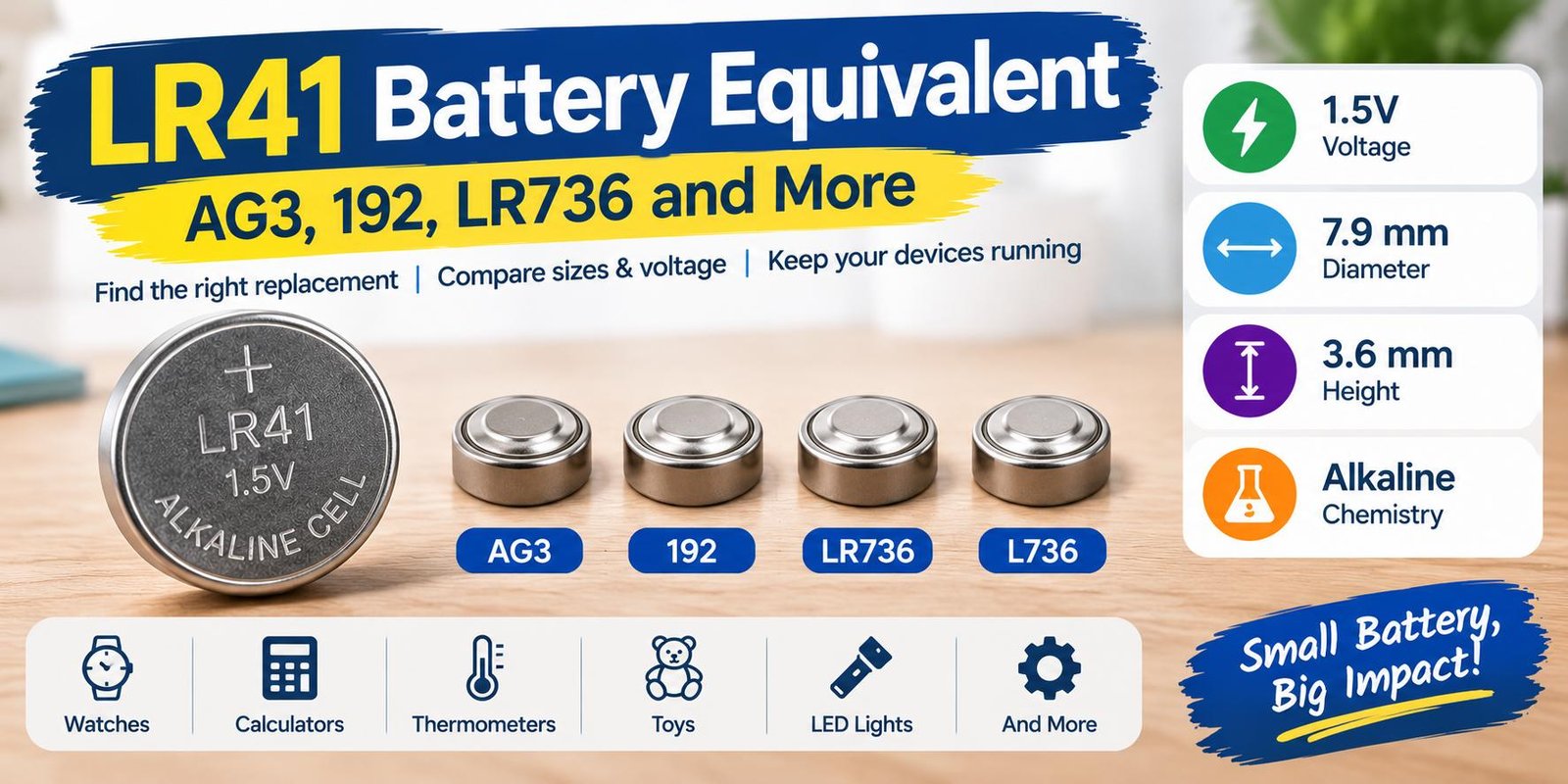
The LR41 is a small, non-rechargeable alkaline button cell designed for compact electronic devices. It provides a nominal voltage of 1.5 volts and has a diameter of approximately 7.9 millimeters with a height of around 3.6 millimeters.
Its compact shape makes it suitable for products that have very limited space for a power source. The battery is commonly found in small household electronics, toys, calculators, watches, and selected medical or measuring devices.
The LR41 is also sold under several alternative identification codes. These names can vary according to the manufacturer, region, or packaging style.
LR41 Battery Equivalent Codes
The most common direct replacements for an LR41 battery include:
- AG3
- 192
- 92A
- LR736
- L736
- V3GA
- GP192
- G3A
- SG3
These codes are generally used for batteries with the same basic physical format and 1.5V alkaline chemistry. However, packaging and brand markings can differ.
LR41 and AG3
AG3 is one of the most widely recognized alternatives to LR41.
If a device requires an LR41 alkaline button cell, an AG3 battery is usually the first replacement to look for. Both codes are commonly associated with a 1.5V cell measuring approximately 7.9 mm across and 3.6 mm high.
LR41 and 192
The number 192 is another common label used for an LR41-style battery.
Some brands print LR41 on the package, while others use 192. The different code does not automatically mean that the battery has a different size.
LR41 and LR736
LR736 is also used as an alternative designation for the LR41 format.
This name is especially useful when searching online or checking the stock of an electronics shop. If LR41 is unavailable, searching for LR736 may help you find a compatible alkaline cell.
LR41 and L736
L736 is closely related to LR736 and is commonly listed among LR41 alternatives.
Before purchasing, check the product description to make sure the cell is an alkaline 1.5V version rather than a different chemistry with a similar code.
LR41 Battery Specifications
Understanding the basic specifications makes it easier to compare replacement batteries.
| Feature | LR41 Specification |
|---|---|
| Battery type | Alkaline button cell |
| Nominal voltage | 1.5V |
| Diameter | Approximately 7.9 mm |
| Height | Approximately 3.6 mm |
| Rechargeable | No |
| Common alternative codes | AG3, 192, 92A, LR736, L736 |
Battery capacity can vary slightly between manufacturers and testing conditions. For this reason, capacity should not be the only factor used when selecting a replacement.
The most important checks are the physical size, voltage, chemistry, and the requirements listed by the device manufacturer.
Is SR41 the Same as LR41?
SR41 is often mentioned in searches for an LR41 battery equivalent because it has a similar physical size.
However, SR41 is normally a silver-oxide battery, while LR41 is an alkaline battery. Both are commonly associated with the same general button-cell dimensions, but their electrical behavior is not identical.
LR41 Alkaline Battery
An LR41 battery normally offers:
- 1.5V nominal voltage
- Alkaline chemistry
- Affordable replacement cost
- Good performance in basic, low-drain devices
SR41 Silver-Oxide Battery
An SR41 battery normally offers:
- Approximately 1.55V nominal voltage
- Silver-oxide chemistry
- More stable voltage during discharge
- Potentially better performance in devices that need consistent power
For simple products such as toys or basic lights, an alkaline replacement may be suitable. For precision instruments, watches, or measuring devices, it is better to follow the device manufacturer’s recommendation.
Do not assume that every battery with a similar size is automatically the correct replacement.
Can You Use 392 Instead of LR41?
The 392 code is commonly connected with silver-oxide button cells. Some sellers also group 392 with LR41-style batteries because the physical dimensions are similar.
The important difference is chemistry. A 392 battery may fit the battery compartment, but it is not the same chemical type as a standard LR41 alkaline cell.
If your device specifically requires LR41, use a direct 1.5V alkaline equivalent unless the manufacturer confirms that a silver-oxide alternative is acceptable.
This is especially important for devices that measure temperature, time, voltage, or another value where stable power may affect the result.
Where Are LR41 Batteries Used?
LR41 batteries are designed for small electronic products that require a compact power source.
Common applications include:
Digital Thermometers
Some digital thermometers use small button cells because they need limited power and a compact battery compartment.
If a thermometer stops working, check the old battery marking before purchasing a replacement. The battery code may be printed on the cell or inside the battery compartment.
Watches and Small Clocks
Certain small watches and clocks use LR41-style batteries.
For these products, it is important to check the recommended battery chemistry. A silver-oxide cell may provide more consistent voltage, depending on the design.
Calculators
Small calculators may use button batteries to operate the display and internal electronics.
An AG3 or 192 battery may be suitable when the calculator specifies LR41.
Toys and Small Lights
Compact toys, mini LED lights, and novelty products sometimes use LR41 batteries.
These devices generally have simple power requirements, but the replacement should still match the original voltage and size.
Laser Pointers and Small Electronic Tools
Some small laser pointers and electronic tools use LR41-type cells.
Always check the polarity markings before inserting a new battery.
How to Choose the Correct LR41 Replacement
Choosing a replacement involves more than matching the name.
Check the Battery Code
Look at the old battery and write down every marking.
The code may appear as LR41, AG3, 192, LR736, or another equivalent label.
Confirm the Voltage
A standard LR41 alkaline battery has a nominal voltage of 1.5V.
Avoid selecting a battery with a different voltage unless the device documentation specifically allows it.
Compare the Dimensions
The replacement should have approximately the same diameter and height.
A battery that is too wide may not fit into the compartment. A battery that is too thin may fail to maintain contact with the terminals.
Identify the Chemistry
Check whether the replacement is alkaline or silver oxide.
For a direct LR41 replacement, a 1.5V alkaline cell is usually the closest match. Silver-oxide alternatives may be suitable for some devices, but they should not be treated as identical in every situation.
Follow the Device Manual
If the device manufacturer lists a specific battery code, use that information as the primary reference.
This is particularly important for medical devices, measuring equipment, and products with sensitive electronic circuits.
How to Replace an LR41 Battery Safely
Replacing a button battery is usually simple, but small cells require careful handling.
Turn the Device Off
Switch off the device before opening the battery compartment.
If the product has no power switch, remove it from use before changing the cell.
Observe the Polarity
Look for the plus and minus markings inside the compartment.
The positive side of a button cell is normally the flat surface marked with a plus sign. Insert the battery according to the device’s markings rather than guessing.
Remove the Old Cell Carefully
Use clean fingers or a suitable non-metallic tool.
Avoid forcing the battery out with sharp metal objects, especially if the compartment is delicate.
Insert the New Battery
Place the replacement into the correct position.
Make sure it sits flat and that the contacts touch the correct surfaces.
Test the Device
Close the battery cover and turn the device on.
If it does not work, check the battery direction, contact points, and whether the replacement is fully compatible.
Mistakes to Avoid With LR41 Batteries
Several common mistakes can create problems during replacement.
Choosing LR44 Instead of LR41
LR44 is much larger than LR41. Although both are button cells, they are not interchangeable in most devices.
Ignoring Battery Chemistry
A battery with the same shape may still use a different chemical system.
For sensitive equipment, the wrong chemistry can affect operating stability.
Installing the Battery Backward
Incorrect polarity may prevent the device from working and can sometimes damage electronic components.
Using a Rechargeable Substitute
Standard LR41 batteries are primary cells and are not designed to be recharged.
Never place a normal LR41 alkaline battery in a charger.
Mixing Old and New Batteries
If a device uses more than one button cell, avoid mixing batteries with different ages, brands, or charge levels unless the manufacturer allows it.
How Should LR41 Batteries Be Stored?
Proper storage can help preserve battery performance.
Keep unused button cells:
- In their original packaging
- Away from moisture
- Away from extreme heat
- Separate from loose metal objects
- Out of reach of children and pets
Do not store loose batteries in a pocket, drawer, or container with coins, keys, or other metal items. Metal contact can create a short circuit.
Button Battery Safety
Small button batteries can be dangerous if swallowed, especially by children.
Keep new and used cells away from young children. Used batteries should be disposed of promptly and according to local battery-recycling guidance.
Do not puncture, crush, open, burn, or recharge an LR41 battery.
If a button battery may have been swallowed, seek emergency medical assistance immediately. Do not wait for symptoms to appear.
Frequently Asked Questions
What is the closest LR41 battery equivalent?
AG3 is one of the most common direct alternatives. Other commonly listed codes include 192, 92A, LR736, and L736.
Is AG3 the same as LR41?
AG3 is generally used as an alternative name for a 1.5V alkaline button cell with the same basic dimensions as LR41.
Is 192 the same as LR41?
Yes, 192 is commonly used as an equivalent code for an LR41-style alkaline battery.
Can I use LR736 instead of LR41?
LR736 is commonly listed as a direct LR41 alternative. Confirm the voltage and dimensions before installation.
Is LR44 compatible with LR41?
No. LR44 is larger than LR41, so it usually will not fit the same battery compartment.
Is SR41 better than LR41?
SR41 uses silver-oxide chemistry and may provide more stable voltage. Whether it is suitable depends on the device and its recommended battery type.
Are LR41 batteries rechargeable?
No. Standard LR41 batteries are non-rechargeable primary cells.
What devices use LR41 batteries?
They may be used in small watches, calculators, digital thermometers, toys, mini lights, and other compact electronic products.
Final Thoughts
The best LR41 battery equivalent is usually a 1.5V alkaline button cell sold under another recognized code, such as AG3, 192, 92A, LR736, or L736.
Before buying, compare the battery marking, voltage, dimensions, and chemistry. Do not select a replacement only because it looks similar. LR44 is larger, while SR41 and 392 generally use silver-oxide chemistry rather than the alkaline chemistry associated with LR41.
When in doubt, check the original battery, read the device manual, and choose a replacement that matches the manufacturer’s specifications.