The Ultimate Guide to Summarize Tools
Introduction
In a world where information is being produced faster than anyone could ever hope to consume it, the ability to quickly extract the essence of a document, article, or report has become a genuine superpower. This is exactly where summarize tools come in. Whether you are a student trying to get through a mountain of research papers, a professional skimming through long reports before a meeting, or simply someone who wants to stay informed without spending hours reading, summarize tools have become an essential part of modern digital life.
In this article, we will explore what summarize tools are, how they work, why they matter, the different types available, their benefits and limitations, and how you can choose the right one for your needs.
What Are Summarized Tools?
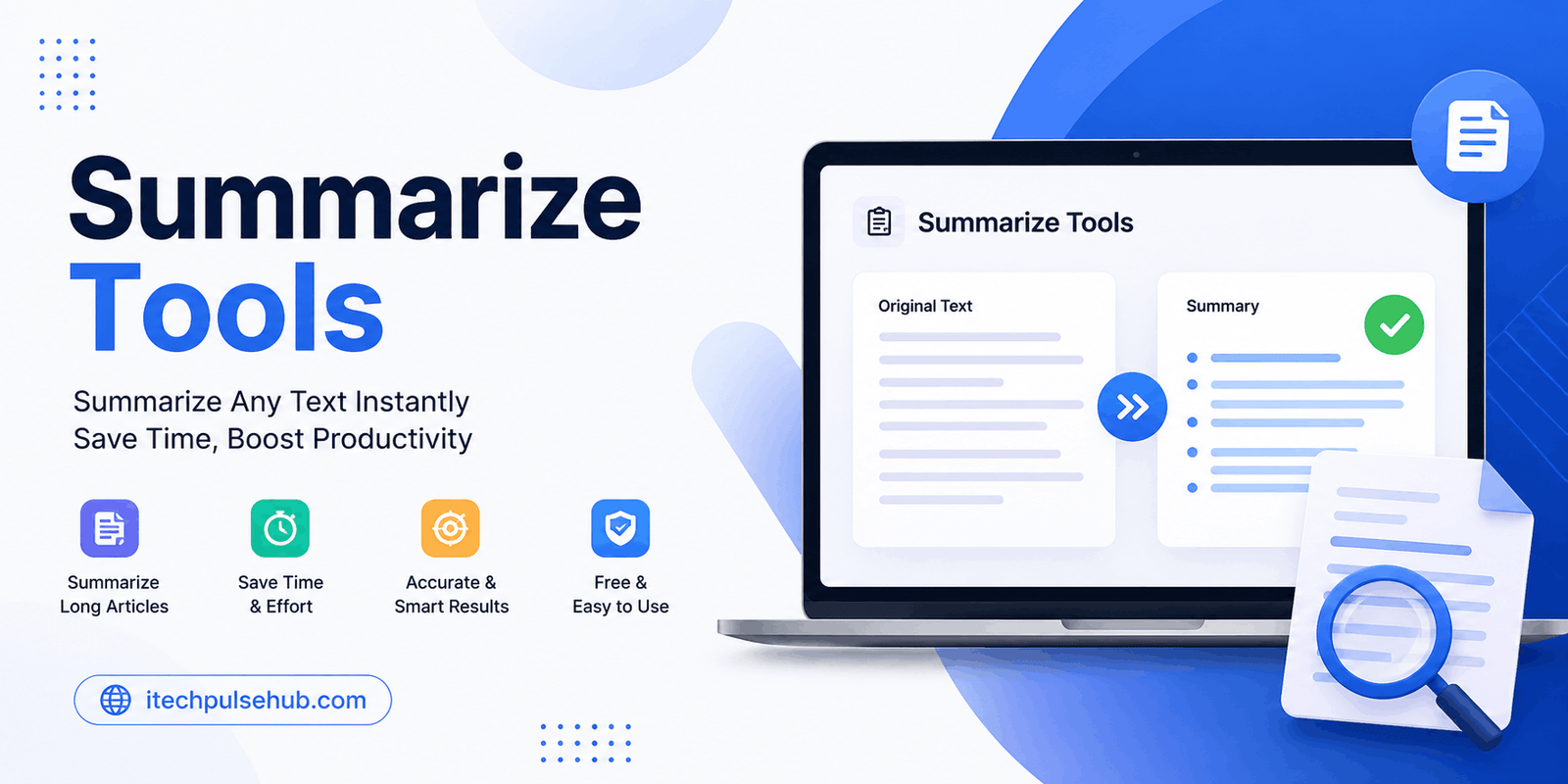
Summarize tools are software applications or online platforms designed to take a large piece of text — such as an article, essay, research paper, or even an entire book — and condense it into a shorter version while retaining the most important information. The goal is simple: save time without sacrificing understanding.
These tools range from simple algorithms that extract key sentences to sophisticated artificial intelligence systems capable of understanding context, tone, and meaning to generate entirely new, coherent summaries. Some tools work with plain text, while others can summarize PDFs, web pages, YouTube videos, and even audio recordings.
How Do Summarize Tools Work?
There are generally two main approaches that summarize tools use to condense content:
1. Extractive Summarization
Extractive summarization works by scanning the original text, identifying the most important sentences or phrases, and then pulling them out to form a summary. This method does not create new sentences; it simply selects existing ones based on factors like word frequency, sentence position, and relevance to the overall topic. Extractive tools are fast and tend to preserve the original wording, but the resulting summary can sometimes feel choppy or disconnected since it’s essentially a collection of borrowed sentences.
2. Abstractive Summarization
Abstractive summarization, on the other hand, is a more advanced technique that relies on natural language processing and machine learning models. Instead of copying sentences directly from the source, these tools understand the meaning of the text and generate brand-new sentences that capture the core ideas. This approach produces summaries that read more naturally and are often shorter and clearer than extractive summaries. Most modern AI-powered summarize tools, especially those built on large language models, use this abstractive method.
Why Summarize Tools Matter
The importance of summarize tools cannot be overstated in today’s fast-paced digital environment. Here are some of the key reasons why these tools have become so popular:
Time Efficiency: The most obvious benefit is time saved. Instead of reading a ten-page report, you can get the key points in a fraction of the time.
Improved Comprehension: Summaries can help readers grasp the main ideas before diving into the full text, making the actual reading process more efficient and focused.
Better Decision Making: Professionals who need to review multiple documents quickly can make faster, more informed decisions when they have concise summaries at hand.
Accessibility: Summarize tools make dense academic or technical material more accessible to people who may not have the time or background knowledge to digest lengthy content in its original form.
Content Curation: Content creators, marketers, and researchers often use summarize tools to quickly review sources before citing or referencing them in their own work.
Types of Summarize Tools
There is no shortage of summarize tools available today, each catering to different needs. Here are some of the most common categories:
Text Summarizers
These are the most basic and widely used tools. You paste in a block of text, and the tool returns a condensed version. Many of these tools also allow you to adjust the summary length, choosing between a short, medium, or detailed summary depending on your needs.
Document and PDF Summarizers
These tools go a step further by allowing users to upload entire documents, including PDFs, Word files, and even scanned images. They extract the text first and then apply summarization algorithms to generate a concise overview of the whole document.
Web Article Summarizers
Some tools work as browser extensions or standalone platforms that summarize online articles and blog posts directly from a URL. This is particularly useful for people who want to quickly evaluate whether an article is worth reading in full.
Video and Audio Summarizers
With the rise of video content, especially on platforms like YouTube, video summarization tools have become increasingly popular. These tools transcribe spoken content and then summarize it into text, allowing users to get the key takeaways from a video without watching the entire thing.
AI Chatbot-Based Summarizers
Modern AI assistants can also serve as powerful summarize tools. Users can simply paste text or upload a document and ask the AI to summarize it, often with the ability to customize tone, length, and focus areas in real time.
Benefits of Using Summarize Tools
The advantages of incorporating summarize tools into your daily routine are numerous:
- Saves valuable time that can be redirected toward deeper analysis or other tasks.
- Reduces information overload, helping users focus only on what truly matters.
- Enhances productivity for students, researchers, and professionals alike.
- Improves retention since concise summaries are often easier to remember than lengthy texts.
- Supports multitasking, allowing users to quickly review multiple sources in a short period.
Limitations to Keep in Mind
While summarize tools offer tremendous value, they are not without their drawbacks. It is important to be aware of these limitations before relying on them completely.
Loss of Nuance: Summarization inevitably involves cutting out details, which means some nuance, tone, or contextual information may be lost in the process.
Accuracy Concerns: Not all tools are equally reliable. Poorly designed summarizers may misinterpret the source material, leading to summaries that are misleading or inaccurate.
Over-Reliance Risk: Depending too heavily on summaries without ever engaging with the original material can limit critical thinking and deeper understanding of complex topics.
Formatting Challenges: Some tools struggle with documents that contain tables, charts, or complex formatting, which can lead to summaries that miss important data points.
How to Choose the Right Summarize Tool
With so many options available, choosing the right summarize tool depends on your specific needs. Here are a few factors to consider:
- Purpose: Are you summarizing academic papers, business reports, news articles, or videos? Choose a tool designed for your specific content type.
- Accuracy: Look for tools that are known for producing coherent, accurate summaries rather than simply extracting random sentences.
- Customization: The ability to adjust summary length and focus is a valuable feature, especially for more complex documents.
- File Support: If you frequently work with PDFs, Word documents, or other file types, make sure the tool supports these formats.
- Privacy: If you are summarizing sensitive or confidential documents, check the tool’s privacy policy to ensure your data is handled securely.
The Future of Summarize Tools
As artificial intelligence continues to evolve, summarize tools are only going to become more sophisticated. Future tools are likely to offer even more personalized summaries, tailored to the reader’s background knowledge, interests, and reading goals. We can also expect better multi-language support, deeper integration with productivity apps, and improved handling of complex documents containing charts, tables, and technical jargon.
The rise of large language models has already dramatically improved the quality of abstractive summarization, and this trend is expected to continue as these models become more capable of understanding context, tone, and subtle meaning within text.
Final Thoughts
Summarize tools have become indispensable in a world overflowing with information. From students and researchers to business professionals and casual readers, these tools help people save time, boost productivity, and stay informed without becoming overwhelmed. While they are not a perfect substitute for deep, careful reading, they serve as an incredibly useful starting point for understanding large volumes of content quickly and efficiently.
As technology continues to advance, we can expect summarize tools to become even smarter, more accurate, and more tailored to individual needs, making them an even more valuable part of our daily digital toolkit.