
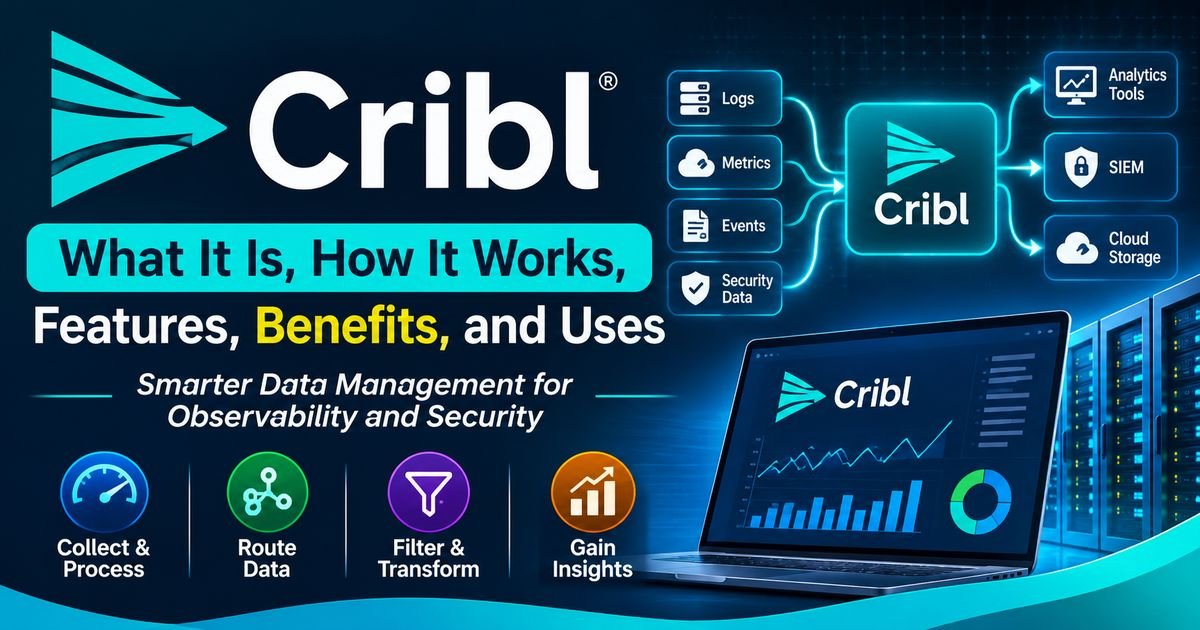
Cribl: What It Is, How It Works, Features, Benefits, and Use Cases
Introduction
Cribl is a modern data management and observability platform designed to help organizations collect, process, route, and manage large volumes of machine-generated data. Businesses depend on information from servers, applications, cloud environments, security systems, networks, and other technology infrastructure. Managing all this information can become complicated, especially when data comes from different sources and needs to reach multiple monitoring or security tools.
Cribl helps solve this challenge by providing technologies that give organizations greater control over their data before it reaches its final destination. Instead of sending every event directly to a monitoring platform, companies can use Cribl to organize, filter, transform, enrich, and route information according to their requirements.
The platform is particularly relevant to organizations working with observability, cybersecurity, IT operations, and large-scale data environments. These teams often handle enormous amounts of logs, metrics, events, and other telemetry information. Without an effective data management strategy, storing and analyzing this information can become expensive and difficult.
One of Cribl’s important capabilities is its observability pipeline technology. It allows businesses to manage data movement between different sources and destinations while maintaining control over the information being processed.
Cribl also offers solutions for collecting data from distributed systems, searching information, and managing telemetry storage. These capabilities can help organizations improve visibility into their infrastructure and make better decisions about how they use their data.
In this guide, we explore what Cribl is, how it works, its major products, important features, advantages, limitations, practical applications, and how businesses can use it to improve their data operations.
What Is Cribl?
Cribl is a technology company that develops data infrastructure software for observability and security operations. Its platform helps organizations manage machine-generated information from different environments.
Machine-generated data is information automatically produced by computers, applications, devices, and network systems. Examples include server logs, application events, authentication records, performance measurements, security alerts, and network activity information.
Organizations use this information to understand what is happening inside their technology environments.
However, collecting data is only one part of the process. Businesses also need to decide which information is important, where it should be stored, how it should be formatted, and which tools should receive it.
Cribl provides technologies that help manage these activities.
Its solutions can support data collection, processing, routing, search, and storage workflows. This gives organizations more flexibility when working with different observability and security products.
Cribl is especially useful for companies that operate complex IT environments with multiple data sources and destinations.
For example, a company might collect information from cloud servers, employee devices, web applications, and security systems. Different teams may need access to different parts of that information.
Cribl can help organize these data flows so that the right information reaches the appropriate systems.
Understanding Cribl’s Main Purpose
The main purpose of Cribl is to help organizations manage their machine data more efficiently.
Traditional data environments sometimes send every available event directly to a monitoring or analytics platform. This approach can create unnecessary storage requirements and increase processing costs.
Not every event has the same business value. Some information is important for immediate security investigations, while other information may only be needed for occasional analysis.
Cribl helps organizations create more flexible data management processes.
Managing Large Data Volumes
Modern businesses generate information continuously.
Cloud applications, employee devices, databases, network equipment, and security tools can produce millions of events.
Handling this information requires systems that can process data reliably.
Cribl provides technologies that help organizations manage these large data volumes.
Improving Data Quality
Data collected from different systems may have different structures, formats, and levels of detail.
This can make analysis more complicated.
Cribl can transform and enrich supported data before forwarding it to another destination.
Controlling Data Movement
Different departments may use different monitoring and security platforms.
Cribl helps manage the movement of information between these systems.
Organizations can create routing rules based on their operational requirements.
Supporting Observability
Observability involves understanding the internal condition of a system by examining information it produces.
Logs, metrics, and traces are commonly used to investigate application performance and infrastructure behavior.
Cribl supports the data workflows that make this information available to observability tools.
How Does Cribl Work?
Cribl works by providing a layer between data sources and the systems that receive or analyze information.
This layer is often described as an observability pipeline.
A typical workflow begins when an organization collects data from different sources. That information is then processed according to configured rules before being forwarded to one or more destinations.
The exact process depends on the Cribl product, configuration, and infrastructure.
Step 1: Collect Data
The first stage involves receiving information from supported data sources.
These sources may include:
- Cloud infrastructure.
- Applications and databases.
- Operating systems.
- Network devices.
- Security products.
- Containers and Kubernetes environments.
- Servers and endpoints.
- Monitoring applications.
The available collection methods depend on the source and integration being used.
Step 2: Process Incoming Information
After receiving data, Cribl can apply processing rules.
These rules may identify relevant events, change data structures, remove unnecessary fields, or prepare information for another system.
For example, an organization might receive application logs containing several fields that are not useful for its monitoring requirements.
A processing workflow can help remove unnecessary information while retaining important details.
Step 3: Transform and Enrich Data
Different applications may expect information in different formats.
Cribl can transform supported events into structures that are more suitable for downstream systems.
Data enrichment can also add useful context.
For example, an event may contain an internal device identifier. A processing workflow could add additional information that helps an analyst understand which system generated the event.
Step 4: Route Data
After processing, information can be directed toward configured destinations.
These destinations may include observability platforms, security analytics tools, storage systems, and other supported services.
Routing rules allow organizations to decide where particular information should go.
Step 5: Analyze and Use Information
Once data reaches its destination, teams can use their preferred tools to search, monitor, investigate, and analyze it.
The purpose of the pipeline is to make data more useful before it reaches those systems.
Main Cribl Products
Cribl provides several products designed for different parts of the data management process.
Understanding these products helps explain how the platform supports observability and security operations.
1. Cribl Stream
Cribl Stream is one of the company’s best-known products. It provides observability pipeline capabilities that help organizations collect, process, transform, and route machine-generated data.
It gives teams control over how information moves between sources and destinations.
Data Routing
Cribl Stream allows organizations to create routing rules for supported data sources and destinations.
For example, security-related events may need to reach a security analytics platform, while application performance information may be directed to an observability system.
This separation helps different teams receive the information they need.
Data Filtering
Filtering helps organizations control which information continues through a pipeline.
Some events may not be relevant to a particular monitoring workflow.
Removing unnecessary information can reduce the amount of data sent to downstream platforms.
However, filtering rules should be designed carefully so that important information is not accidentally excluded.
Data Transformation
Cribl Stream can modify supported data structures.
This is useful when information arrives in a format that does not match the requirements of its destination.
Data Enrichment
Organizations can add contextual information to events.
Additional context can help security analysts and IT professionals understand the origin and meaning of an event.
Multi-Destination Routing
A single data workflow may need to send information to different systems.
Cribl Stream supports routing approaches that allow organizations to manage multiple destinations according to their configurations.
This can be helpful when security, operations, and engineering teams use separate platforms.
2. Cribl Edge
Cribl Edge focuses on collecting and managing data from distributed environments.
Organizations often operate infrastructure across different locations, including remote offices, cloud platforms, servers, and employee endpoints.
Collecting information from these environments can be challenging.
Cribl Edge provides capabilities for managing telemetry collection closer to where information is generated.
Distributed Data Collection
Cribl Edge can help collect supported information from different machines and infrastructure environments.
This is useful for businesses with large technology environments.
Local Processing
Processing information closer to its source can support more flexible data collection workflows.
Organizations can apply appropriate configurations before data moves through the wider infrastructure.
Endpoint Visibility
Distributed endpoints can generate useful operational and security information.
Cribl Edge helps organizations manage supported telemetry from these environments.
Centralized Management
Teams can manage supported Edge deployments through the Cribl environment.
The exact management capabilities depend on the deployment model and product configuration.
3. Cribl Search
Cribl Search provides capabilities for searching and investigating machine-generated information across supported data sources.
Organizations often need to investigate events that have already occurred.
For example, a security team might want to understand what happened before a suspicious login or an unexpected application error.
Search capabilities help analysts explore relevant information.
Searching Operational Data
IT professionals can investigate logs and other supported information to understand application or infrastructure behavior.
Security Investigations
Security teams may need to examine historical events while investigating suspicious activity.
Search tools can help them identify relevant records and understand event relationships.
Flexible Data Investigation
Different teams may need to examine information from different sources.
Cribl Search helps support these investigation workflows without requiring every question to begin with a traditional dashboard.
Availability and supported source integrations depend on the product environment.
4. Cribl Lake
Cribl Lake is designed to help organizations manage and store machine data for later access and analysis.
Storing every event in an expensive analytics platform may not be suitable for every organization.
Some information needs immediate analysis, while other information may be retained for future investigations or compliance requirements.
Cribl Lake provides a data lake approach for supported telemetry storage workflows.
Centralized Data Storage
Organizations can use a centralized storage approach for supported data.
This can make it easier to manage information collected from different systems.
Historical Data Access
Historical information may become important when investigating older security events or understanding long-term infrastructure changes.
A suitable storage strategy helps organizations retain information according to their requirements.
Flexible Data Management
Different data types may have different storage and access needs.
Organizations can design storage workflows around their operational requirements.
Important Features of Cribl
Cribl provides several capabilities that make it useful for organizations handling large amounts of telemetry information.
1. Observability Pipelines
Observability pipelines are central to Cribl’s platform.
They provide a way to manage information between data-generating systems and the applications that analyze it.
Instead of connecting every source directly to every destination, organizations can use a managed pipeline.
This can simplify complicated data environments.
2. Data Reduction
Large amounts of machine-generated information can increase storage and processing expenses.
Cribl provides processing capabilities that can help organizations reduce unnecessary data before forwarding it.
For example, repeated or low-value events may not need to reach every destination.
Data reduction should always follow business and security requirements.
3. Flexible Data Routing
Different types of information can be directed to different destinations.
This allows organizations to create data flows that match their operational needs.
For example, application logs may go to an observability platform, while selected security events are forwarded to a security monitoring system.
4. Data Transformation
Cribl can help prepare information for systems that expect particular formats.
Transformation capabilities can improve compatibility between different tools.
5. Data Enrichment
Adding context to machine data can improve its usefulness.
An event containing a device identifier, for example, may become easier to investigate when additional device information is available.
6. Integration Capabilities
Organizations rarely use only one technology platform.
Cribl is designed to work with a range of supported sources and destinations.
This flexibility can help businesses connect existing infrastructure without immediately replacing their established tools.
7. Centralized Configuration
Managing data workflows across a large environment can become complicated.
Cribl provides management capabilities that help teams organize supported configurations and deployments.
8. Scalability
Large organizations may generate substantially more telemetry than smaller businesses.
Cribl’s architecture and deployment options are designed to support different operational requirements.
Actual capacity depends on infrastructure, configuration, workload, and licensing.
9. Monitoring and Troubleshooting
Data pipelines need to operate reliably.
Teams must understand whether information is being collected, processed, and delivered correctly.
Cribl provides operational capabilities that help users manage and troubleshoot supported workflows.
10. Security Data Management
Security teams depend on information from many different sources.
Cribl can help prepare and route relevant security information to supported analysis platforms.
This can improve the organization of security data workflows.
Cribl for Cybersecurity
Cybersecurity is one of the important areas where Cribl can provide value.
Organizations use security tools to monitor networks, applications, endpoints, and user activities.
These systems generate large volumes of information that security teams need to review.
Cribl can help manage this information before it reaches security analytics platforms.
Security Log Management
Security logs provide records of activities performed across an IT environment.
They may contain authentication events, access attempts, application activities, and other operational details.
Cribl can help collect and route supported security logs.
Security Information and Event Management
Security Information and Event Management platforms, commonly known as SIEM systems, analyze security-related events.
They help security professionals identify suspicious patterns and investigate potential incidents.
Cribl can operate as a data management layer that prepares selected information for SIEM destinations.
Reducing Unnecessary Security Data
Not every event needs to be sent to every security platform.
Organizations can use appropriate processing and filtering rules to control data volumes.
However, important security records should not be discarded simply to reduce costs.
Supporting Investigations
Security investigations often require information from multiple systems.
A well-designed data pipeline can make relevant information available to the appropriate analysis tools.
Cribl for IT Operations
IT operations teams are responsible for keeping technology infrastructure available and functioning properly.
They monitor servers, applications, databases, networks, and cloud services.
Cribl can support these activities by helping manage operational telemetry.
Application Monitoring
Applications generate logs that describe errors, requests, performance conditions, and other activities.
Cribl can help prepare and route supported application information to monitoring platforms.
Infrastructure Visibility
Servers and network systems produce information that helps IT teams understand their operational condition.
Managing these data flows can improve visibility across an organization’s infrastructure.
Troubleshooting
When an application stops working correctly, IT professionals often examine logs and events to identify the cause.
Cribl can help organize the information that reaches their investigation tools.
Cloud Operations
Businesses increasingly use cloud infrastructure.
These environments produce large amounts of telemetry.
Cribl can help organizations manage supported data from cloud-based systems.
Cribl and Observability
Observability is the ability to understand a system’s internal state through the information it produces.
It is particularly important for complex applications and distributed infrastructure.
Three common types of observability data are logs, metrics, and traces.
Logs
Logs are records of events generated by applications and systems.
They can help explain what happened at a particular time.
For example, an application log may contain information about an unsuccessful request.
Metrics
Metrics are numerical measurements that describe system behavior.
Examples include processor usage, memory consumption, response time, and network activity.
These measurements help teams monitor performance trends.
Traces
Traces help show how requests move through different components of an application.
They are particularly useful in distributed systems where a single request may involve multiple services.
Why Data Preparation Matters
Observability platforms work more effectively when incoming information is relevant and properly structured.
Cribl can help prepare supported telemetry before it reaches those platforms.
This gives organizations greater control over their observability workflows.
Benefits of Using Cribl
Cribl offers several potential advantages for businesses that manage complex data environments.
Better Data Control
Organizations can define how supported information is collected, processed, and delivered.
This creates more flexibility than sending all data directly to individual destinations.
Potential Cost Reduction
Processing and filtering unnecessary data can reduce the amount of information sent to certain storage and analytics systems.
This may help lower costs associated with data ingestion and retention.
Actual savings depend on existing infrastructure and licensing arrangements.
Improved Operational Efficiency
A centralized pipeline approach can simplify complicated integrations.
Teams may spend less time managing separate data connections.
Greater Flexibility
Organizations can change data destinations and processing rules as their requirements evolve.
This can help them adapt to new monitoring and security platforms.
Improved Data Quality
Transformation and enrichment can make information more consistent and useful.
Support for Multiple Teams
Security, engineering, and IT operations teams may have different information requirements.
Cribl can help organize data delivery for these different groups.
Better Infrastructure Visibility
Managing telemetry across distributed systems can help organizations maintain a clearer understanding of their technology environments.
Potential Challenges and Limitations of Cribl
Although Cribl provides useful capabilities, organizations should understand the challenges involved in implementing and maintaining it.
Initial Configuration
Setting up an observability pipeline requires planning.
Teams must understand their data sources, destinations, processing requirements, and operational objectives.
A poorly designed configuration can create unnecessary complexity.
Technical Knowledge
Cribl is primarily designed for technical environments.
Users may need experience with data formats, networking, system administration, and observability concepts.
Integration Planning
Organizations may use a wide variety of technology products.
Before deployment, they should confirm that the required sources and destinations are supported.
Ongoing Maintenance
Data pipelines require monitoring and maintenance.
Applications change, infrastructure expands, and data formats may evolve.
Teams need to review configurations regularly.
Licensing and Costs
Cribl’s commercial offerings and pricing arrangements can depend on the selected products, usage, and business requirements.
Organizations should evaluate the total cost before choosing a deployment.
Data Governance
Filtering and transforming information requires careful planning.
Organizations must consider privacy, compliance, security, and data retention obligations.
Removing important information may create problems during future investigations.
Cribl vs Traditional Data Management Approaches
Traditional data management environments often connect information sources directly to monitoring and analytics platforms.
This approach can work for smaller environments.
However, it may become difficult to manage when organizations use many sources and destinations.
Cribl introduces an additional data management layer.
Traditional Approach
In a traditional environment, applications and infrastructure may send information directly to their respective monitoring tools.
When organizations add new destinations, they may need to create additional integrations.
Pipeline-Based Approach
With Cribl, organizations can manage supported data flows through configured pipelines.
This can provide more centralized control over processing and routing.
Flexibility
A pipeline approach can make it easier to adjust where selected information is delivered.
Operational Considerations
Adding a pipeline also introduces another component that needs configuration, monitoring, and maintenance.
Businesses should evaluate whether the flexibility it provides justifies the additional infrastructure and operational requirements.
Common Use Cases of Cribl
Cribl can support different business scenarios involving machine-generated information.
1. Enterprise Log Management
Large companies generate logs from thousands of systems.
Cribl can help collect and route supported information to appropriate destinations.
2. Security Monitoring
Security teams can use Cribl to prepare and deliver relevant events to security analytics platforms.
3. Cloud Infrastructure Monitoring
Cloud environments generate information about applications, resources, and system activity.
Cribl can help manage supported cloud telemetry.
4. Application Performance Monitoring
Development teams need information about application errors, response times, and service behavior.
Cribl can help organize relevant data flows.
5. Data Routing Between Platforms
Companies sometimes use several observability products.
Cribl can help direct different information to the appropriate tools.
6. Historical Data Management
Organizations may need to retain information for future analysis.
Cribl Lake can support suitable data storage workflows.
7. Distributed Infrastructure
Businesses with remote locations and distributed endpoints may need a flexible collection strategy.
Cribl Edge can help support these environments.
8. Compliance and Auditing
Some industries need to maintain records of system activity.
Cribl can help manage supported information flows, but organizations must configure retention and access controls according to applicable compliance requirements.
Who Should Use Cribl?
Cribl is generally most relevant to organizations that handle substantial volumes of machine-generated information.
It may be particularly useful for the following groups.
Large Enterprises
Large companies often operate complicated technology environments.
They may have multiple monitoring tools, security platforms, and data sources.
Cribl can help organize these environments.
Cybersecurity Teams
Security professionals can use supported Cribl capabilities to manage security telemetry and prepare information for analysis.
IT Operations Teams
IT teams responsible for servers, applications, and networks may benefit from better data routing and processing.
Cloud Engineers
Cloud engineers can use observability pipelines to manage supported information from distributed environments.
DevOps Professionals
DevOps teams depend on logs, metrics, and traces to understand application behavior.
Cribl can support their data management workflows.
Managed Service Providers
Service providers that manage infrastructure for multiple customers may find data pipeline capabilities useful for organizing supported telemetry environments.
How to Get Started With Cribl
Organizations interested in Cribl should begin by understanding their data management requirements.
A clear implementation plan can make deployment easier.
Step 1: Identify Data Sources
List the systems generating information.
These may include servers, applications, databases, cloud platforms, network devices, and security products.
Step 2: Identify Data Destinations
Determine which systems need to receive the information.
Examples include observability platforms, SIEM products, and storage environments.
Step 3: Understand Data Requirements
Different teams may need different information.
Identify which events are essential, which fields need transformation, and which records require long-term retention.
Step 4: Select the Appropriate Cribl Product
Review the available Cribl products and select the capabilities that match your requirements.
For example, Stream is relevant to observability pipelines, while Edge focuses on distributed collection.
Step 5: Design the Pipeline
Create a plan for how information will move through the environment.
Consider filtering, transformation, enrichment, routing, and error handling.
Step 6: Test the Configuration
Test data flows before using them in important production environments.
Confirm that required information reaches the correct destinations.
Step 7: Monitor and Maintain
Review pipeline performance and update configurations as the environment changes.
Regular maintenance helps maintain reliable operations.
Is Cribl Suitable for Small Businesses?
Cribl can be useful for organizations of different sizes, but its value depends on the amount and complexity of their data.
A small business with only a few applications may not need an advanced observability pipeline.
Its existing monitoring tools may already provide sufficient functionality.
However, a smaller company operating several cloud services, security systems, and distributed applications may benefit from centralized data management.
Businesses should evaluate their actual requirements rather than adopting a platform simply because it offers advanced capabilities.
Cribl and Data Privacy
Data privacy is an important consideration when managing machine-generated information.
Logs and events may contain sensitive information, including usernames, device identifiers, network details, and other operational records.
Organizations should understand what their data contains before sending it to external systems.
Sensitive Information
Teams should identify sensitive fields and determine whether they need masking, removal, or other protection measures.
Access Management
Only authorized personnel should have access to sensitive information and pipeline configurations.
Data Retention
Organizations should establish appropriate retention periods for different types of information.
Compliance Requirements
Businesses should review applicable privacy and regulatory requirements before implementing data collection and storage workflows.
Cribl provides data management capabilities, but organizations remain responsible for configuring their systems appropriately.
Cribl’s Role in the Future of Data Management
The amount of machine-generated information continues to grow as businesses adopt cloud services, connected devices, distributed applications, and artificial intelligence technologies.
This growth creates new challenges for data collection, storage, analysis, and security.
Organizations need flexible infrastructure that can manage information across different systems.
Observability pipelines are becoming an important part of this process because they provide greater control over data before it reaches analytics platforms.
Cribl operates in this area by developing technologies for data processing, routing, collection, and search.
Artificial intelligence may also increase the importance of efficient data management.
AI applications often depend on reliable information from different sources.
Organizations need to understand which information is useful, how it should be prepared, and where it should be made available.
Cribl’s data infrastructure capabilities are relevant to these broader technology developments.
However, the effectiveness of any data platform depends on its implementation, integrations, security controls, and suitability for the organization’s requirements.
Frequently Asked Questions About Cribl
1. What Is Cribl Used For?
Cribl is used to collect, process, transform, route, search, and manage machine-generated data. Organizations use its products to support observability, cybersecurity, and IT operations.
2. Is Cribl a Software Platform?
Yes. Cribl develops software products designed to help organizations manage data infrastructure and observability workflows.
3. What Is Cribl Stream?
Cribl Stream is an observability pipeline product that helps collect, process, transform, and route supported machine-generated information.
4. What Is Cribl Edge?
Cribl Edge focuses on collecting and managing telemetry from distributed environments, including supported endpoints and infrastructure.
5. What Is Cribl Search?
Cribl Search provides capabilities for searching and investigating supported machine-generated data across available sources.
6. What Is Cribl Lake?
Cribl Lake is a data lake offering designed to help organizations store and manage supported telemetry information for access and analysis.
7. Is Cribl Used for Cybersecurity?
Yes. Cribl can support cybersecurity workflows by helping organizations collect, process, and route security-related information to supported analysis platforms.
8. Can Cribl Reduce Data Costs?
Cribl can help organizations reduce unnecessary data volumes through appropriate filtering and processing. Potential savings depend on data usage, platform pricing, and implementation.
9. Does Cribl Replace SIEM Tools?
Cribl is not simply a replacement for SIEM platforms. It can work alongside security analytics products by preparing and routing relevant information to them.
10. Is Cribl Suitable for Cloud Environments?
Cribl supports data management workflows involving supported cloud infrastructure and applications. Organizations should review the relevant integrations before deployment.
11. Does Cribl Support Multiple Data Sources?
Yes. Cribl is designed to work with a range of supported data sources and destinations. Available integrations depend on the product and configuration.
12. Is Cribl Difficult to Learn?
The difficulty depends on the user’s technical background. People familiar with logs, networking, data formats, and observability concepts may find it easier to understand.
13. Who Developed Cribl?
Cribl is developed by Cribl, a technology company focused on data infrastructure and observability solutions.
14. Can Small Businesses Use Cribl?
Yes, depending on their requirements. However, smaller organizations should evaluate whether their data volumes and infrastructure complexity justify using an advanced data management platform.
15. What Is an Observability Pipeline?
An observability pipeline is a system that collects, processes, transforms, and routes telemetry data before it reaches monitoring or analytics tools.
16. Does Cribl Store Data?
Cribl offers different data management capabilities, including Cribl Lake for supported storage workflows. Storage functionality depends on the selected product and configuration.
17. Is Cribl Free?
Cribl offers different product and licensing options. Availability, free usage limits, and commercial pricing can change, so users should consult the official Cribl website for current details.
Final Thoughts
Cribl is an important platform in the modern data infrastructure and observability market. It helps organizations manage the growing amount of information generated by applications, servers, cloud environments, security systems, and network devices.
Its products address different parts of the data management process. Cribl Stream provides observability pipeline capabilities, Cribl Edge supports distributed data collection, Cribl Search helps investigate information, and Cribl Lake provides a data lake approach to telemetry storage.
These technologies can help organizations improve data quality, control information movement, simplify integrations, and manage operational requirements.
Cribl is particularly relevant to cybersecurity professionals, IT operations teams, cloud engineers, and businesses with complex technology environments.
However, successful implementation requires careful planning, technical knowledge, appropriate security controls, and ongoing maintenance.
For organizations dealing with large volumes of machine-generated data, Cribl offers a flexible approach to managing information and connecting different technology platforms. Understanding its products and capabilities can help businesses decide whether it is the right solution for their observability and data management needs.