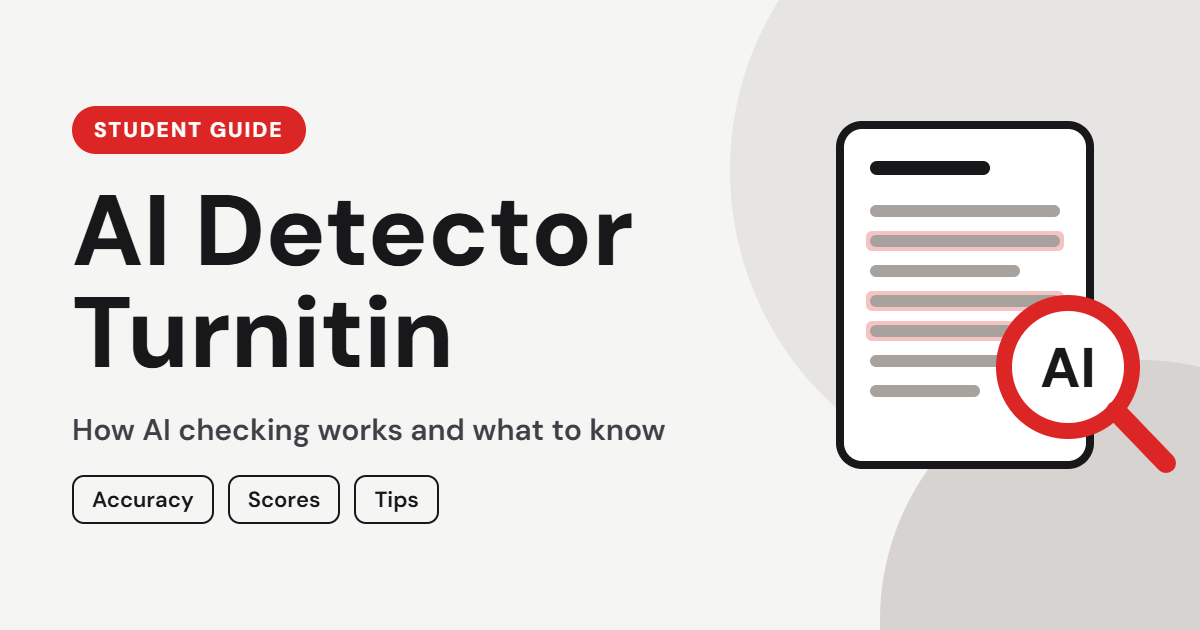
AI Detector Turnitin: A Complete Guide to AI Writing Detection
Introduction
Artificial intelligence has changed the way people write, research, and create digital content. Students, teachers, researchers, and professional writers increasingly use AI-powered tools to complete writing tasks, improve grammar, organize ideas, and produce information. Although these technologies offer many benefits, they have also created questions about originality, academic honesty, and the difference between human-written and AI-generated content. This is where AI detection technology becomes important.
Turnitin is one of the well-known platforms used by educational institutions to review academic writing and identify potential originality concerns. Its AI writing detection feature is designed to help educators understand whether certain parts of a submitted document may have been generated using artificial intelligence. However, understanding how the system works is essential before interpreting its results.
An AI detector is not the same as a traditional plagiarism checker. Plagiarism detection focuses on identifying matching text from existing sources, while AI writing detection examines language patterns that may be associated with AI-generated content. These technologies serve different purposes, even though some platforms provide both features.
This guide explains AI Detector Turnitin, its main features, how AI writing detection works, its potential benefits, limitations, and responsible uses. It also explores why AI detection results should be reviewed carefully instead of being treated as final proof of how a document was written.
What Is AI Detector Turnitin?
Turnitin is an academic integrity platform that provides tools for reviewing written assignments, checking similarities, and supporting educational assessment. Its AI writing detection feature helps educators identify text that may have been generated by artificial intelligence.
The purpose of this technology is to provide additional information during the evaluation of academic work. Teachers can use the available results as one part of a broader review process when considering whether an assignment follows their institution’s academic integrity policies.
AI Detector Turnitin is particularly relevant because generative AI tools can produce essays, reports, summaries, and other forms of written content. These tools can create fluent sentences within seconds, making it increasingly important for educational institutions to understand how AI may be used in academic environments.
However, an AI detection result does not automatically establish that a student has violated academic rules. The system provides an indication based on its analysis, and educators must consider the complete situation before making decisions.
How Does Turnitin AI Detection Work?
AI writing detection uses computational methods to examine different characteristics of written language. These characteristics may include sentence structure, linguistic patterns, predictability, and other statistical signals.
AI-generated writing can sometimes contain patterns that differ from those commonly found in human writing. Detection systems are developed to recognize certain patterns and estimate whether portions of a document resemble AI-generated text.
Turnitin’s AI detection technology analyzes eligible submitted documents and identifies passages that its system considers potentially AI-generated. The resulting information is presented through an AI writing indicator or report, depending on the institution’s configuration and available features.
It is important to understand that AI writing detection is not a perfect science. Human writing can sometimes resemble machine-generated language, while AI-generated writing can contain characteristics that make reliable classification difficult.
For this reason, detection results should always be interpreted with care.
Main Features of Turnitin AI Detector
Turnitin provides several features that support academic writing reviews. The exact features available depend on an institution’s subscription, configuration, and product version.
1. AI Writing Detection
AI writing detection is one of the platform’s important features. It helps educators identify passages that may have been generated using supported artificial intelligence writing systems.
The feature is intended to support academic discussions about responsible AI use. Rather than replacing teachers, it provides additional information that can help them review submitted assignments.
2. Similarity Checking
Turnitin is widely recognized for its similarity checking capabilities. The system compares submitted writing with content available in its comparison databases.
These databases may include academic publications, websites, and previously submitted student papers, depending on the institution’s access and settings.
A similarity score represents matching text, not necessarily plagiarism. Properly quoted material, references, and commonly used phrases can also contribute to similarity results.
3. Detailed Reports
Turnitin provides reports that help educators examine different aspects of submitted work.
Depending on the enabled features, a report may include similarity information, matching sources, and AI writing indicators.
These reports make it easier to review documents systematically instead of relying only on a single percentage.
4. Academic Integrity Support
Academic integrity involves honesty, transparency, and responsible research practices.
Turnitin supports educational institutions by providing information that can help teachers evaluate written assignments. It can also encourage conversations about appropriate AI usage, citation practices, and original research.
5. Educational Institution Integration
Turnitin is commonly integrated into learning management systems and institutional assignment workflows.
This allows students to submit their work through supported educational platforms while teachers review the resulting reports.
The available integration options depend on the institution’s subscription and technical environment.
AI Detection vs. Plagiarism Detection
AI detection and plagiarism detection are two different technologies. Understanding this distinction helps prevent confusion when reviewing an academic report.
Plagiarism detection focuses on identifying similarities between a submitted document and existing content. It may find matching sentences, paragraphs, or phrases from other sources.
AI detection, on the other hand, attempts to identify linguistic patterns that may be associated with AI-generated writing.
For example, a student could write an entirely original paragraph that shares similarities with an existing online source. A similarity checker may identify the matching language.
Similarly, an AI-generated paragraph might contain original wording that does not match any existing source. A plagiarism checker may not identify a match, while an AI detector could still flag the passage for further review.
Neither result should be interpreted without examining the actual document and its context.
Why Do Schools Use Turnitin AI Detector?
Educational institutions use academic integrity tools to maintain consistent standards for written assignments.
Students are generally expected to demonstrate their understanding of course material, conduct appropriate research, and follow instructions provided by their teachers.
AI writing tools have introduced new challenges because they can generate complete drafts, explanations, and summaries. Institutions therefore need clear policies explaining which uses are acceptable.
Turnitin’s AI detection feature can support these policies by giving educators additional information about submitted work.
Schools and universities may use the technology for several reasons:
- Supporting academic integrity policies.
- Encouraging original research and independent thinking.
- Reviewing potentially AI-generated passages.
- Helping teachers discuss responsible AI use.
- Improving awareness of writing and citation standards.
- Supporting consistent assignment evaluation.
The technology is most useful when combined with clear academic policies and fair review procedures.
Is Turnitin AI Detector Accurate?
Accuracy is one of the most important questions surrounding AI writing detection.
No AI detector can guarantee a correct result in every situation. Natural language is complex, and different people can write in similar styles. AI-generated content can also vary significantly depending on the model, instructions, editing, and subject matter.
Turnitin’s detection technology is designed to identify certain patterns associated with AI-generated writing. However, its results should not be considered absolute proof.
There are several reasons why AI detection can be challenging.
First, some human writers naturally use predictable sentence structures and formal language. This can sometimes create patterns that resemble AI-generated writing.
Second, AI writing systems continue to improve. Their outputs can vary in vocabulary, sentence length, organization, and tone.
Third, documents may contain a combination of human-written and AI-assisted material. A single document can therefore include several different writing styles.
Finally, short documents and unusual writing formats may provide limited information for reliable analysis.
For these reasons, teachers should review the writing itself, assignment requirements, research sources, and relevant institutional policies before reaching a conclusion.
What Does the Turnitin AI Writing Percentage Mean?
Turnitin’s AI writing report may display an indicator representing the proportion of qualifying text that its system identifies as potentially AI-generated.
This percentage should not be confused with the similarity score.
A similarity score measures matching text found in comparison sources. An AI writing indicator relates to the system’s assessment of potentially AI-generated writing.
The two measurements answer different questions.
An AI writing percentage does not automatically establish how much of an assignment was written dishonestly. It also does not independently determine whether academic misconduct occurred.
Educators should consider the report alongside the student’s writing process, assignment instructions, and institutional rules.
Turnitin has also changed aspects of its AI reporting over time. Therefore, users should consult the current official documentation to understand the meaning of the indicators displayed in their version of the platform.
Can Turnitin Detect ChatGPT Writing?
Turnitin has developed AI writing detection capabilities intended to identify certain AI-generated writing patterns.
ChatGPT is one of the widely known generative AI systems used for writing assistance, research support, brainstorming, and explanations.
However, it is important to avoid assuming that every document produced with ChatGPT will receive the same detection result.
AI writing detection depends on several factors, including the submitted text, the detection system’s supported capabilities, and the characteristics of the document.
A result is an assessment produced by the detection system, not a guaranteed identification of a particular AI tool.
Turnitin’s AI detector should therefore not be treated as a universal method for identifying every sentence produced by ChatGPT or another writing assistant.
Can Turnitin Detect Other AI Writing Tools?
Generative AI is available through many different applications and services. These tools can produce articles, summaries, essays, reports, and other types of written material.
Some popular AI writing platforms include:
- ChatGPT
- Google Gemini
- Microsoft Copilot
- Claude
- Jasper AI
- Writesonic
Each platform may generate text using different models and writing approaches.
Turnitin’s AI writing detection is designed around supported AI-generated text patterns. It does not guarantee the identification of every AI platform or every type of generated content.
Users should also remember that AI writing detection does not necessarily identify the exact application used to produce a passage.
Turnitin AI Detector for Students
Students can benefit from understanding how AI detection works, even when they do not have direct access to the feature.
The most important responsibility is to follow the academic policies of their school, college, or university.
Before using AI tools for an assignment, students should check whether their institution permits AI-assisted brainstorming, grammar suggestions, research organization, or other forms of assistance.
Some institutions allow limited AI support when students disclose their use. Others impose stricter restrictions on particular assignments.
Students can protect the quality of their academic work by following several good practices.
Understand the Assignment
Read the instructions carefully before beginning an assignment. Identify the required topics, research expectations, formatting rules, and citation requirements.
Understanding the task helps students produce work that directly addresses the teacher’s expectations.
Conduct Independent Research
Use reliable books, academic publications, official websites, and other suitable sources.
Research should support the student’s understanding rather than simply provide material to copy into an assignment.
Maintain Proper References
Whenever information comes from another source, follow the required citation style.
Accurate referencing helps readers distinguish between original analysis and information obtained from external materials.
Follow AI Policies
If an educational institution allows AI assistance, use it only within the permitted boundaries.
Students should never assume that every AI tool is automatically acceptable for every assignment.
Turnitin AI Detector for Teachers
Teachers and academic administrators can use AI detection reports as supporting information during assignment reviews.
The technology may help identify submissions that deserve additional attention, but educators should avoid making decisions based on an AI indicator alone.
A fair review process can include examining previous writing samples, discussing the assignment with the student, and reviewing research notes or draft history when appropriate.
Teachers should also provide clear information about acceptable AI usage before students begin their assignments.
This approach helps reduce misunderstandings and supports a more transparent learning environment.
Benefits of AI Writing Detection
AI writing detection offers several potential benefits for educational institutions.
Encourages Academic Responsibility
AI detection can encourage students to understand the importance of producing original academic work.
It also creates opportunities to discuss the appropriate role of artificial intelligence in education.
Supports Teachers
Reviewing large numbers of assignments can be challenging. AI detection reports may provide additional information that helps teachers decide which documents require closer examination.
Promotes Awareness
Students become more aware of academic integrity, responsible research, and the difference between writing assistance and submitting work that does not represent their own learning.
Supports Institutional Policies
Educational institutions can use detection technology as one part of a broader academic integrity framework.
However, technology should complement clear rules rather than replace them.
Limitations of Turnitin AI Detector
Despite its usefulness, AI writing detection has important limitations.
False Positives
A false positive occurs when human-written content is incorrectly identified as potentially AI-generated.
This can happen because natural human writing sometimes contains predictable language patterns.
False Negatives
A false negative occurs when AI-generated writing is not identified by the detection system.
No detection platform can guarantee that every AI-generated passage will be recognized.
Changing AI Technology
Generative AI models continue to develop. As their writing capabilities change, detection systems also face new technical challenges.
Language Differences
Writing patterns vary across languages, educational backgrounds, and individual writing styles.
Detection performance may therefore differ depending on the language and document type.
Context Matters
A percentage alone cannot explain why a student wrote a particular passage or whether a school policy was violated.
Human evaluation remains important.
Is Turnitin AI Detector Free?
Turnitin’s availability and pricing depend on its products and institutional agreements.
It is generally offered through schools, colleges, universities, and other educational organizations rather than as a completely open public AI detection service.
Students may receive access through their institution when an eligible Turnitin subscription includes the relevant features.
The availability of AI detection is not necessarily included in every Turnitin account or subscription.
Anyone interested in using the service should check with their educational institution or visit the official Turnitin website for current product information.
Official website: https://www.turnitin.com/
How to Access Turnitin AI Detection
Access to Turnitin AI detection usually depends on the educational institution.
Students can begin by checking whether their school or university uses Turnitin.
If the institution provides access, the usual process involves:
- Signing in to the institution’s supported learning platform.
- Opening the relevant course or assignment.
- Following the teacher’s submission instructions.
- Uploading the required document.
- Waiting for the available report to be generated.
- Reviewing the report if the institution provides student access.
The exact process may vary depending on the learning management system and institutional settings.
Not every student can view the AI writing report directly. Some institutions reserve access to instructors and administrators.
AI Detection and Responsible Writing
Artificial intelligence can be useful when applied responsibly.
Students and professional writers can use AI tools to understand difficult subjects, organize research questions, improve their knowledge, and explore different ways to explain complex ideas.
However, responsible writing requires more than producing grammatically correct sentences.
Writers should understand the subject, verify factual information, use trustworthy references, and take responsibility for the final document.
AI-generated information can contain mistakes, outdated details, or unsupported statements. Therefore, reviewing and verifying content is essential.
For academic work, students should also understand the difference between permitted assistance and prohibited use.
Following institutional guidelines is more important than focusing only on an AI detection percentage.
Turnitin AI Detector vs. Other AI Detection Tools
Several online platforms offer AI writing detection. They differ in their features, intended audiences, pricing, and reporting methods.
Examples include GPTZero, Originality.ai, Copyleaks, and other AI detection services.
Some tools focus primarily on educational writing, while others are marketed toward publishers, businesses, and content creators.
Turnitin is particularly associated with educational institutions and academic integrity workflows.
However, comparing AI detection platforms requires understanding what each tool actually measures.
A result from one detector may differ from the result produced by another platform. This does not necessarily mean that one system is correct and the other is wrong.
Different detection models may use different evaluation methods and thresholds.
Users should avoid relying on a single AI detection score when making important academic or professional decisions.
Common Myths About Turnitin AI Detector
There are several misunderstandings about AI writing detection.
Myth 1: A High AI Score Automatically Proves Misconduct
This is incorrect. An AI writing indicator is not independent proof of academic misconduct.
The document and relevant academic policies must be reviewed before reaching a conclusion.
Myth 2: Similarity and AI Scores Mean the Same Thing
They measure different characteristics.
Similarity checking examines matching text, while AI detection estimates whether writing may have been generated using artificial intelligence.
Myth 3: Every AI Tool Is Always Detected
No detection system guarantees identification of every AI-generated document.
Different tools and writing models produce different results.
Myth 4: Human Writing Always Receives a Zero AI Score
Human-written documents can sometimes receive AI detection indicators.
This is one reason why reports should be interpreted carefully.
Myth 5: AI Detection Replaces Teachers
AI detection provides supporting information. Teachers remain responsible for evaluating academic work and applying institutional policies fairly.
The Future of AI Writing Detection
Artificial intelligence is becoming an increasingly important part of education, publishing, and professional communication.
As generative AI systems improve, the need for clear academic guidelines and responsible writing practices will continue to grow.
AI detection platforms are likely to evolve alongside these developments. Future improvements may focus on more reliable analysis, clearer reporting, better language support, and improved integration with educational platforms.
However, technical improvements alone cannot solve every challenge.
Educational institutions will also need to update their policies and explain how students can use AI appropriately.
Instead of treating artificial intelligence only as a threat, schools can help students understand its strengths, weaknesses, and responsible applications.
This balanced approach can support learning while maintaining academic standards.
Frequently Asked Questions About AI Detector Turnitin
What is AI Detector Turnitin?
AI Detector Turnitin is a reference to Turnitin’s AI writing detection feature, which helps educators identify passages that may have been generated using artificial intelligence.
Can Turnitin detect ChatGPT?
Turnitin offers AI writing detection designed to identify certain patterns associated with AI-generated writing, including supported generative AI outputs. However, detection is not guaranteed in every case.
Is Turnitin AI detection always accurate?
No. AI detection systems can produce false positives and false negatives. Their results should be treated as supporting information rather than absolute proof.
Is AI detection the same as plagiarism checking?
No. Plagiarism checking identifies similarities with existing sources, while AI detection estimates whether text may have been generated by artificial intelligence.
Can students use Turnitin AI detection?
Access depends on the educational institution and its subscription. Some institutions allow students to view certain reports, while others restrict AI reports to teachers.
Does Turnitin identify which AI tool created the text?
An AI writing indicator does not necessarily identify the exact AI application responsible for generating a passage.
Is Turnitin available for individual users?
Turnitin primarily serves educational institutions and organizations. Individual access depends on the available products and institutional arrangements.
Can teachers rely only on AI detection results?
No. Teachers should consider assignment instructions, writing context, institutional policies, and other relevant information before making decisions.
Conclusion
AI Detector Turnitin has become an important topic as artificial intelligence continues to influence education and academic writing. Its AI writing detection feature provides educators with additional information about passages that may have been generated using AI.
The platform also offers similarity checking and other academic integrity features that support the review of student assignments.
However, AI detection is not perfect. False positives, false negatives, changing AI technology, and differences in writing styles can affect results. An AI indicator should never be treated as automatic proof of misconduct.
Students should focus on understanding their subjects, conducting reliable research, following citation standards, and respecting their institution’s AI policies. Teachers should use detection reports carefully and combine them with human judgment.
Ultimately, the best approach is to use technology responsibly while maintaining honesty, originality, and quality in academic writing.