Agile: Meaning, Principles, Benefits, and Best Practices
Introduction
Modern businesses need effective ways to manage projects, respond to customer expectations, and deliver valuable products. Traditional project management methods can work well when requirements remain stable, but they may become difficult to manage when priorities change frequently. This is where Agile becomes an important approach to project planning and development.
Agile is a project management and software development approach that emphasizes flexibility, teamwork, continuous improvement, and delivering useful results in small increments. Instead of planning every detail at the beginning and waiting until the end to deliver a finished product, teams work through smaller stages, gather feedback, and adjust their plans as they learn more.
Although this approach became popular in software development, its principles are now used in marketing, product design, business operations, education, and other fields. Organizations use it to improve collaboration, identify problems earlier, and respond more effectively to changing requirements.
Understanding Agile can help business owners, project managers, developers, students, and professionals choose better ways to organize their work. However, it is not a universal solution for every project. Its effectiveness depends on the team’s experience, organizational culture, project requirements, and ability to communicate.
In this guide, you will learn what Agile means, how its principles work, which methodologies are commonly used, and how teams can apply them successfully. You will also discover its advantages, limitations, tools, and practical examples.
What Is Agile?
Agile is an approach to managing work that focuses on delivering value, collaborating with people, responding to change, and improving processes continuously.
In software development, teams following this approach divide large projects into smaller pieces of work. They prioritize important features, develop and test them, collect feedback, and use the results to guide future decisions.
For example, imagine a company building an online shopping website. Instead of spending months designing every possible feature before releasing anything, the team might begin with product listings, a shopping cart, and a basic checkout process. After testing this version, the team can improve the user experience and introduce additional features based on customer feedback.
This process allows teams to discover problems earlier and make adjustments before investing too much time in the wrong direction.
Agile is not a single software program, project management application, or rigid framework. It is a broader philosophy supported by a collection of principles and practices. Scrum, Kanban, and Extreme Programming are examples of approaches that incorporate these ideas in different ways.
The goal is not simply to finish tasks quickly. Instead, teams aim to deliver useful outcomes while maintaining quality and learning throughout the project.
What Is the Agile Manifesto?
The Agile Manifesto was published in 2001 by a group of software development professionals who wanted to improve the way software projects were managed.
It introduced four core values that continue to influence modern project management.
1. Individuals and Interactions Over Processes and Tools
Successful projects depend on people who communicate clearly and work together effectively.
Processes and software tools can support collaboration, but they cannot replace thoughtful discussion, shared understanding, and good decision-making.
For example, a development team may use a task management application to track work. However, team members still need to discuss unclear requirements and resolve disagreements.
2. Working Software Over Comprehensive Documentation
Documentation remains useful, particularly for technical systems, regulated industries, and long-term maintenance. However, documentation alone does not demonstrate that a product works.
Teams should regularly produce and test usable results. This helps stakeholders understand actual progress instead of relying only on plans and written reports.
The principle does not mean that documentation is unnecessary. Rather, it encourages teams to prioritize meaningful outcomes while creating documentation that supports the project.
3. Customer Collaboration Over Contract Negotiation
Customers and stakeholders often understand their needs more clearly after seeing a working product.
Regular collaboration allows teams to clarify requirements, review progress, and make appropriate adjustments.
For instance, a customer may initially request a complicated dashboard but later discover that a simpler report provides more value. Ongoing communication helps the team respond to that discovery.
4. Responding to Change Over Following a Plan
Plans provide direction, but new information can make existing assumptions outdated.
Teams should be willing to revise priorities when customer needs, technical conditions, or business objectives change.
This flexibility does not eliminate planning. Instead, it encourages teams to treat plans as useful guides that can be updated when circumstances require it.
The 12 Principles of Agile
The Agile Manifesto includes twelve principles that explain how teams can put its values into practice.
Customer satisfaction: Deliver valuable results regularly rather than waiting until the end of a long project.
Welcome changing requirements: Use new information to improve the product, even when requirements change during development.
Frequent delivery: Produce working results at regular intervals so stakeholders can evaluate progress.
Daily collaboration: Encourage business representatives and developers to communicate throughout the project.
Support motivated individuals: Provide capable people with the resources, trust, and environment they need to complete their work.
Direct communication: Prefer clear, effective conversations when they help resolve questions and misunderstandings.
Working results: Measure meaningful progress through usable products and outcomes.
Sustainable development: Maintain a reasonable pace that allows teams to continue producing quality work over time.
Technical excellence: Invest in good design, reliable testing, and maintainable code.
Simplicity: Avoid unnecessary work and focus on what provides genuine value.
Self-organizing teams: Allow teams to organize their work and make appropriate decisions about how to achieve their goals.
Regular reflection: Review working practices and make improvements based on experience.
Together, these principles encourage teams to deliver useful results while remaining adaptable and accountable.
How Does Agile Work?
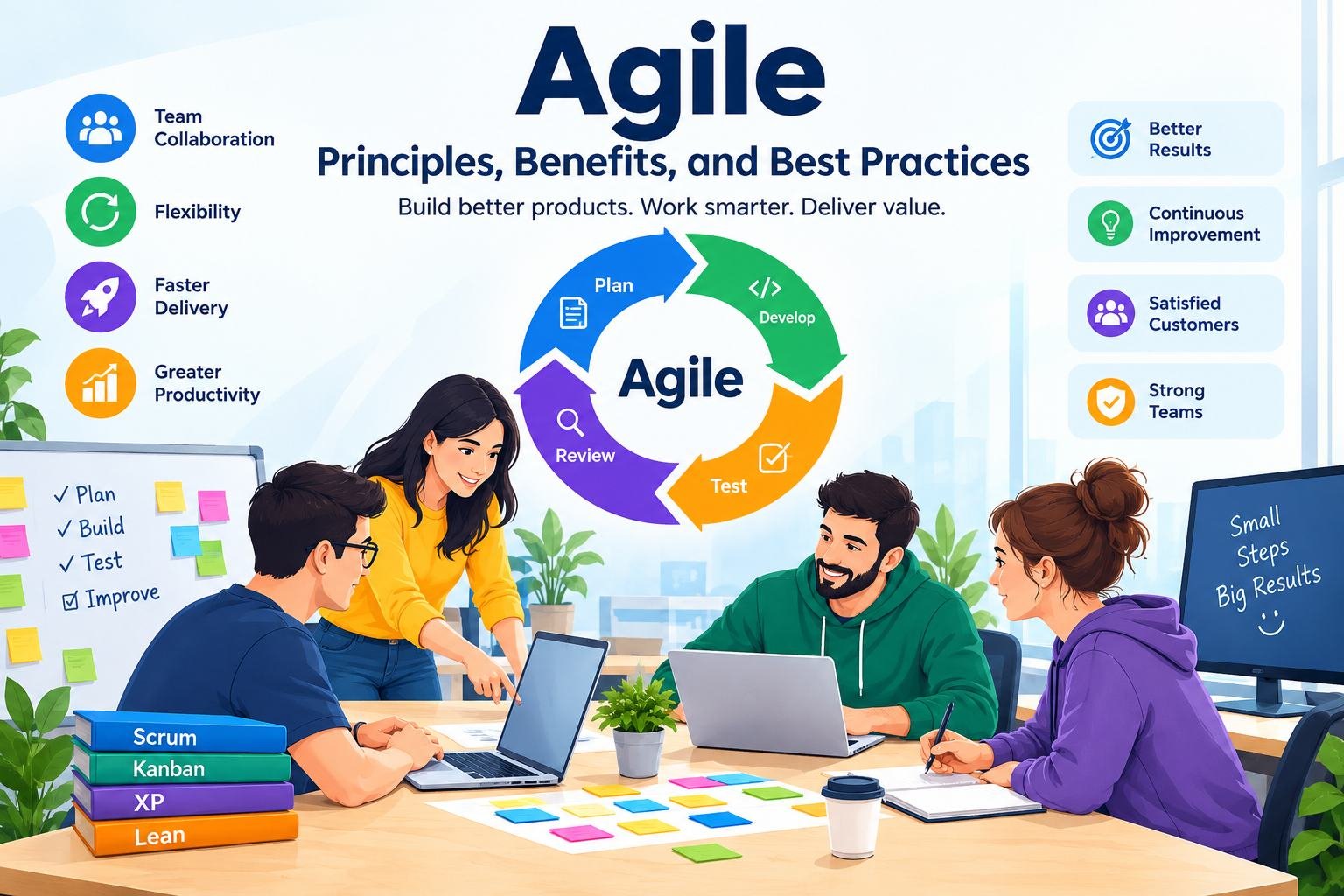
Although individual frameworks differ, many projects follow a repeating cycle of planning, development, evaluation, and improvement.
Step 1: Define the Goal
The team identifies the problem it wants to solve and establishes the project’s main objectives.
For a mobile application, the goal might be to help customers manage appointments more easily. The team also identifies the intended users and the business outcomes the application should support.
Step 2: Create and Prioritize Requirements
Requirements describe what the product should do or what problems it should solve.
Teams often maintain a prioritized list of features, improvements, and technical tasks. This list is commonly called a product backlog in Scrum.
The highest-priority items are generally selected according to customer value, urgency, dependencies, risk, and available resources.
Step 3: Plan a Small Amount of Work
Instead of attempting to finalize every detail at the beginning, the team plans a manageable amount of work for the next development period.
In Scrum, this period is called a sprint. Other approaches may use continuous workflow without fixed-length sprints.
The selected work should be realistic and aligned with the project’s current priorities.
Step 4: Develop and Test
Team members work together to create the selected features or deliverables.
Developers may write code, designers may improve interfaces, and testers may check functionality. Regular communication helps the team identify problems before they become more expensive to resolve.
Testing should be integrated into the workflow rather than postponed until every feature is complete.
Step 5: Review the Results
At the end of a work period, the team demonstrates what it has completed.
Customers, stakeholders, or internal reviewers can provide feedback and explain whether the result meets their expectations.
This review may reveal missing requirements, usability problems, or opportunities for improvement.
Step 6: Improve the Process
The team examines its own working methods and identifies changes that could improve future performance.
For example, it may discover that unclear task descriptions cause delays. The team can then improve how requirements are written before starting new work.
Step 7: Repeat and Adapt
The team uses feedback and new information to determine what should happen next.
This repeating process allows the product to evolve as users’ needs become clearer.
The result is a project workflow that combines planning with the flexibility to respond to new information.
Common Agile Methodologies
Several frameworks and methods help teams apply Agile principles. Each has different practices, strengths, and limitations.
Scrum
Scrum is a framework for solving complex problems through iterative work and regular inspection.
A Scrum team typically includes a Product Owner, a Scrum Master, and Developers. These accountabilities help the team manage priorities, improve its process, and deliver a usable product increment.
Scrum uses events such as Sprint Planning, the Daily Scrum, Sprint Review, and Sprint Retrospective. These events provide opportunities to plan work, coordinate activities, inspect results, and improve.
Scrum works well for teams that need a regular rhythm for reviewing progress and adjusting their plans. However, it requires discipline and a shared understanding of its responsibilities and events.
Kanban
Kanban focuses on visualizing work, managing work in progress, and improving the flow of tasks.
A Kanban board may contain columns such as Backlog, Ready, In Progress, Review, and Done. Team members move tasks across the board as work progresses.
Work-in-progress limits help prevent teams from starting too many tasks simultaneously. This can reduce bottlenecks and encourage people to finish existing work before taking on additional tasks.
Kanban can be useful for support teams, maintenance work, content production, and environments where priorities change frequently.
Unlike Scrum, Kanban does not require fixed-length sprints or the same set of prescribed events.
Extreme Programming
Extreme Programming, often called XP, is a software development methodology that emphasizes technical quality and frequent feedback.
Common XP practices include pair programming, test-driven development, continuous integration, simple design, and frequent releases.
These practices help developers detect defects earlier and keep code easier to change.
XP can be valuable for software teams working with evolving requirements. However, adopting its practices successfully requires technical skill, cooperation, and consistent attention to engineering quality.
Lean Software Development
Lean software development applies ideas from lean thinking to software delivery.
It encourages teams to eliminate unnecessary work, improve flow, build quality into the process, and make decisions based on useful information.
For example, a team might reduce approval steps that repeatedly delay small improvements without adding meaningful value.
Lean thinking is useful when organizations want to improve efficiency without sacrificing quality.
Feature-Driven Development
Feature-Driven Development, or FDD, organizes software development around small, client-valued features.
Teams create an overall model, build a feature list, plan development, and work through individual features.
This approach can help larger development efforts maintain visibility into specific deliverables.
However, it may require additional coordination and modeling, particularly when teams work across complex systems.
Benefits of Using Agile
Organizations adopt Agile practices for several reasons. The benefits depend on how well the methods fit the work and how consistently teams apply them.
1. Greater Flexibility
Changing requirements are common in modern projects. Customers may discover new needs, competitors may introduce different features, or technical limitations may require alternative solutions.
An iterative workflow makes it easier to reconsider priorities without treating every change as a complete project failure.
This flexibility is particularly valuable when the team cannot predict every requirement at the beginning.
2. Faster Feedback
Regular reviews allow stakeholders to evaluate working results instead of waiting until the end.
Early feedback can reveal misunderstandings while changes are still manageable.
For example, testing a new registration page with a small group of users may reveal confusing instructions before the company launches the complete application.
3. Improved Team Collaboration
Frequent communication helps developers, designers, project managers, and business stakeholders maintain a shared understanding of priorities.
It also encourages team members to raise concerns earlier rather than allowing small issues to become larger problems.
Good collaboration depends on respectful communication, clear responsibilities, and realistic expectations.
4. Better Product Quality
Frequent testing and review can help teams detect defects earlier.
Engineering practices such as automated testing, code review, and continuous integration can strengthen this benefit.
However, short development cycles do not automatically guarantee quality. Teams must maintain appropriate standards and avoid rushing work merely to meet deadlines.
5. Greater Visibility
Regular demonstrations, prioritized backlogs, and visual task boards help stakeholders understand what has been completed and what remains.
This visibility can make project discussions more practical and help managers identify risks.
Teams should measure actual outcomes rather than relying exclusively on the number of completed tasks.
6. Reduced Risk of Building the Wrong Product
When teams test ideas early, they can learn whether a feature solves a real problem before investing heavily in it.
This reduces the risk of spending substantial resources on functionality that customers do not need.
7. Continuous Improvement
Regular reflection gives teams an opportunity to identify bottlenecks, improve communication, and refine their working methods.
Small improvements made consistently can lead to better results over time.
Challenges and Limitations
Despite its advantages, Agile is not suitable for every situation, and poor implementation can create problems.
Unclear Requirements
Flexibility does not mean that a project can succeed without a clear purpose.
Teams still need a shared understanding of the intended outcome, important constraints, and the people who will use the product.
Without that foundation, changing priorities can create confusion.
Scope Creep
Scope creep occurs when additional requirements keep entering a project without appropriate consideration of time, cost, or capacity.
Frequent changes can become disruptive if stakeholders expect every request to be accepted immediately.
Teams should evaluate new work, explain trade-offs, and maintain a clear prioritization process.
Limited Stakeholder Availability
Regular feedback is valuable, but stakeholders may not always have time to participate.
When decisions are delayed, the team may continue working with incomplete information.
Organizations should identify decision-makers and establish practical review arrangements.
Difficulty Scaling
Coordinating several teams can be more complicated than coordinating a small group.
Large organizations may need shared priorities, clear ownership, dependency management, and consistent communication.
Frameworks designed for larger environments can help, but they also introduce additional processes that require careful evaluation.
Resistance to Change
Some organizations are accustomed to strict approval chains and detailed plans created long before development begins.
Changing these habits can be difficult, particularly when managers expect immediate results without changing their own decision-making practices.
Successful adoption often requires leadership support, training, and realistic expectations.
Inconsistent Quality
Teams may misunderstand flexibility as permission to skip testing or documentation.
This creates maintenance problems and increases the chance of defects.
A sustainable approach balances frequent delivery with engineering standards, suitable documentation, and responsible decision-making.
Agile vs. Traditional Project Management
Traditional project management often uses a more sequential approach, in which major stages are planned and completed in a defined order. The Waterfall model is a familiar example.
The distinction is not simply that one approach plans while the other does not. Both can involve planning, documentation, testing, and project controls.
The main difference concerns how work is organized and how the team responds to change.
| Feature | Agile Approach | Traditional Sequential Approach |
|---|---|---|
| Planning | Revisited as the project evolves | Often established in greater detail upfront |
| Delivery | Frequently incremental | Often delivered after major stages |
| Feedback | Collected throughout development | May be concentrated at specific milestones |
| Requirements | Can evolve through feedback | Usually more tightly controlled after approval |
| Testing | Often integrated throughout development | May occur mainly at designated stages |
| Best fit | Evolving requirements and frequent learning | Stable requirements and predictable stages |
A traditional approach may work well when requirements are clearly defined, changes are costly, and formal approvals are essential.
An iterative approach may be more suitable when the team needs to learn from users and adjust its solution frequently.
Some organizations combine approaches to match their regulatory, technical, and operational needs.
Agile Roles and Responsibilities
Clear responsibilities help teams coordinate work and make timely decisions.
Product Owner
In Scrum, the Product Owner is accountable for maximizing product value and managing the Product Backlog.
This includes clarifying priorities, communicating product goals, and ensuring that the team understands which work matters most.
The role requires regular engagement with stakeholders and an understanding of user needs.
Scrum Master
The Scrum Master helps the team understand Scrum and improve its effectiveness.
This includes supporting productive events, helping remove impediments, and encouraging continuous improvement.
The role is not simply that of a traditional project manager who assigns every task.
Developers
Developers are responsible for creating a usable product increment during each sprint.
Depending on the project, the team may include programmers, testers, designers, analysts, and other specialists.
The team collaborates to plan and complete the work while maintaining agreed quality standards.
Stakeholders
Stakeholders include customers, users, business leaders, and others who have an interest in the product.
They provide information, explain priorities, and evaluate results.
Their involvement helps the team understand whether its work is delivering the intended value.
Project Manager
Some organizations also employ project managers to coordinate budgets, dependencies, schedules, reporting, and organizational risks.
The exact responsibilities vary by organization. Project management and Scrum accountabilities can coexist when responsibilities are clearly defined and do not undermine team ownership.
Popular Agile Tools
Project management tools can help teams organize tasks, communicate progress, and maintain visibility.
The right application depends on team size, workflow, budget, integrations, and security requirements.
Jira
Jira is widely used for software project tracking, issue management, and team workflows.
It supports configurable boards, backlog management, reporting, and integrations with development tools.
It can be useful for teams that need detailed tracking, although smaller teams may find some features unnecessary.
Trello
Trello provides a visual board-and-card interface for organizing work.
Teams can create cards for tasks and move them between lists as work progresses.
Its straightforward design can be helpful for small teams, content planning, and simple workflows.
Asana
Asana supports task management, project coordination, deadlines, and collaboration.
It can help teams coordinate work across departments and monitor responsibilities.
The available features depend on the selected plan.
Monday.com
Monday.com offers configurable workflows and visual project tracking.
Teams can use it to organize projects, assign responsibilities, and monitor progress.
Its suitability depends on the complexity of the workflow and the organization’s preferred way of working.
Azure DevOps
Azure DevOps provides tools for planning, source code management, build automation, testing, and software delivery.
It can be useful for development teams that need integrated engineering workflows.
Before choosing a tool, compare current pricing, supported integrations, access controls, and the features included in each plan.
Remember that software alone does not make a team effective. Clear goals, communication, and good working practices remain essential.
How to Implement Agile Successfully
Introducing a new project management approach requires more than changing a board or purchasing software.
Organizations should start with a clear objective and make changes that suit their working environment.
Step 1: Identify the Problem
Determine what needs to improve.
Common goals include reducing delays, receiving feedback earlier, improving product quality, or making priorities more visible.
A specific goal makes it easier to evaluate whether the new approach is helping.
Step 2: Select a Suitable Framework
Choose a method based on the type of work, team size, and level of uncertainty.
Scrum may suit teams that benefit from regular planning and review cycles. Kanban may be preferable for ongoing work with changing priorities.
The framework should support the team’s needs rather than create unnecessary administration.
Step 3: Establish Clear Priorities
Create an understandable list of work and decide how priorities will be determined.
Teams should know which tasks provide the greatest value and which requirements are essential.
Clear prioritization also helps stakeholders understand why some requests must wait.
Step 4: Define Quality Standards
Agree on what it means for work to be complete.
For software, this may include testing, code review, documentation, security checks, and acceptance criteria.
A shared definition of done helps prevent unfinished work from being treated as a completed result.
Step 5: Encourage Open Communication
Create opportunities for team members to discuss progress, dependencies, and problems.
Communication should be useful rather than unnecessarily frequent. Meetings need clear purposes, and people should be able to raise concerns without fear of blame.
Step 6: Measure Meaningful Outcomes
Track measures that relate to the project’s goals.
Examples include customer satisfaction, defect rates, delivery predictability, cycle time, and the frequency of successful releases.
Avoid using a single metric to judge the entire team. Measurements should support learning rather than encourage people to manipulate numbers.
Step 7: Review and Improve
Regularly examine what is working and what needs to change.
Start with manageable improvements, observe their effects, and adjust when necessary.
Successful implementation is an ongoing process rather than a one-time organizational change.
Real-World Examples of Agile
The approach can be adapted to many different types of work.
Example 1: Mobile Application Development
A startup wants to build a budgeting application.
The team begins with essential functions such as recording expenses and viewing a spending summary. It tests the first version with users, collects feedback, and then prioritizes improvements.
Users may request recurring expenses or additional reporting options. The team can evaluate those requests before deciding what to build next.
This method helps the startup learn which features are most valuable before investing in a large collection of features.
Example 2: Website Redesign
A business plans to redesign its website.
Instead of waiting until every page has been redesigned, the team can begin with the most important user journey, such as finding a product and contacting the company.
It reviews usability, checks performance, and gathers feedback before extending the new design to other sections.
This approach can help reveal navigation problems early.
Example 3: Marketing Campaign
A marketing team wants to improve an online campaign.
It creates a small initial campaign, measures engagement, and reviews which messages perform well.
The team then adjusts content, targeting, and presentation based on available evidence.
The same iterative thinking can support email campaigns, content calendars, and landing page improvements.
Example 4: Customer Support
A customer support team receives a growing number of requests.
It uses a Kanban board to visualize incoming tasks, ongoing investigations, and completed cases.
By limiting work in progress and identifying repeated bottlenecks, the team can improve its workflow.
The objective is not merely to close more tickets but to resolve customer problems accurately and efficiently.
Future Trends in Agile Project Management
Project management practices continue to evolve as organizations adopt new technologies and distributed working arrangements.
Artificial Intelligence
AI-powered tools can assist with summarizing meetings, organizing requirements, drafting documentation, and identifying patterns in project information.
These capabilities may reduce administrative work, but their output still requires human judgment.
Organizations should also consider data privacy, accuracy, and appropriate access controls.
Remote and Distributed Teams
Teams increasingly work across different locations and time zones.
Clear written communication, shared project boards, documented decisions, and well-planned meetings can help distributed teams coordinate their work.
The aim is to maintain collaboration without requiring everyone to be online at the same time.
Data-Informed Decisions
Teams can use project data to identify delays, evaluate delivery patterns, and understand customer feedback.
However, data should be interpreted in context. A change in one metric does not necessarily explain why performance improved or declined.
Greater Attention to Outcomes
Organizations are increasingly interested in whether projects solve real problems rather than simply whether tasks are completed.
This encourages teams to connect their work with customer needs, business objectives, and measurable improvements.
Continuous Learning
As technologies and customer expectations change, teams need opportunities to develop new skills and improve their processes.
Training, knowledge sharing, technical experimentation, and regular reflection can support this learning.
Frequently Asked Questions About Agile
1. What does Agile mean?
Agile describes an approach to project management and product development that emphasizes flexibility, collaboration, frequent delivery, and continuous improvement.
2. Is Agile only used in software development?
No. Although it became popular in software development, its principles are also used in marketing, product design, operations, and other types of work.
3. What is the Agile Manifesto?
The Agile Manifesto is a document published in 2001 that defines four core values and twelve principles for improving software development.
4. What is the difference between Scrum and Kanban?
Scrum uses defined accountabilities, events, and timeboxed sprints. Kanban focuses on visualizing work, limiting work in progress, and improving flow without requiring the same sprint structure.
5. Is Agile better than Waterfall?
Neither method is best for every project. The right choice depends on how stable the requirements are, how much feedback is needed, and the project’s constraints.
6. What are the main benefits?
Potential benefits include earlier feedback, improved collaboration, greater adaptability, more visible progress, and earlier discovery of problems.
These outcomes depend on effective implementation rather than the methodology alone.
7. What are the main challenges?
Common challenges include unclear requirements, changing priorities, limited stakeholder involvement, organizational resistance, and difficulty coordinating multiple teams.
8. Which tools are commonly used?
Jira, Trello, Asana, Monday.com, and Azure DevOps are examples of tools that support different aspects of project tracking and collaboration.
9. Can beginners learn Agile?
Yes. Beginners can start by learning its values, principles, and common terminology before exploring a framework such as Scrum or Kanban.
Practical exercises can help them understand how the concepts work.
10. What is a sprint?
In Scrum, a sprint is a fixed-length period during which a team works toward a Sprint Goal and produces a usable product increment.
11. What is a product backlog?
A Product Backlog is an ordered list of work needed to improve a product. In Scrum, the Product Owner is accountable for effective Product Backlog management.
12. Does Agile eliminate documentation?
No. The approach values working results while recognizing that useful documentation remains important. Teams should create documentation that supports development, maintenance, communication, and compliance.
13. How is progress measured?
Teams may examine customer outcomes, delivery patterns, cycle time, defect rates, and other measures relevant to their goals. The best measurements depend on the project.
14. Can large organizations use Agile?
Yes, but coordinating several teams can require additional planning, shared priorities, dependency management, and communication.
15. Is Agile suitable for every project?
No. Projects with strict requirements, formal approvals, or highly predictable stages may benefit from more sequential controls. Some organizations combine methods to suit their needs.
Conclusion
Agile has become an influential approach to project management because it helps teams organize work around collaboration, useful outcomes, regular feedback, and continuous learning.
Its principles encourage teams to deliver value in manageable increments, evaluate results, and respond to new information instead of relying entirely on assumptions made at the beginning of a project.
Frameworks such as Scrum, Kanban, Extreme Programming, and Lean provide different ways to apply these ideas. The best choice depends on the work being performed, the people involved, and the organization’s goals.
However, successful implementation requires more than adopting a framework or purchasing project management software. Teams need clear priorities, appropriate quality standards, effective communication, stakeholder participation, and leadership support.
Organizations should also recognize the limitations of their chosen approach. Frequent changes need careful prioritization, and flexibility should never become an excuse for poor planning or inadequate testing.
When used thoughtfully, Agile can help teams learn faster, identify problems earlier, and make better decisions throughout a project’s life cycle.
The most important lesson is to focus on delivering meaningful value, learning from experience, and improving the way people work together. By applying these principles consistently, teams can develop a practical approach that supports both customer needs and long-term project success.