What Is RFID? How Radio Frequency Identification Works
Technology has made it possible to identify products, equipment, cards, and other objects without manually entering information every time. One of the technologies behind this process is RFID.
But what is RFID, and why is it used in so many industries?
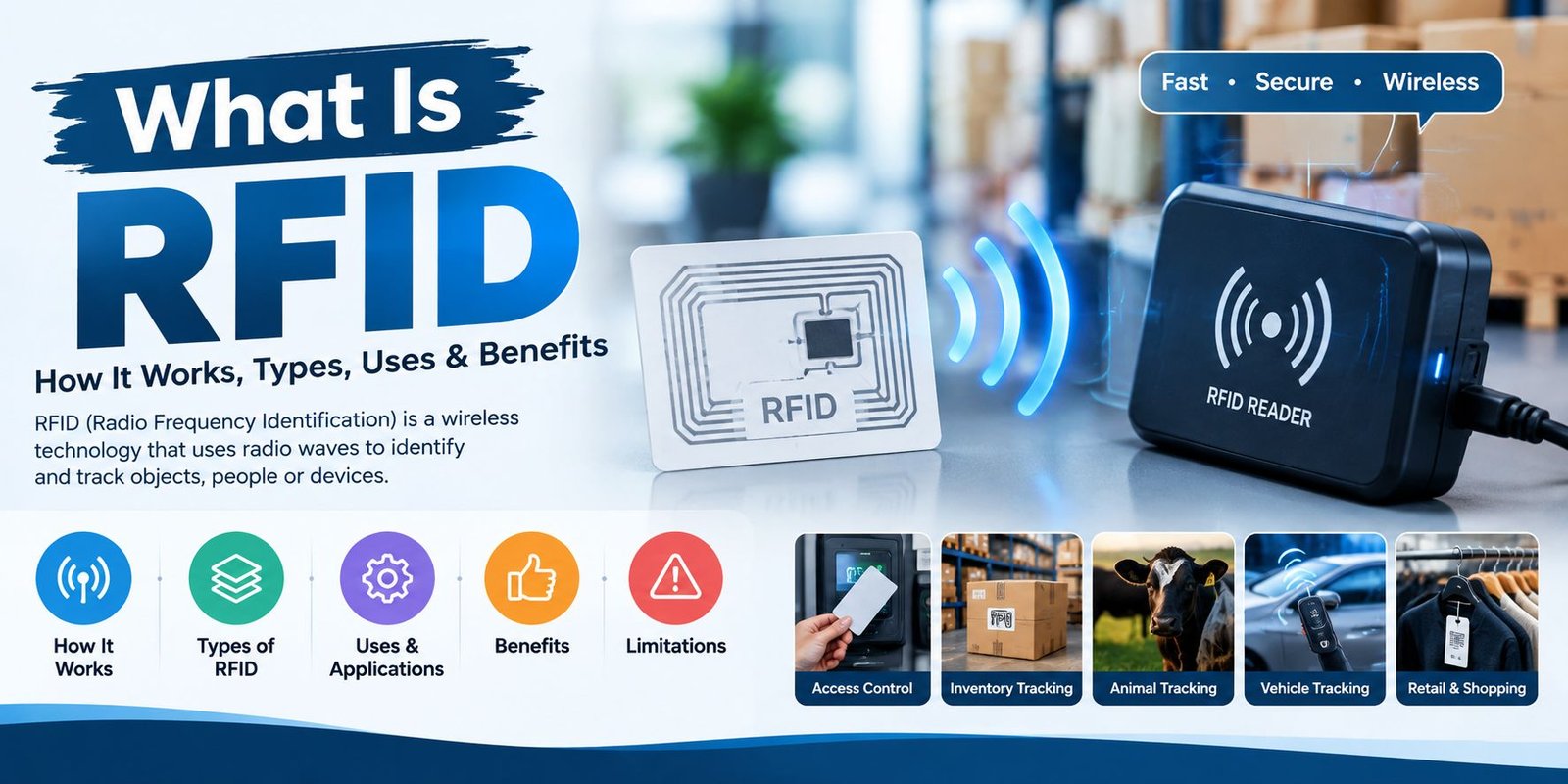
RFID stands for Radio Frequency Identification. It is a wireless identification technology that uses radio waves to exchange information between a reader and an electronic tag. An RFID tag can carry an identifier that allows a connected system to recognize a particular object.
Unlike a traditional printed barcode, RFID does not normally depend on a camera or optical scanner seeing a printed pattern. Depending on the RFID system, tags can be detected when they are within the reader’s operating area.
Today, RFID is used in areas such as retail, inventory management, logistics, manufacturing, access systems, asset tracking, and other applications where automatic identification is useful.
What Does RFID Stand For?
RFID means Radio Frequency Identification.
The name describes the basic idea behind the technology:
- Radio Frequency refers to the radio waves used for communication.
- Identification means recognizing an object or identifier.
- RFID combines these concepts into an electronic identification system.
An RFID setup normally contains a tag and a reader. The tag stores identification information, while the reader communicates with the tag and passes the captured information to another system for processing.
How Does RFID Work?
The easiest way to understand RFID is to follow what happens when a tagged object approaches a reader.
1. The RFID Reader Creates a Signal
An RFID reader uses an antenna to communicate with tags.
Depending on the RFID technology, the reader sends radio-frequency energy or signals into the surrounding area.
2. The Tag Receives the Signal
When a compatible tag enters the reader’s operating area, it can respond.
With a passive RFID tag, the reader’s electromagnetic field supplies the energy needed for the tag’s electronic circuitry. The tag does not need a conventional internal power source for this communication method.
3. The Tag Sends Information Back
The tag communicates its stored information to the reader.
Passive RFID commonly uses a technique called backscatter. Instead of generating a powerful radio transmission of its own, the tag changes the way it reflects the reader’s signal. The reader interprets those changes as digital information.
4. Software Processes the Information
The reader transfers the captured data to a computer system or application.
That software can then use the information for tasks such as:
- Inventory updates
- Asset identification
- Product tracking
- Access management
- Logistics records
- Equipment monitoring
This final step is important because RFID is not simply about reading a tag. The captured identification becomes useful when it is connected to a larger information system.
What Are the Main Parts of an RFID System?
An RFID solution can be simple or highly sophisticated, but several basic elements are commonly involved.
RFID Tag
The tag is attached to the object that needs to be identified.
A typical RFID tag contains an electronic chip and an antenna. The chip handles stored information and communication functions, while the antenna allows the tag to interact with the reader.
Tags can be manufactured in many shapes and sizes. Some are designed for clothing and retail products, while others are built for industrial equipment or specialized environments.
RFID Reader
The reader is responsible for communicating with tags.
Readers can be installed permanently or designed as portable devices. A fixed reader may be positioned at a doorway or warehouse point, while a handheld reader can be carried around by a worker.
RFID Antenna
An antenna helps create the radio communication link between the reader and tag.
The number, position, design, and orientation of antennas can affect how an RFID installation performs.
RFID Software
The reader alone is not usually the end of the process.
Software can receive the captured tag information and connect it with inventory databases, business applications, warehouse systems, or other platforms.
What Are the Main Types of RFID?
RFID systems can be grouped in different ways. One important distinction is whether the tag has its own power source.
Passive RFID
A passive RFID tag does not normally contain its own radio transmitter or conventional battery.
Instead, it receives energy from the reader’s electromagnetic field and uses that energy to communicate. The tag then sends information through backscatter.
Passive tags are widely useful where organizations need to identify large numbers of relatively low-cost objects.
Common Uses of Passive RFID
Passive systems can be used for:
- Retail inventory
- Product identification
- Warehouse operations
- Supply-chain tracking
- Asset identification
- Access applications
Active RFID
An active RFID tag has its own power source and radio transmitter.
Because it can generate its own signal, active RFID can be used for applications requiring longer-range communication or more frequent transmissions.
Active systems can be useful for tracking valuable equipment, vehicles, and other assets.
Active RFID Considerations
The main trade-offs can include:
- Larger tag designs
- Higher cost
- Battery maintenance
- Different system requirements
The appropriate choice depends on what needs to be tracked and how the system will operate.
Battery-Assisted Passive RFID
There is also a category commonly known as Battery-Assisted Passive, or BAP.
These tags can use a battery to power certain internal functions while still communicating through backscatter rather than behaving like a fully active transmitter.
This approach can be useful in specialized tracking situations.
What Are RFID Frequency Bands?
Another way to classify RFID is by operating frequency.
The three major categories are:
- LF — Low Frequency
- HF — High Frequency
- UHF — Ultra-High Frequency
Each band behaves differently and is suited to different applications.
LF RFID
Low-frequency RFID systems commonly operate around 125 kHz or 134 kHz.
They generally provide relatively short reading distances and are less sensitive to some forms of radio interference.
Applications can include animal identification and certain access-control systems.
HF RFID
High-frequency RFID commonly operates at 13.56 MHz.
HF technology is used in applications such as ticketing, payment systems, access control, secure documents, and data-transfer applications. NFC is also based on HF RFID technology.
UHF RFID
Ultra-high-frequency RFID is particularly important for large-scale identification and tracking.
Passive UHF RFID is often referred to as RAIN RFID. It is widely associated with inventory, asset identification, and supply-chain applications.
The usable range varies according to the tag, reader, antenna, environment, and other technical conditions.
Where Is RFID Used?
RFID is valuable because it can be adapted to many real-world situations.
RFID in Retail Stores
Retail businesses can attach RFID tags to products and use readers to identify items.
This can help stores improve visibility into their stock and make certain inventory-counting processes more efficient.
Because RFID can identify multiple tags within a suitable reading area, workers may not need to handle every individual item as they would with conventional barcode scanning.
RFID in Warehouses
Warehouses constantly move products between receiving areas, storage locations, picking stations, and shipping zones.
RFID can provide an electronic identity for tagged items and help connect physical movement with digital records.
For example, an organization may use readers at specific points to record when tagged goods pass through those locations.
RFID in Logistics
Transportation and logistics operations involve large numbers of packages, containers, pallets, and assets.
RFID can help organizations capture identification information automatically as tagged objects move through a supply chain.
GS1 describes RFID as one of the automatic identification technologies used to connect physical objects with digital information.
RFID in Manufacturing
Factories can use RFID to identify:
- Components
- Tools
- Containers
- Work-in-progress items
- Finished products
Connecting a physical item to a digital identity can help manufacturing systems keep track of objects as they move through different stages.
RFID for Asset Tracking
Businesses often need to know where equipment or valuable assets are located.
An RFID tag can give an asset a unique electronic identity. Readers can then detect that identity at appropriate locations.
This can be useful for tools, equipment, containers, vehicles, and other trackable objects.
RFID in Healthcare
Healthcare environments can use RFID for applications such as inventory and equipment tracking.
The technology can help organizations identify equipment and supplies without relying entirely on manual processes.
The exact implementation depends on the medical environment and the requirements of the system.
What Is the Difference Between RFID and Barcode?
RFID and barcodes both support automatic identification, but they use different methods.
A barcode stores information in a printed visual pattern. A scanner typically needs a suitable view of that pattern.
RFID uses radio communication between a reader and an electronic tag. This means the tag generally does not have to be visually exposed to the reader in the same way a barcode does.
RFID
- Uses radio communication
- Uses electronic tags
- Can work without optical line-of-sight
- Suitable systems can identify multiple tags
- Can support serialized item identification
Barcode
- Uses a printed pattern
- Requires optical scanning
- Usually needs a clear scanning view
- Very inexpensive to produce
- Widely available and easy to implement
RFID does not automatically make barcodes obsolete. The two technologies can be used together depending on the application.
What Are the Benefits of RFID?
RFID can provide several practical advantages.
Faster Identification
A suitable RFID installation can automatically detect tags within its reading area.
This can reduce repetitive manual scanning.
Less Dependence on Line of Sight
Because RFID communicates through radio waves, a reader does not normally need a camera-like view of a printed code.
This can be particularly useful for objects inside packaging or in situations where barcode positioning is inconvenient.
Multiple Items Can Be Detected
Some RFID systems can identify multiple tags during a single reading operation.
This can be useful for inventory counting and logistics processes.
Digital Item Identity
RFID tags can carry unique identifiers that allow individual objects to be distinguished.
This is particularly useful when a business needs to track specific items rather than simply identify a product category.
Automation Opportunities
RFID can be connected with software and databases, allowing organizations to automate parts of their identification and tracking workflows.
What Are the Limitations of RFID?
Despite its advantages, RFID is not suitable for every situation.
Installation Costs
A complete RFID system can involve more than tags.
Organizations may need:
- Readers
- Antennas
- Tags
- Software
- Network infrastructure
- Integration
- Installation and maintenance
For a small operation, a simple barcode solution may be more economical.
Materials Can Affect Performance
The surrounding environment matters.
Metal can reflect or alter electromagnetic waves, while liquids can absorb radio-frequency energy and reduce the performance of some RFID tags. Specialized tag designs can help address certain difficult environments.
Range Is Not the Same for Every Tag
There is no single RFID reading distance.
Range depends on factors such as:
- RFID type
- Operating frequency
- Reader power
- Antenna design
- Tag orientation
- Interference
- Surrounding materials
GS1 notes that active and passive RFID can have substantially different reading ranges, while even passive systems vary according to their technology and environment.
System Compatibility
An RFID tag is not automatically compatible with every reader.
The frequency, protocol, tag type, reader capabilities, and software environment all need to work together.
Is RFID the Same as NFC?
No, but the two technologies are closely related.
NFC, or Near Field Communication, is a short-range communication technology based on HF RFID standards.
NFC is commonly used for close-proximity interactions such as contactless payments, smartphone functions, tickets, access systems, and device pairing. GS1 describes NFC as an RFID technology operating at 13.56 MHz with a reading distance below 10 cm.
So, NFC can be considered a specialized form of RFID technology rather than a completely unrelated technology.
Does RFID Need Internet?
An RFID reader and tag do not inherently require an internet connection simply to communicate.
The local radio interaction can happen between the tag and reader.
However, the overall application may use a network connection to send captured information to:
- A local database
- Inventory software
- Enterprise systems
- Cloud applications
- Supply-chain platforms
Therefore, RFID communication and internet connectivity are separate concepts.
Does RFID Need a Battery?
It depends on the type of tag.
Passive RFID
Passive tags generally receive their operating energy from the reader’s signal and therefore do not require a conventional internal battery.
Active RFID
Active tags normally contain their own power source and transmitter.
Battery-Assisted Passive
BAP tags use a battery for certain functions while still relying on backscatter for communication.
This distinction is important when comparing RFID products.
Can RFID Work Through Metal or Water?
RFID performance can be affected by both metal and liquids.
Metal can reflect and alter electromagnetic waves, while water can absorb radio-frequency energy. However, manufacturers can design specialized tags for challenging environments, including tags intended for metal surfaces.
Therefore, the presence of metal or liquids does not automatically mean RFID cannot be used. Instead, the tag and system should be selected for the actual environment.
How Far Can RFID Be Read?
There is no universal RFID range.
Some RFID systems are intended for very short distances, while others can operate over several meters or more under suitable conditions.
For example, LF and HF systems often operate at shorter distances, whereas UHF RFID can provide substantially greater range in appropriate environments. Active RFID can reach considerably farther because its tags can transmit using their own power.
The antenna and physical environment can be just as important as the theoretical specifications.
Is RFID Secure?
RFID security depends on the specific technology, tag, reader, application, and data being handled.
Not every RFID tag has the same security capabilities.
For applications involving sensitive information, organizations should consider authentication, access controls, encryption where supported, secure system design, and appropriate privacy practices.
The security requirements for a retail inventory tag, an access credential, and a payment application can be very different.
How Should a Business Choose RFID?
A business should begin with the problem rather than the hardware.
Before selecting an RFID solution, consider:
What Needs to Be Identified?
Determine whether you are tracking products, packages, tools, equipment, vehicles, documents, or another type of object.
How Far Away Should the Reader Work?
A short-range application may require a very different RFID system from a warehouse where objects need to be detected several meters away.
What Is the Environment Like?
Consider metal, liquids, temperature, packaging, machinery, and other physical conditions.
How Many Items Need to Be Read?
If hundreds or thousands of items need to be identified, the system should be designed around the required throughput.
Which Frequency Is Appropriate?
LF, HF, and UHF have different characteristics. Selecting the appropriate band is an important part of system design.
What Software Will Use the Data?
The reader is only one part of the solution. Make sure the captured RFID information can integrate with the software and databases you already use.
Frequently Asked Questions
What Is RFID in Simple Words?
RFID is a wireless technology that allows a reader to identify an electronic tag attached to an object using radio waves.
What Is an RFID Tag?
An RFID tag is a small electronic device containing a chip and antenna that can communicate with an RFID reader.
What Is an RFID Reader?
An RFID reader is the device that communicates with RFID tags and captures their information.
What Is RFID Used For?
RFID is used for product identification, inventory management, logistics, asset tracking, manufacturing, access control, and many other automatic-identification applications.
Can RFID Track Location?
RFID can support location or movement tracking when readers are positioned appropriately. Active RFID systems can also be used in real-time location solutions where tags periodically transmit signals.
Is RFID Better Than a Barcode?
Neither technology is universally better. RFID can provide benefits such as non-line-of-sight reading and automated multi-tag detection, while barcodes are simple, inexpensive, and widely supported.
What Are the Three Main RFID Frequencies?
The commonly discussed RFID frequency categories are LF, HF, and UHF. Each has different characteristics and applications.
Final Thoughts
Understanding what is RFID becomes much easier when you think of it as a bridge between physical objects and digital information.
An RFID tag gives an object an electronic identity. A reader detects and communicates with that tag, while software can turn the captured information into something useful for a business or organization.
The technology comes in many forms, from short-range HF systems to UHF solutions designed for inventory and supply-chain applications. Passive, active, and battery-assisted tags also serve different purposes.
RFID is therefore not one single device or standard. It is a broad family of identification technologies that can be designed around different distances, environments, objects, and business requirements.
For anyone researching RFID, the most important step is to understand the actual application first. Once the identification requirements, environment, range, and data needs are clear, it becomes much easier to determine which RFID technology is appropriate.