
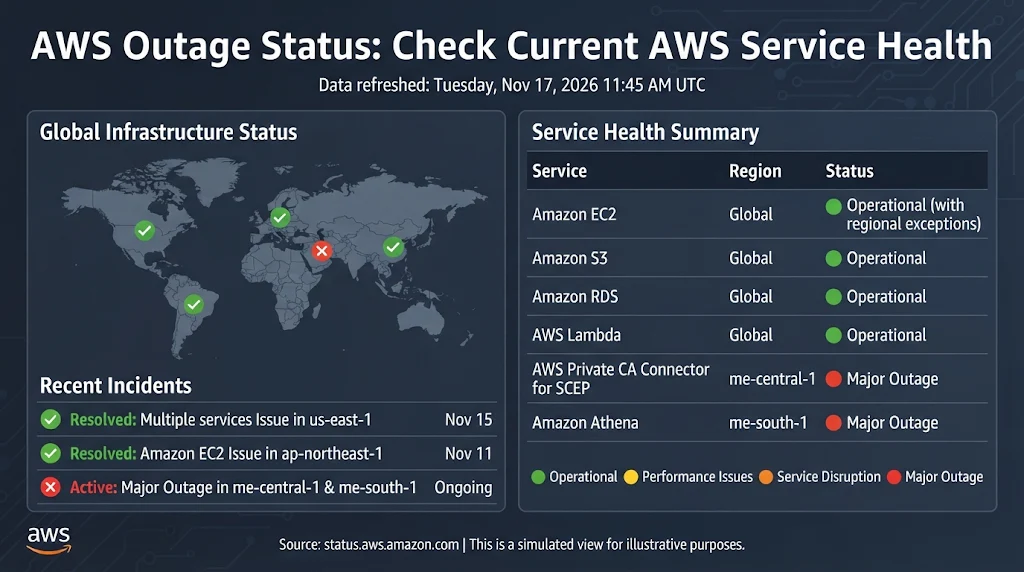
AWS Outage Status: Check Current AWS Service Health
AWS Outage Status is an important topic for website owners, developers, businesses, and everyday users who depend on Amazon Web Services. When an AWS Outage Status service becomes unavailable, applications may stop responding, websites may load slowly, databases may become inaccessible, and cloud-based systems can experience unexpected errors. Knowing how to check the latest service status helps users understand whether a problem is affecting AWS or whether the cause is somewhere else in their own infrastructure.
Amazon Web Services (AWS) provides cloud computing services to organizations around the world. Its platform includes computing power, storage, databases, networking, content delivery, security tools, and many other services. These products operate across different geographic regions and availability zones. As a result, an incident may affect one service or location without taking down the entire AWS platform.
If your website, application, or cloud environment is experiencing problems, checking the official AWS Health Dashboard is a useful first step. This guide explains how to check service availability, understand outage reports, identify affected regions, troubleshoot common errors, and prepare your systems for future disruptions.
What Is AWS Outage Status?
AWS outage status describes the current operational condition of Amazon Web Services and its individual cloud products. It helps users determine whether AWS Outage Status services are operating normally, experiencing performance problems, or affected by a confirmed incident.
An outage does not always mean that every AWS product is unavailable. Cloud services are distributed across multiple regions and availability zones. An issue may affect a particular database service in one location while computing, storage, and networking services continue working elsewhere.
For example, a customer using an application hosted in the United States may experience a regional connectivity problem. Another customer running a similar application in Europe may continue operating normally.
AWS incidents can involve several types of problems:
- Service outage: A cloud product becomes unavailable or stops performing an important function.
- Connectivity issue: Users or applications cannot establish reliable connections to an AWS service.
- Performance degradation: A service remains accessible but responds slowly or produces elevated error rates.
- Authentication problem: Users experience difficulties signing in or receiving permission to access resources.
- Regional disruption: Several services in a geographic AWS region experience problems.
- Maintenance or scheduled change: Planned work may temporarily affect certain resources or operations.
Understanding these differences helps users avoid assuming that a problem affecting one AWS service means the entire platform is down.
AWS Outage Status Today: What Is Currently Reported?
AWS provides a public service-health page where users can review open incidents and recent service history. The dashboard separates operational issues by service and region, making it easier to understand the scope of a disruption.
At the time this article was prepared on November 17, 2026, the public AWS Health Dashboard listed ongoing disruptions involving multiple services in two Middle East regions:
- Middle East (UAE), me-central-1: AWS reports a continuing regional disruption. The company says it cannot restore access to resources and data hosted exclusively in the affected availability zone mec1-az2, while recovery work continues for other affected infrastructure.
- Middle East (Bahrain), me-south-1: AWS reports a continuing disruption. Its latest update says that access to resources and data hosted exclusively in the affected region cannot be restored following the infrastructure damage.
These are regional incidents, not evidence that all AWS regions worldwide are unavailable. Customers operating outside the affected locations should check the dashboard and their own account health before drawing conclusions about their workloads.
The dashboard also records a separate November 15, 2026 connectivity incident in the US East (N. Virginia) region. AWS marked that incident resolved. It affected signup, authentication, and connectivity for several services, including IAM Identity Center and services that rely on it.
Because cloud incidents can change quickly, readers should always check the live dashboard before publishing or acting on a status report.
How to Check the Official AWS Health Dashboard
The AWS Health Dashboard is the primary place to check publicly reported AWS service incidents. It provides information about current issues, affected services, regions, and recovery updates.
Follow these steps to check the latest information.
Step 1: Open the AWS Health Dashboard
Visit the official page:
The page displays public service-health information. You can review open and recent issues without relying on social media posts or third-party outage claims.
Step 2: Review Open and Recent Issues
Look for the section showing open and recent operational issues. If AWS has reported an incident, the dashboard may display its service name, affected region, severity, and latest update.
An issue marked as open may still be under investigation or recovery. Read the update carefully before deciding whether it affects your application.
Step 3: Identify the Affected Region
AWS Outage Status services operate in different geographic regions. The region is an important part of every outage report because a problem may be limited to one location.
Examples of AWS region names include:
- US East (N. Virginia) –
us-east-1 - US West (Oregon) –
us-west-2 - Europe (Ireland) –
eu-west-1 - Asia Pacific (Singapore) –
ap-southeast-1 - Middle East (UAE) –
me-central-1
Your application may use one region for its main resources and another for backup or disaster recovery. Confirm which location hosts the affected resource.
Step 4: Read the Incident Details
Select the relevant incident to review its description and updates. AWS may explain when the issue started, which services are affected, what customers might experience, and what recovery actions are underway.
Do not rely only on the incident title. The detailed update may explain that only certain operations or availability zones are affected.
Step 5: Check Your Account Health
The public dashboard provides general service information. The account-specific AWS Health view can provide additional notifications about events that affect your own resources.
Sign in to your AWS account and open AWS Outage Status Health. Review open issues, scheduled changes, and account notifications. This can help identify problems that are not visible in a general public report.
Understanding AWS Regions and Availability Zones
To understand cloud outages, it helps to know how AWS organizes its infrastructure.
What Is an AWS Region?
An AWS Region is a separate geographic area where Amazon operates cloud infrastructure. Each region contains multiple availability zones, subject to the region’s design and service availability.
Customers choose regions based on factors such as application latency, legal requirements, service availability, and operating costs.
For example, a company serving customers in Europe may choose a European region to reduce network latency. Another business may select a region closer to its main users in Asia.
A regional incident can affect multiple resources hosted in that location. However, it does not automatically mean that every AWS region is experiencing the same problem.
What Is an Availability Zone?
An Availability Zone (AZ) is an isolated location within an AWS region. Regions generally contain multiple availability zones that are designed to support resilient application architectures.
Businesses can distribute workloads across multiple zones to reduce dependence on a single location.
For example, an application may run servers in two availability zones. If one zone experiences a disruption, the application may continue operating through resources in the other zone, provided its architecture and dependencies support failover.
However, using multiple zones does not guarantee uninterrupted service. Shared dependencies, incorrect configurations, capacity limits, or regional problems may still affect an application.
Why Region and Zone Information Matters
When checking an outage report, identifying the exact region and availability zone can help you decide what to do next.
A service may be working normally in one region but experiencing problems in another. Moving an application to a different region may help in some situations, but migration requires planning, available capacity, data replication, and correct network configuration.
Do not move production workloads without understanding the possible impact on data, security, application dependencies, and operating costs.
Common Reasons AWS Services Experience Outages
AWS operates large-scale cloud infrastructure, but complex systems can still experience interruptions. Outages may result from infrastructure problems, software changes, networking issues, or external events.
Infrastructure and Power Problems
Cloud data centers depend on power, cooling, network equipment, and physical infrastructure. A serious problem involving these systems can affect servers and other resources.
A localized infrastructure incident may disrupt one availability zone, while a larger event can affect multiple locations.
Network Connectivity Issues
Cloud applications depend on network communication between users, servers, databases, and external systems.
Routing problems, network equipment failures, configuration errors, or connectivity disruptions can prevent applications from communicating correctly.
A network problem may appear to users as a website outage even when the underlying servers are still running.
Software and Configuration Changes
Cloud services are updated regularly. Software deployments and configuration changes are necessary for maintenance and improvement, but unexpected problems can sometimes affect service availability.
A change involving authentication, networking, or service dependencies may create errors for customers using related products.
Authentication and Identity Problems
AWS provides identity and access-management tools that control who can sign in and what resources they can use.
If an authentication service experiences problems, users may be unable to access the management console or services that depend on that authentication system. This does not necessarily mean their running servers have stopped working.
Database and Storage Problems
Applications depend on databases and storage systems to read and write information. If a database becomes unavailable or storage requests fail, applications may stop completing important operations.
A database problem can also affect other services that rely on it, creating a wider impact.
External Events
Natural disasters, physical damage, and other external events can affect data-center infrastructure. AWS may need to restore physical systems, recover data, or help customers move workloads to other regions.
These situations can require longer recovery periods than ordinary software or configuration incidents.
Signs That Your Application May Be Affected by an AWS Outage
Not every website error is caused by AWS. However, certain symptoms may suggest that an AWS service or regional dependency is experiencing a problem.
Common signs include:
- Websites hosted on AWS fail to load.
- Applications return repeated server errors.
- API requests time out or fail.
- Database connections become unreliable.
- Cloud storage operations return errors.
- Users cannot access an application dashboard.
- Authentication requests fail unexpectedly.
- Server response times become unusually slow.
- Deployment or infrastructure-management operations fail.
These symptoms are not proof of an AWS outage. A local internet connection, application bug, expired certificate, incorrect permission, DNS configuration, or exhausted resource limit can create similar problems.
Compare your application’s behavior with the official AWS status information before deciding what caused the issue.
How to Troubleshoot AWS Connection Problems
If your application stops working, follow a structured troubleshooting process. Avoid making major infrastructure changes before identifying the likely cause.
1. Check the AWS Health Dashboard
Start with the official status page. Look for an incident involving the AWS service and region used by your application.
If AWS reports a matching issue, read the latest update and follow its recommendations.
2. Confirm Your Region
Check the region configured in your application, AWS CLI profile, SDK, or management console.
A mismatch can lead to failed requests or attempts to access resources in the wrong location.
3. Test Your Internet Connection
If you cannot access the AWS console or your application, check whether other websites and services are working.
Try another network or device if possible. This can help distinguish a local connectivity problem from a wider cloud-service issue.
4. Review Application Logs
Logs can reveal whether requests are failing because of timeouts, authentication errors, permission problems, or unavailable dependencies.
Check application logs, server logs, and relevant AWS service logs. Look for the time of the failure and compare it with the incident timeline.
5. Check CloudWatch Metrics
Amazon CloudWatch helps users monitor AWS resources and applications. Depending on the service, useful metrics may include CPU utilization, request counts, latency, error rates, and database performance.
Compare current metrics with normal operating levels. A sudden change may help identify which part of your application is experiencing trouble.
6. Review Permissions and Credentials
An authentication failure may result from expired credentials, incorrect permissions, or an identity-service problem.
Review IAM policies, roles, temporary credentials, and application configuration. Avoid changing permissions broadly just to make an error disappear.
7. Retry Failed Requests Carefully
Some temporary errors may disappear after a short period. Applications can use retry logic with exponential backoff to handle temporary failures.
However, repeated aggressive retries can increase pressure on an already struggling service. Use sensible retry limits and follow AWS guidance for the affected service.
8. Contact AWS Support When Necessary
If the issue affects production resources or important business operations, use the AWS Support Center or the account-specific AWS Health Dashboard.
Provide useful details such as the affected service, region, resource identifiers, error messages, timestamps, and troubleshooting steps already completed.
Do not include passwords, secret access keys, or other sensitive credentials in support messages.
What Should You Do During an AWS Outage?
Your response depends on the affected service and the importance of your application. A small personal project may only require monitoring, while a business-critical system may need an established disaster-recovery plan.
Avoid Unnecessary Configuration Changes
During an outage, changing multiple settings at once can make troubleshooting harder. Record the current configuration and identify the affected component before making changes.
Follow AWS Incident Updates
AWS may provide new information as engineers investigate and recover a service. Review the latest updates rather than relying on an old social media post or screenshot.
Protect Important Data
If storage or database operations are affected, avoid risky actions that could cause data loss. Check backup availability and follow the recovery procedures documented for your application.
Consider Alternative Regions
If AWS recommends moving workloads away from a severely affected region, review your disaster-recovery plan.
Before switching regions, confirm that the required resources, backups, networking, permissions, and application dependencies are available.
Communicate With Users
If customers are affected, provide a clear status update. Explain which features are unavailable, whether data is safe based on what you know, and when users can expect another update.
Avoid promising a recovery time unless AWS has provided reliable information that supports it.
How to Prepare Your Business for Future AWS Outages
No cloud platform can guarantee that every service will remain available at all times. Businesses should design their systems to handle interruptions rather than assuming that outages will never happen.
Use Multi-AZ Architecture
Where supported and appropriate, distribute important application resources across multiple availability zones.
This can reduce the effect of a localized zone failure. Make sure that databases, load balancers, networking, and other dependencies also support the intended design.
Maintain Regular Backups
Create backups of important databases, files, and application configurations. Store recovery copies in locations that are not dependent on the same failure domain as the original data.
Test restoration regularly. A backup is only useful if it can be recovered successfully.
Create a Disaster-Recovery Plan
A disaster-recovery plan should explain how your organization will restore services after a major incident.
Include recovery priorities, responsible team members, backup locations, communication procedures, and steps for switching to alternative infrastructure.
Monitor Services Continuously
Use monitoring tools to detect errors, latency increases, and unusual resource behavior. CloudWatch alarms can notify teams when selected metrics cross defined thresholds.
Monitoring your own application is important because a public status dashboard may not show every issue affecting your particular resources.
Document Your Dependencies
List the AWS services, regions, databases, APIs, and external systems required by your application.
Understanding these dependencies helps teams identify what may fail together and where alternative options are needed.
Test Recovery Procedures
Do not wait for a real outage to discover that a backup is incomplete or a recovery process does not work.
Run controlled recovery exercises and document the results. Update the plan whenever your infrastructure changes.
AWS Health Dashboard vs. Third-Party Outage Trackers
Several websites and monitoring services collect reports about service disruptions. They can be useful, but they do not all provide the same type of information.
| Feature | AWS Health Dashboard | Third-Party Trackers |
|---|---|---|
| Information source | AWS service-health reporting | User reports and other sources |
| Official incident updates | Yes | Not necessarily |
| Affected service details | AWS-reported information | Depends on the tracker |
| Regional information | Available for reported incidents | Varies |
| Account-specific notifications | Available through AWS Health | Usually not |
| Best use | Confirming AWS-reported incidents | Spotting possible user-facing problems |
Third-party trackers may help identify unusual reports from customers, but a spike in user complaints does not automatically confirm an AWS outage.
Use the official AWS dashboard for service-health information and your own monitoring systems for application-specific evidence.
Is AWS Down for Everyone?
No. An AWS outage does not necessarily affect every customer or region.
AWS operates many services across different geographic locations. A problem affecting one product in one region may have little or no effect on applications hosted elsewhere.
Even within the same region, customers may experience different results because they use different availability zones, architectures, and service dependencies.
For example, one application may stop responding because it relies on a resource in an affected availability zone. Another application in the same region may continue working because it uses a different zone or service configuration.
The best way to determine whether your system is affected is to compare the public status report with your account-specific notifications, resource configuration, and application logs.
Frequently Asked Questions About AWS Outage Status
How can I check whether AWS is down right now?
Visit the official AWS Health Dashboard at. Review open incidents, affected services, regions, and the latest updates. You can also sign in to AWS Health to review events that affect your account.
Is AWS outage status the same worldwide?
No. AWS operates in multiple geographic regions. An incident may affect one region, availability zone, or service without disrupting the entire platform.
What does an AWS operational issue mean?
An operational issue means AWS has reported a problem affecting a service or part of its infrastructure. The issue may involve availability, connectivity, authentication, or performance. Read the incident details to understand its actual scope.
Why is my AWS website not loading?
A website hosted on AWS may fail because of an AWS incident, application errors, DNS problems, network connectivity, database failures, or incorrect configuration. Check the AWS Health Dashboard and your application logs to narrow down the cause.
Can I use AWS during an outage?
It depends on which service and region are affected. Some AWS products may continue operating normally while others experience disruptions. Check the specific incident report and your account health before deciding what actions to take.
Does an AWS outage cause data loss?
Not every outage causes data loss. Some incidents involve temporary access or connectivity problems. However, serious infrastructure disruptions can affect access to resources and data. Maintain independent backups and follow AWS recovery guidance.
What is the difference between AWS Health and the public status page?
The public AWS Health Dashboard shows general service-health information. The account-specific AWS Health view provides notifications about events that may affect your own AWS resources or organization.
How long do AWS outages usually last?
There is no fixed recovery time. Some incidents are resolved quickly, while infrastructure damage or complex regional disruptions may require much longer. Follow the latest AWS updates rather than assuming a standard recovery period.
Can I move my AWS application to another region?
In many cases, applications can be deployed in another AWS region, but the process depends on architecture, data replication, service availability, networking, and security requirements. Plan and test regional recovery before an emergency occurs.
Is AWS more reliable than traditional hosting?
AWS provides cloud infrastructure and tools designed to support scalable and resilient applications. However, reliability depends on how a system is designed, configured, monitored, and maintained. Cloud hosting does not automatically eliminate downtime.
Where can I get official AWS outage updates?
The official AWS Health Dashboard is the main public source for service-health information. Account holders can also review personalized notifications through AWS Health in their AWS account.
Final Thoughts
Checking AWS Outage Status is an important step when a website, application, database, or cloud service stops working. The official AWS Health Dashboard helps users identify reported incidents, affected services, and regional disruptions. However, a public incident report is only one part of troubleshooting.
Always compare AWS updates with your own account notifications, application logs, monitoring metrics, and resource configuration. This helps you determine whether the problem is caused by AWS or by another part of your system.
For better long-term reliability, maintain tested backups, monitor important services, distribute critical workloads across suitable availability zones, and prepare a disaster-recovery plan. These practices cannot prevent every interruption, but they can help reduce downtime and make recovery more manageable.