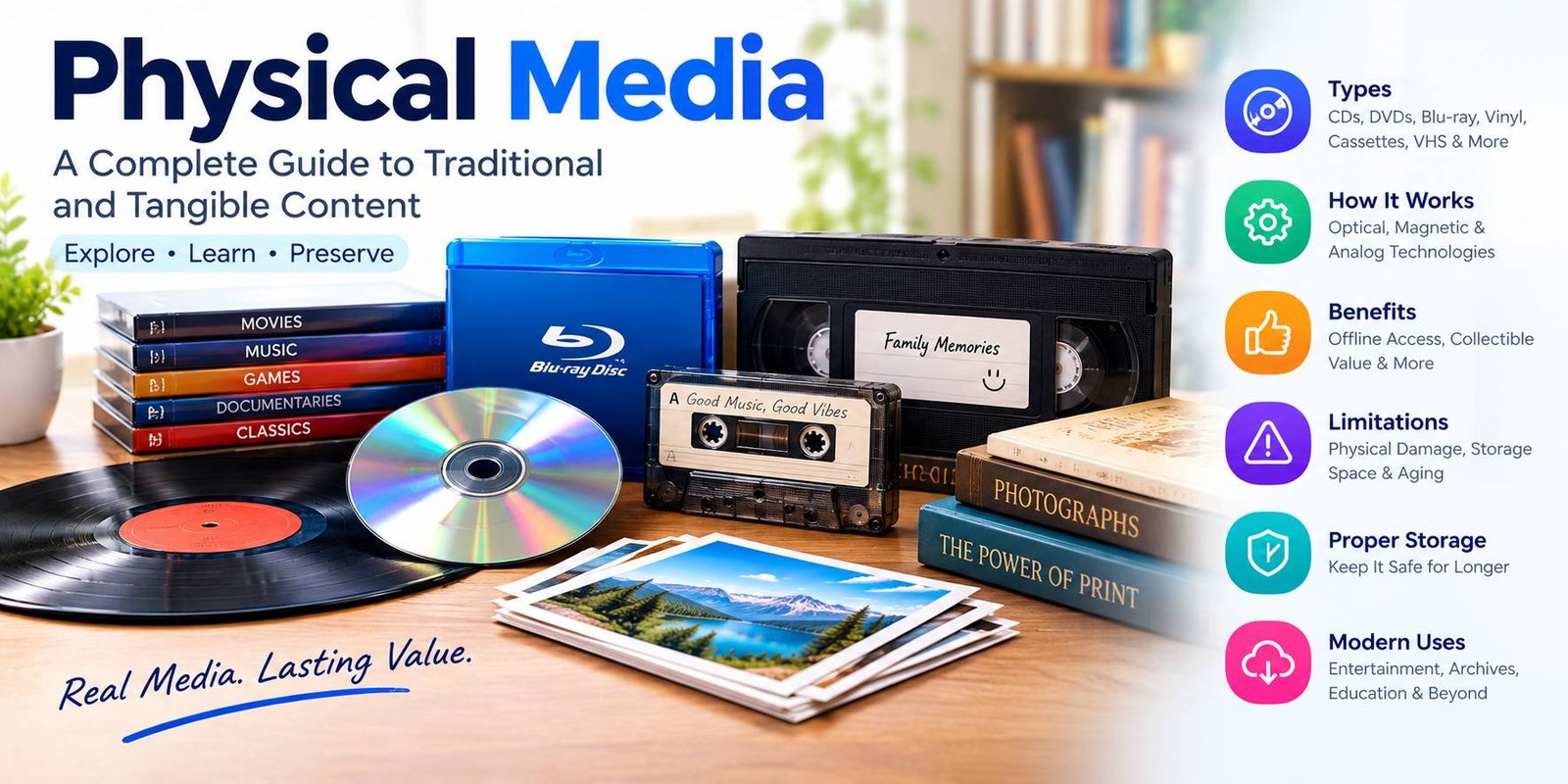
Physical Media: Types, Uses, Benefits & Complete Guide
Even though most people now use streaming platforms, cloud storage, and online downloads, physical media has not disappeared. CDs, DVDs, vinyl records, cassette tapes, Blu-ray discs, and other tangible formats are still used by collectors, businesses, archives, and people who want access to content without depending entirely on an online service.
But what exactly is physical media, and why does it still matter in the digital age?
This guide explains the concept in simple language, explores different examples, and looks at the benefits, limitations, storage requirements, and modern uses of physical media.
What Is Physical Media?
Physical media is a tangible object that contains, carries, distributes, or preserves information.
Unlike content that exists only as a cloud file or online stream, physical media has an actual object associated with it. Depending on the technology, that object may store information using optical, magnetic, mechanical, or other physical methods.
For example, a movie stored on a DVD is physical media. A music album pressed onto vinyl is also physical media. A cassette containing an audio recording falls into the same broad category.
The exact way information is stored varies from one format to another.
Why Is Physical Media Different From Digital Content?
The main distinction is the presence of a physical carrier.
When you stream a movie, the content is delivered through a digital network. When you store a document in cloud storage, you normally access it through an internet-connected service.
With physical media, the information is associated with an object that you can physically possess.
This difference affects several things, including:
- How the content is accessed
- Whether an internet connection is required
- How much storage space is needed
- What equipment is necessary
- How the material can be collected or preserved
Examples of Physical Media
There are many forms of physical media, and each was developed for a different purpose.
CDs
Compact discs became widely popular for music, software, photographs, and computer data.
A CD uses optical technology to store information. A compatible optical drive or player is required to read its contents.
Although CDs are less common than they once were, they remain important to music collectors, archives, and people with existing disc libraries.
DVDs
DVDs became a popular way to distribute movies, television programs, software, and other digital information.
Compared with traditional CDs, DVDs provide more storage capacity and became an important part of home entertainment before online streaming became widespread.
Many people still maintain DVD collections because they provide an offline way to access purchased content.
Blu-ray Discs
Blu-ray is another optical format designed for higher-capacity storage.
It became especially associated with high-definition movies and larger video files. Blu-ray discs can provide more space than standard DVDs, making them suitable for content that requires additional storage capacity.
Vinyl Records
Vinyl records are one of the most recognizable examples of physical media.
Instead of storing audio as a modern digital file, a traditional vinyl record represents sound through grooves on its surface. A turntable and stylus are used to reproduce the recording.
Vinyl has also developed into a popular collector format, with album artwork and the physical record forming part of the overall experience.
Cassette Tapes
Cassette tapes use magnetic tape to record sound.
They were once commonly used for music, voice recordings, and personal mixtapes. Although they are no longer a mainstream audio format, cassette releases and older recordings continue to interest collectors.
VHS Tapes
VHS tapes were widely used for recording and watching video before DVDs and digital video became dominant.
A VHS recording normally requires a compatible VCR for playback. Old family recordings are one reason some people continue to preserve VHS equipment and tapes.
Printed Materials
Physical media is not limited to electronic storage.
Printed books, magazines, newspapers, photographs, posters, and documents can also be considered physical forms of information media because the information is carried on a tangible object.
How Does Physical Media Store Information?
Different physical formats use different methods.
Optical discs use microscopic physical structures that are interpreted by a laser. Magnetic tapes store information through changes in magnetic properties. Vinyl records represent audio through grooves that a stylus follows.
This means there is no single technology behind all physical media.
The common feature is that information is connected to a physical carrier rather than existing solely as an intangible online service or digital distribution channel.
Advantages of Physical Media
Physical formats continue to attract users for several reasons.
1. Offline Availability
One useful characteristic of physical media is that it can often be accessed without an internet connection.
A compatible disc player, record player, or other device may be enough to use the content.
This can be helpful in situations where internet access is unavailable or unreliable.
2. Tangible Ownership
A physical copy gives the user an actual object to keep.
For collectors, this can be especially valuable because the packaging, artwork, edition, and condition of the item can all contribute to its appeal.
3. Collectible Value
Some physical releases become collector’s items.
Special editions, limited releases, older records, rare games, and historical recordings may have value beyond the information they contain.
4. No Need for Continuous Streaming
A physical movie, album, or other item does not depend on a streaming platform remaining available for every viewing or listening session.
The user can access the copy as long as the item and necessary equipment remain usable.
5. Useful for Archives
Physical formats can be important sources of historical information.
Libraries, museums, archives, and private collectors may preserve older recordings and documents because the physical object itself can have cultural or historical significance.
Disadvantages of Physical Media
Physical media also comes with practical challenges.
Physical Damage
Objects can be scratched, cracked, bent, exposed to moisture, or otherwise damaged.
Magnetic tape can also experience deterioration over time, making older recordings increasingly difficult to use.
Requires Space
A large collection of discs, records, tapes, or printed materials can occupy considerable physical space.
Someone with hundreds of albums or movies may need shelves, cabinets, or dedicated storage areas.
Older Equipment Can Be Difficult to Find
One of the biggest challenges with older formats is hardware compatibility.
A VHS tape is not useful without a working VCR. Likewise, an old computer disc may become difficult to access if suitable drives are no longer commonly available.
Physical Media Can Age
Keeping an item untouched does not necessarily guarantee permanent preservation.
Both the physical material and the technology needed to read it can eventually become obsolete.
Physical Media and Digital Media Compared
Physical and digital media serve many of the same purposes, but they work differently.
| Feature | Physical Media | Digital Media |
|---|---|---|
| Tangible object | Yes | Usually no |
| Internet required | Often not | Sometimes |
| Physical storage space | Required | Usually minimal locally |
| Hardware dependency | Can be significant | Device/software dependent |
| Collectible potential | High for some formats | Generally different |
| Easy duplication | Depends on format | Usually easier |
| Vulnerable to physical damage | Yes | Less directly |
| Risk of technological obsolescence | Yes | Yes |
The right choice depends on what the user wants to accomplish.
Is Physical Media Still Relevant?
Yes, although its role has changed.
For everyday entertainment, many people now prefer streaming and downloads because they are convenient. However, physical media continues to have applications in collecting, archival work, offline access, personal preservation, and certain entertainment markets.
Some users also prefer having a permanent physical item rather than depending exclusively on an online platform.
Physical Media for Personal Collections
Building a physical collection can be more than simply storing information.
A collection may include:
- Favorite music albums
- Movies
- Video games
- Books
- Family photographs
- Old recordings
- Historical documents
- Limited-edition releases
For collectors, the condition and presentation of an item can matter almost as much as its content.
How to Store Physical Media Safely
Good storage practices can extend the useful life of physical formats.
Keep Items Away From Moisture
Water and excessive humidity can damage many physical formats. Store valuable materials in a clean and reasonably controlled environment.
Avoid Direct Sunlight
Long-term exposure to unsuitable light and heat can contribute to deterioration of some materials.
Handle Discs Correctly
When handling optical discs, avoid touching the recording surface whenever possible. Holding the edges is a safer practice.
Keep Tapes Protected
Magnetic tapes should be stored carefully and protected from unsuitable environmental conditions.
Maintain Backup Copies
If a physical item contains irreplaceable family photographs, recordings, or documents, consider creating a digital copy.
This provides an additional way to access the information if the original becomes damaged.
Should Old Physical Media Be Digitized?
For important material, digitization can be useful.
Imagine having a box of family VHS tapes recorded many years ago. The tapes may still contain valuable memories, but the equipment needed to play them may become increasingly difficult to maintain.
Converting important recordings into modern digital files can make them easier to access and duplicate.
However, digitization does not necessarily mean throwing away the original. If the physical item has sentimental, historical, or collection value, keeping it may still make sense.
Physical Media in the Entertainment Industry
Physical formats have played a major role in music, movies, television, books, and gaming.
Before streaming became common, consumers often purchased entertainment in physical forms. Even today, special editions, collector releases, vinyl albums, Blu-ray sets, books, and physical video games can appeal to audiences who want something tangible.
This makes physical media both a technological format and, in some cases, a cultural product.
Physical Media for Data Preservation
Long-term preservation requires more than simply putting an old disc or tape into a box.
There are two important questions:
Can the physical item survive?
and
Will future technology still be able to read it?
A disc may remain physically intact while compatible hardware becomes difficult to find. A tape may have working equipment available while the recording itself has degraded.
For valuable information, maintaining more than one copy and periodically reviewing the preservation strategy can reduce the risk of permanent loss.
What Should You Do With Old Physical Media?
If you have old CDs, DVDs, tapes, photographs, or other formats, first determine whether the information is still valuable.
For important material:
- Identify the content.
- Check its physical condition.
- Find compatible playback equipment.
- Create a digital copy when appropriate.
- Keep more than one backup of irreplaceable digital files.
- Store the original carefully if it has personal or historical value.
This approach can help protect information from both physical deterioration and technological change.
Frequently Asked Questions
What is physical media?
Physical media is a tangible format used to carry, store, distribute, or preserve information. CDs, DVDs, vinyl records, and cassette tapes are common examples.
Is a CD considered physical media?
Yes. A CD is a tangible optical storage format and is therefore a type of physical media.
Is vinyl physical media?
Yes. Vinyl records are physical media that traditionally reproduce analog audio through grooves on the record surface.
Is a DVD physical media?
Yes. DVDs are tangible optical discs used for storing and distributing digital information.
Does physical media require the internet?
Usually, no. Many physical formats can be used offline, although the required playback device must be available and functional.
Is physical media obsolete?
Not completely. Many older formats are less common than they once were, but physical media remains relevant for collecting, offline access, preservation, and specialized entertainment products.
How long does physical media last?
There is no single lifespan that applies to every format. Durability depends on the material, storage conditions, handling, manufacturing quality, and format.
Should I keep my old CDs and DVDs?
If they contain valuable, rare, personal, or irreplaceable information, keeping them may be worthwhile. For important data, creating an additional digital copy is also a sensible precaution.
Final Thoughts
Physical media represents a different way of storing and experiencing information in comparison with today’s online-first world.
From vinyl records and cassette tapes to DVDs, Blu-ray discs, CDs, photographs, and printed materials, these formats have played an important role in preserving and distributing information.
Digital technology has made access faster and more convenient, but physical formats still offer tangible ownership, offline access, collectibility, and potential historical value.
For important personal content, combining carefully preserved physical originals with reliable digital backups can provide a practical approach to long-term access.