Bibliography Generator: Features, Uses and Benefits
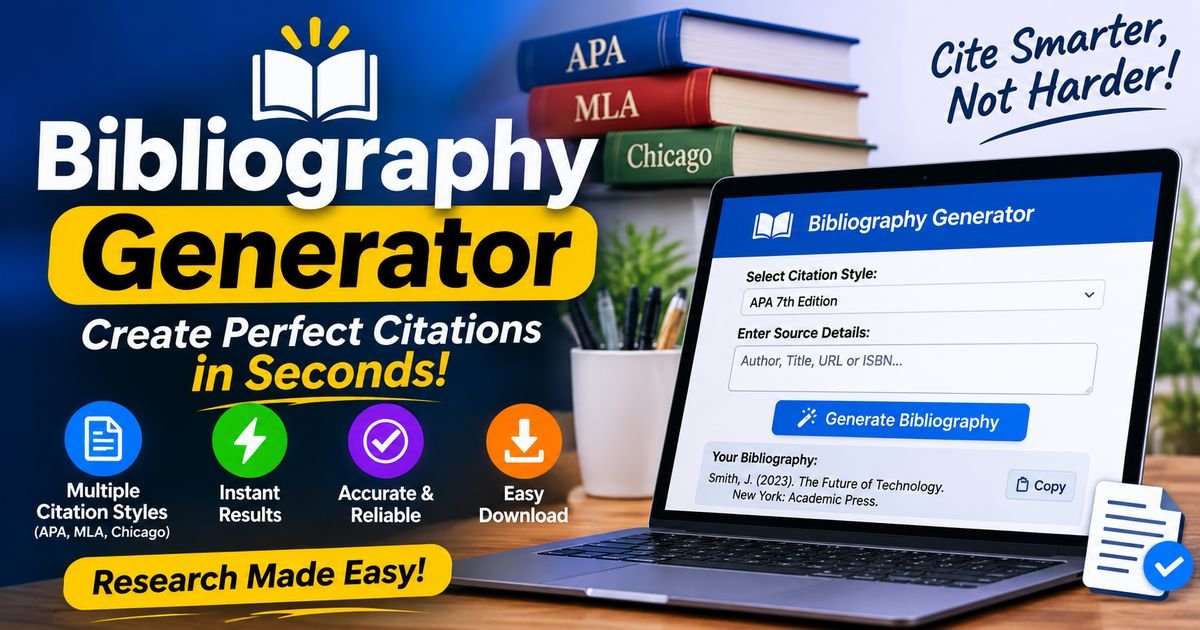
A bibliography generator is a useful online tool that helps students, researchers, teachers, and writers create properly formatted references. It simplifies the process of citing books, websites, journal articles, research papers, and other information sources. Instead of arranging every publication detail manually, users can enter basic information and allow the tool to organise it according to a selected citation style.
Academic writing requires more than collecting information and presenting ideas. Writers must also acknowledge the original sources they use. Proper referencing allows readers to identify publications, verify information, and explore related research. However, preparing citations manually can become confusing, particularly when a document contains many different sources.
Fortunately, a bibliography generator makes this process easier. It can arrange author names, publication dates, titles, publishers, and other details into recognised citation formats. Furthermore, many modern tools support different referencing styles, automatic source lookup, and reference management features.
Whether you are preparing a school assignment, university project, research paper, or professional report, understanding bibliography generators can improve your writing process. This guide explains how these tools work, their main features, advantages, limitations, and practical applications.
What Is a Bibliography Generator?
A bibliography generator is an online service or software application that creates formatted references from publication information. It helps users prepare bibliographies, reference lists, and citations without manually arranging every detail.
A bibliography is a collection of sources consulted or used while preparing a document. These sources may include books, academic journals, websites, newspapers, reports, videos, and other publications.
Each citation style follows its own formatting rules. For example, APA, MLA, Chicago, and Harvard use different methods to arrange author names, dates, titles, and publication information. A bibliography generator applies the selected rules to the information supplied by the user.
The process usually begins with entering a source title, author name, ISBN, DOI, or website address. Some tools can retrieve publication details automatically. Others require users to provide the information manually.
After collecting the necessary details, the generator produces a formatted reference. Users can then review the result and copy it into their documents.
Moreover, certain platforms allow users to save multiple references in one research project. This feature is particularly useful for students and researchers working with large collections of publications.
Why Do People Use a Bibliography Generator?
Referencing is an important part of academic and professional writing. It identifies the original creators of information and allows readers to locate the materials behind particular statements.
However, citation formatting can become a time-consuming task. Different publications require different information, and every referencing style has specific requirements.
A bibliography generator reduces this workload by automating repetitive formatting tasks.
Saves Time During Writing
Preparing references manually can take considerable time. Writers must check publication information, arrange author names, and follow the correct formatting rules.
A citation generator handles much of this work automatically. Instead of formatting every reference individually, users can enter the available details and generate a citation within seconds.
As a result, students can spend more time researching, editing, and improving their assignments.
Helps Maintain Consistent Formatting
Consistency is important when preparing academic documents. A reference list should follow the same formatting rules throughout the entire document.
For example, author names, publication dates, and titles should appear in the correct order.
A bibliography generator applies a consistent structure to each reference. Therefore, it can reduce formatting differences between individual entries.
Supports Academic Integrity
Academic integrity means presenting information honestly and acknowledging the work of other people.
Whenever writers use information from another publication, they should provide appropriate attribution. This applies to direct quotations, paraphrased ideas, and information obtained from research materials.
A bibliography generator makes it easier to prepare the required references. Nevertheless, users must still ensure that every borrowed idea receives appropriate attribution.
Makes Research Easier to Organise
Research projects often involve numerous books, articles, reports, and websites. Keeping track of every source can become difficult.
Some bibliography generators provide reference libraries where users can save and organise their publications.
Additionally, these collections can make it easier to return to important materials during editing. This is especially helpful when preparing lengthy research papers or dissertations.
How Does a Bibliography Generator Work?
Most bibliography generators follow a straightforward process. Although their interfaces may look different, the basic steps are generally similar.
Step 1: Select a Source Category
First, users select the type of publication they want to reference.
Common categories include books, journal articles, websites, newspapers, magazines, reports, and videos.
Choosing the correct category is important because different publications require different information.
For instance, a book citation may need a publisher and edition number. In comparison, a journal article may require a journal title, volume, issue, and page range.
Step 2: Enter Publication Details
After selecting a source category, users provide the available publication information.
This information may include:
- Author or organisation name
- Publication title
- Publication date
- Publisher
- Website name
- Page numbers
- ISBN or DOI
- Website address
Some generators also provide automatic lookup options. In these cases, users can enter an identifier or publication title to retrieve available information.
However, automatically retrieved information should always be checked against the original source.
Step 3: Choose a Citation Style
The next step is selecting the required referencing format.
Popular choices include APA, MLA, Chicago, Harvard, IEEE, and Vancouver.
Each style has its own rules for presenting publication details. Therefore, users should select the format requested by their school, university, publisher, or research organisation.
Step 4: Generate the Citation
Once the source details and citation style are selected, the generator processes the information.
It then arranges the details into the selected reference format.
Depending on the platform, users may also receive an in-text citation that can be inserted into the main document.
Step 5: Check the Generated Reference
Reviewing the result is an essential part of the process.
Users should check the author’s spelling, publication date, title, publisher, and other available details.
Furthermore, they should confirm that the selected style matches the assignment requirements.
Automated tools can sometimes retrieve incomplete information. Therefore, reviewing the original publication helps prevent mistakes.
Step 6: Copy, Save, or Export
After checking the citation, users can copy it into their document.
Some platforms also provide options to save references, create collections, or export information into supported file formats.
These features are particularly useful when working with large research projects.
Popular Citation Styles Supported by Bibliography Generators
Different academic subjects use different referencing systems. Consequently, bibliography generators often support several citation styles.
Understanding these formats can help users select the correct option.
APA Style
APA stands for American Psychological Association. It is widely used in psychology, education, social sciences, and related academic fields.
The APA system generally uses the author’s name and publication year in in-text citations.
A complete reference provides additional information about the publication, such as its title, publisher, journal details, or DOI.
APA 7th edition is commonly required by educational institutions. However, users should always check the specific edition requested for their assignment.
MLA Style
MLA stands for Modern Language Association. It is commonly used in literature, language studies, humanities, and related subjects.
The MLA system focuses on identifying the author and source title. Its Works Cited section provides the information readers need to locate the original material.
MLA referencing is especially useful for literary analysis and academic writing involving books, articles, and other publications.
Chicago Style
Chicago style is widely used in history, publishing, and several academic disciplines.
It provides two main documentation systems.
The notes and bibliography system uses footnotes or endnotes alongside a bibliography. Meanwhile, the author-date system uses parenthetical citations and a reference list.
A bibliography generator can simplify both methods when the selected platform supports them.
Harvard Referencing
Harvard is an author-date referencing system used by many educational institutions.
It generally includes the author’s surname and publication year within the text. A corresponding reference list provides complete publication details.
Unlike some other citation systems, Harvard does not have one universal official manual followed by every institution.
Therefore, students should review their university’s specific Harvard guidelines before submitting an assignment.
IEEE Style
IEEE stands for Institute of Electrical and Electronics Engineers.
This referencing style is commonly used in engineering, computing, electronics, and technical research.
It generally uses numbered citations within the document. Each number corresponds to a complete entry in the reference list.
As a result, IEEE is particularly useful for technical papers containing many references.
Vancouver Style
Vancouver is commonly associated with medical and scientific publishing.
It uses numbered citations according to the order in which sources appear in a document.
The reference list follows the same numbering system, allowing readers to identify the original publications.
Researchers preparing medical manuscripts may find Vancouver support particularly useful.
Main Features of a Bibliography Generator
Bibliography generators offer different features depending on their intended audience. Some focus on quick citation creation, while others provide advanced research-management functions.
Automatic Citation Formatting
Automatic formatting is the main purpose of a bibliography generator.
The tool converts publication information into a structured reference based on the selected citation style.
Consequently, users do not need to remember every punctuation and formatting requirement.
Multiple Source Categories
A useful bibliography generator should support different types of publications.
For example, users may need references for books, academic journals, newspapers, websites, reports, conference papers, and online videos.
Supporting multiple categories makes the tool suitable for different academic subjects.
Citation Style Selection
Citation style selection allows users to choose how their references should appear.
For instance, the same publication information can be presented differently in APA, MLA, and Chicago formats.
Some platforms also support different editions of the same referencing style.
Automatic Source Lookup
Automatic lookup is another helpful feature.
Users may enter a DOI, ISBN, publication title, or URL to retrieve available source information.
The generator then uses the retrieved details to create a formatted reference.
However, automatic lookup is not always perfect. Users should confirm that the retrieved information belongs to the exact publication they consulted.
In-Text Citation Creation
Many bibliography generators can create both complete references and in-text citations.
An in-text citation appears within the main content and connects a statement to its original source.
For example, APA commonly uses an author-date format, whereas IEEE uses numbered citations.
This feature helps users maintain consistency between their document and reference list.
Reference Management
Reference management allows users to collect and organise publications in one location.
Some platforms provide folders, projects, collections, or tagging options.
These features are useful when researching several subjects or preparing lengthy academic documents.
Export and Download Options
Export features make it easier to transfer references into other applications.
Depending on the service, users may copy formatted text or export information into supported document and reference-management formats.
This can improve the writing process, especially when working with word processors.
Duplicate Reference Detection
Some advanced tools can identify duplicate entries within a reference collection.
This is helpful when users import publications from several research databases.
Removing repeated entries keeps a bibliography organised and prevents unnecessary duplication.
Benefits of Using a Bibliography Generator
A bibliography generator offers several advantages for people who regularly prepare academic or research-based documents.
Easier Academic Writing
Academic writing involves research, planning, editing, and proper referencing.
Automating citation formatting removes a repetitive task from the process.
As a result, writers can focus more attention on the quality of their explanations and arguments.
Better Reference Accuracy
Citation tools apply predefined formatting patterns. This can reduce mistakes involving punctuation, author order, and publication details.
Nevertheless, the accuracy of the final reference depends on the information supplied or retrieved.
Therefore, users should always check the generated results.
Helpful for Beginners
Students who are learning citation styles may find referencing confusing at first.
A bibliography generator provides practical examples of how different sources should be presented.
By reviewing these examples, beginners can become more familiar with academic referencing rules.
Supports Large Projects
Long research projects may involve dozens or hundreds of publications.
Managing every source manually can become difficult.
A reference-management feature makes it easier to save, organise, and retrieve publication information.
Useful Across Different Subjects
Different academic subjects may require different citation styles.
A generator that supports multiple formats can help students prepare assignments for several courses.
Furthermore, researchers can use the same platform for different publication requirements.
Bibliography Generator for Students
Students are among the most common users of citation generators.
School assignments, college projects, presentations, and university research papers often require properly formatted references.
School Assignments
School assignments may include information from textbooks, educational websites, and other publications.
A bibliography generator helps students organise these materials into a reference list.
It also introduces learners to the importance of acknowledging original sources.
College Projects
College students often use several types of publications when preparing reports and presentations.
These may include books, online articles, research papers, and official reports.
A citation tool can help maintain consistent formatting throughout the project.
University Research
University assignments frequently have detailed referencing requirements.
Students may need to use a specific citation style and provide complete publication information.
Advanced generators can simplify this process through automatic lookup and reference-management features.
However, university guidelines should remain the final authority.
Bibliography Generator for Researchers
Researchers regularly work with large collections of academic publications.
They may need to prepare literature reviews, journal articles, research proposals, and dissertations.
A bibliography generator can support these tasks by organising references and simplifying citation formatting.
Literature Reviews
A literature review examines existing research related to a particular subject.
It often includes many academic publications from different authors and research organisations.
A citation generator helps researchers prepare the required references while maintaining a consistent format.
Research Papers
Research papers require accurate citations to support arguments and identify earlier studies.
A bibliography generator can reduce the time spent formatting individual entries.
Moreover, reference-management features can help researchers organise publications throughout the writing process.
Academic Publications
Different journals and publishers may require specific citation styles.
Researchers can use bibliography generators to adapt references to those requirements.
However, they should review the publication’s official instructions before submitting a manuscript.
Online Bibliography Generator vs Manual Referencing
Automatic and manual referencing methods both have advantages.
Manual referencing gives writers direct control over every citation. It can also help students understand the rules of their chosen citation style.
However, preparing many references manually requires time and attention.
An online bibliography generator automates much of the formatting process. Therefore, it can be more convenient when working with large source collections.
The main difference is the amount of manual effort required.
Automatic tools are useful for producing initial citations. Meanwhile, manual checking helps ensure that the final references are complete and accurate.
For most users, combining both approaches provides a practical solution.
How to Choose the Best Bibliography Generator
Not every citation generator provides the same features. Some are designed for quick references, while others focus on advanced research management.
The right choice depends on your requirements.
Check Citation Style Support
First, confirm that the tool supports the referencing style required for your document.
For example, if your university requires APA 7th edition, make sure the platform offers that specific version.
Look at Supported Source Types
Different projects require different publication categories.
Students may mainly use books, websites, and journal articles. In contrast, researchers may also need conference papers, government reports, and specialist publications.
Choose a tool that supports the sources you regularly use.
Examine Automatic Lookup
Automatic source lookup can save time by retrieving publication details.
However, the tool should provide information that matches the original source.
Check author names, titles, dates, and publication information before accepting the generated citation.
Consider Export Options
Export features can be useful when preparing longer documents.
A platform that allows users to copy references or transfer them into compatible software may improve their workflow.
Choose an Easy Interface
A good bibliography generator should be straightforward to use.
Users should be able to select a source, enter its details, choose a citation style, and generate a reference without unnecessary steps.
Review Privacy Policies
Some citation platforms allow users to upload documents or save research collections.
Before sharing unpublished research, review the platform’s privacy and data-handling policies.
Compare Free and Paid Features
Several citation generators provide basic features without payment.
However, advanced functions may require a subscription.
These can include larger reference libraries, collaboration tools, additional export options, or specialised research features.
Choose a platform according to your actual needs.
Popular Bibliography Generator and Citation Tools
Several platforms provide citation generation and reference-management services.
Each option has its own strengths and intended audience.
Zotero
Zotero is a reference-management application that helps users collect, organise, cite, and share research materials.
It supports different publication types and integrates with compatible writing applications.
Furthermore, its browser tools can help users save bibliographic information from supported websites.
Zotero is particularly useful for students and researchers who manage large collections of sources.
MyBib
MyBib is an online citation generator designed to simplify academic referencing.
It supports several common citation styles and different source categories.
Its straightforward interface makes it useful for students who need to create references quickly.
Scribbr Citation Generator
Scribbr provides academic writing resources and citation tools.
Its citation generator supports popular referencing styles and helps users prepare formatted references.
It can be useful for students who want additional guidance while preparing academic documents.
Citation Machine
Citation Machine is an online service for creating references in different citation formats.
It supports several academic styles and offers tools for organising citations.
Users should still review generated information before adding it to their assignments.
EasyBib
EasyBib provides citation and bibliography tools for academic writing.
It is designed to help users prepare references from different publication types.
Available features and access options may depend on the current service offering.
BibGuru
BibGuru is an online citation tool that helps users create formatted references from publication information.
It supports several common citation styles and provides a simple approach to citation creation.
This makes it a useful option for students who need straightforward referencing assistance.
EndNote
EndNote is a reference-management platform used by researchers and academic professionals.
It provides tools for collecting publications, organising sources, and inserting citations into supported writing applications.
Its advanced research features make it suitable for large academic projects.
Common Mistakes to Avoid When Using a Bibliography Generator
Although citation generators simplify referencing, users can still make mistakes.
Understanding these problems can improve the quality of academic documents.
Entering Incorrect Author Names
Author information is an important part of most citation styles.
Incorrect spelling, missing authors, or the wrong author order can produce inaccurate references.
Always compare the generated information with the original publication.
Using the Wrong Publication Date
Online sources sometimes display publication dates and update dates separately.
Different citation styles may have specific rules for using this information.
Therefore, users should identify the correct date before generating a reference.
Selecting an Incorrect Source Type
A journal article and a website article may require different formatting.
Choosing the wrong category can produce an incorrectly structured citation.
Always select the source type that accurately represents the material being referenced.
Ignoring Missing Details
Some publications do not provide every detail required by a citation style.
For example, a website may not identify an individual author or publication date.
In these situations, users should follow the official referencing rules for missing information rather than inventing details.
Mixing Citation Styles
A reference list should follow a consistent formatting system.
Combining APA, MLA, and Chicago styles in one document can create unnecessary confusion.
Choose the required format and apply it consistently.
Forgetting In-Text Citations
A bibliography alone may not satisfy every academic referencing requirement.
Many assignments also require citations within the main text.
Writers should make sure that borrowed information is properly acknowledged wherever necessary.
Not Checking URLs and DOIs
Online references often contain website addresses or digital object identifiers.
An incorrect link can make it difficult for readers to locate the original publication.
Always verify these details before submitting your document.
Bibliography Generator and Plagiarism Prevention
A bibliography generator supports responsible academic writing, but it is not a plagiarism detector.
Plagiarism occurs when someone presents another person’s words, ideas, or work as their own without appropriate acknowledgement.
Citations help identify the original sources of information.
A bibliography generator makes it easier to prepare references. However, it cannot independently determine whether every borrowed idea has been correctly attributed.
Writers should understand the differences between quoting, paraphrasing, and summarising.
Direct quotations must follow the selected citation style. Similarly, paraphrased ideas obtained from another publication generally require appropriate attribution.
A complete bibliography supports academic transparency, but it does not automatically make a document free from plagiarism.
Students should combine citation tools with careful research practices and their institution’s academic integrity policies.
Can a Bibliography Generator Create Website References?
Yes. Many bibliography generators support website citations.
Website references can sometimes be complicated because online information may change over time.
Depending on the citation style, a website reference may require an author or organisation name, page title, website name, publication date, and URL.
Some styles may also require an access date in particular circumstances.
However, not every website provides an individual author or clear publication date.
Users should follow the relevant citation rules when information is missing.
It is also important to reference the specific webpage containing the information rather than automatically using the website’s homepage.
Can a Bibliography Generator Create Book References?
Yes. Books are among the most common source categories supported by bibliography generators.
A typical book citation may require the author’s name, publication year, title, edition, and publisher.
Some styles also require additional information.
Users may enter an ISBN to help a supported lookup service identify a book.
Nevertheless, an ISBN search does not guarantee that every publication detail will be correct.
Different editions can contain different publication information. Therefore, users should check that the generated reference matches the edition they actually consulted.
Can a Bibliography Generator Create Journal Article References?
Many bibliography generators support academic journal articles.
These references may require more detailed publication information than ordinary website citations.
Common details include the author names, publication year, article title, journal name, volume, issue, page range, and DOI.
A DOI is particularly useful because it provides a persistent identifier for a digital publication.
Researchers should confirm that the DOI and article details refer to the same publication.
Future of Bibliography Generator Technology
Bibliography generation continues to develop as digital research and academic publishing change.
Modern platforms increasingly connect citation tools with research databases, writing applications, and reference-management systems.
These developments can make collecting and organising publications more convenient.
Artificial Intelligence Integration
Artificial intelligence may help users identify publication details, organise references, and recognise possible formatting problems.
AI-assisted tools can also suggest missing information or recommend a suitable source category.
However, automatically generated reference information must be checked.
A realistic-looking citation does not prove that a publication exists or that its details are correct.
Improved Database Connections
Better connections with academic databases may help citation tools retrieve more accurate publication information.
This can be especially useful for researchers working with large collections of journal articles and conference papers.
Reliable database connections also reduce the need for manual data entry.
Better Collaboration Features
Research projects often involve several writers working together.
Reference-management tools can help team members share publication collections and maintain consistent citation practices.
As a result, collaboration features may become increasingly useful for universities and research organisations.
Integration With Writing Applications
Integration with word processors is another important development.
Users can already manage citations directly within several supported writing applications.
Further improvements may reduce the need to switch between different platforms while preparing academic documents.
Frequently Asked Questions About Bibliography Generators
What Is a Bibliography Generator Used For?
A bibliography generator creates formatted references for books, websites, journal articles, reports, and other information sources. It helps users prepare citations according to recognised academic styles.
Is a Bibliography Generator Free?
Some bibliography generators offer free citation creation, while others provide paid plans for advanced features. Pricing and available functions depend on the platform.
Which Citation Styles Do Bibliography Generators Support?
Common options include APA, MLA, Chicago, Harvard, IEEE, and Vancouver. However, the available styles vary between services.
Can a Bibliography Generator Create APA References?
Yes. Many generators support APA formatting, including APA 7th edition. Users should confirm that the selected version matches their institution’s requirements.
Can Students Use Bibliography Generators?
Yes. Students can use these tools to prepare references for school assignments, college projects, university essays, and research papers.
Is a Bibliography Generator Accurate?
It can produce correctly formatted references when the supplied information is accurate. Nevertheless, users should review the results because automatic lookup systems can retrieve incomplete or incorrect details.
What Is the Difference Between a Bibliography and a Reference List?
A reference list generally includes sources cited directly in a document. A bibliography may also include additional materials consulted during research. Exact definitions depend on the citation style and academic guidelines.
Can a Bibliography Generator Create In-Text Citations?
Many generators support both full references and in-text citations. Available options depend on the platform and selected referencing style.
Do Bibliography Generators Support Websites?
Yes. Most popular services support website references and can organise available information such as page titles, authors, publication dates, and URLs.
Can I Generate a Citation Using a DOI?
Yes. Many tools support DOI-based lookup and can retrieve available publication information automatically.
Does a Bibliography Generator Prevent Plagiarism?
No. It helps users acknowledge sources through formatted references, but it cannot independently identify every instance of plagiarism.
Which Bibliography Generator Is Best for Students?
The best option depends on individual requirements. Zotero, MyBib, Scribbr, and other citation tools provide different combinations of automatic formatting and reference-management features.
Can I Change the Citation Style After Generating a Reference?
Many generators allow users to change the selected citation style without entering all source information again. However, this feature depends on the platform.
Do Bibliography Generators Work for Research Papers?
Yes. They can help researchers prepare and organise references for literature reviews, academic articles, dissertations, and other research documents.
Final Thoughts
A bibliography generator is a practical tool for anyone who regularly prepares academic or research-based content. It simplifies reference formatting, supports different citation styles, and reduces repetitive work during writing.
Students can use these tools for assignments and research projects. Similarly, teachers, researchers, and professionals can organise publication information and maintain consistent references.
Platforms such as Zotero, MyBib, Scribbr, Citation Machine, BibGuru, and EndNote provide different approaches to citation creation and reference management.
Although automatic referencing saves time, checking every generated citation remains important. Users should verify author names, publication dates, titles, publishers, and digital links before submitting their documents.
Ultimately, a bibliography generator works best as a supporting tool within a responsible research process. When combined with accurate source information and proper citation practices, it can make academic writing more organised, efficient, and reliable