
Translator English to Hindi : Complete Guide
Introduction
A translator English to Hindi helps people understand written information, conversations, instructions, and digital content across two widely used languages. English is commonly used in education, business, technology, and international communication, while Hindi is spoken by millions of people in India and by communities around the world. Because these languages have different grammar systems, sentence structures, expressions, and writing styles, translating between them requires more than replacing individual words.
People use English to Hindi translation for many different reasons. Students may need help understanding study material, travelers may want to read signs or communicate with local people, and professionals may need to prepare documents for Hindi-speaking audiences. Website owners, content creators, teachers, and everyday internet users also depend on translation tools to make information easier to understand.
Modern translation technology has made this process faster and more convenient. Users can enter a sentence, paste a paragraph, or sometimes speak into a microphone to receive a Hindi translation. However, automated results are not always perfect. Context, tone, cultural expressions, and technical vocabulary can affect the meaning of a translated sentence.
Understanding how English to Hindi translation works can help users choose suitable tools, recognize translation mistakes, and produce more natural results. This guide explains the purpose of translation, its common uses, different methods, important features, limitations, and practical ways to improve translation quality.
What Is an English to Hindi Translator?
An English to Hindi translator is a tool, service, or person that converts information written in English into Hindi. The result may be displayed in Devanagari script, which is the standard writing system used for modern Hindi.
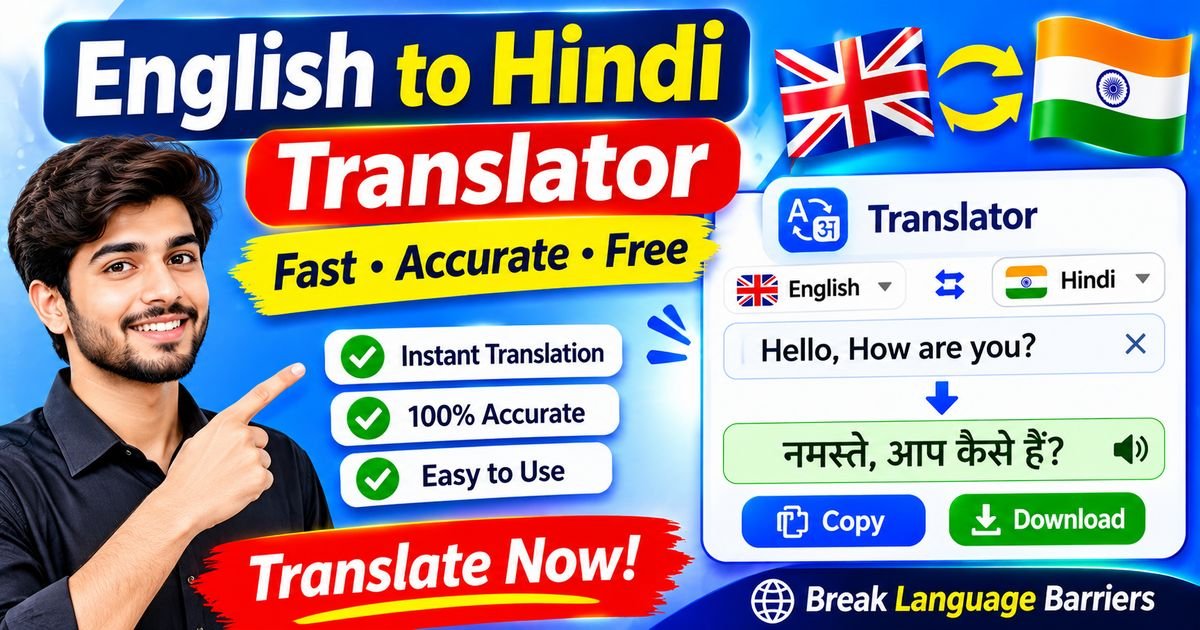
For example, the English sentence “How are you?” can be translated into Hindi as “आप कैसे हैं?” The translated version communicates the same general question, but it uses Hindi vocabulary and sentence construction.
Translation can involve a single word, a short expression, a complete sentence, or a lengthy document. The process may be performed manually by a human translator or automatically through computer software.
A simple translation tool is useful for everyday expressions, while professional translation may be necessary for legal documents, medical information, business agreements, and other content where accuracy is especially important.
The main purpose is to transfer meaning from one language into another while keeping the original message understandable.
Why English to Hindi Translation Is Important
Language differences can make useful information difficult to access. Someone who understands Hindi better than English may struggle to read an English instruction manual, educational article, or online service description.
Translation helps reduce this difficulty by making information available in a language the reader understands.
It also supports communication between people who do not share the same first language. A business can communicate with Hindi-speaking customers, a teacher can explain English learning material, and a traveler can understand common expressions used in everyday situations.
The importance of translation has increased as more information becomes available online. Websites, applications, educational platforms, and digital services often serve audiences with different language preferences.
English to Hindi translation can help people participate in these digital activities without needing advanced English skills.
However, translation should not be treated as a simple word replacement process. A useful translation communicates the intended message, not just the individual meanings of words.
How English to Hindi Translation Works
The method depends on the type of translator being used. Human translators understand the source material, identify its intended meaning, and express that meaning naturally in Hindi.
Automated translation systems use computer models to process text and generate a translated result.
Older translation systems often depended on dictionaries, language rules, and statistical patterns. Modern systems may use neural networks and artificial intelligence models that analyze relationships between words and sentences.
When a user enters an English sentence, the software processes the text and estimates an appropriate Hindi version. It considers language patterns and, depending on the system, surrounding context.
For example, the English word “light” can refer to brightness, a lamp, or something that is not heavy. The correct Hindi translation depends on the sentence in which the word appears.
A translation system that considers context has a better chance of selecting the intended meaning than a tool that translates each word separately.
Even advanced systems can make mistakes. Unusual expressions, incomplete sentences, regional language differences, and specialized terminology may produce inaccurate results.
Understanding the Differences Between English and Hindi
English and Hindi have several important linguistic differences. These differences explain why direct word-for-word translation does not always produce natural sentences.
Sentence Structure
English commonly follows a Subject-Verb-Object structure.
For example:
“She reads a book.”
Hindi generally uses a Subject-Object-Verb structure.
The same sentence can be expressed as:
“वह एक किताब पढ़ती है।”
The order of the words changes because Hindi normally places the verb near the end of the sentence.
Gender and Grammar
Hindi uses grammatical gender in many situations. Verbs and adjectives may change depending on whether the subject is masculine or feminine.
English does not use grammatical gender in the same way for most ordinary nouns and verbs.
This difference can create difficulties for automated translators, particularly when the original sentence does not clearly identify the subject.
Formal and Informal Language
Hindi has different ways of addressing people depending on the relationship and level of respect.
For example, “आप” is commonly used for respectful or formal communication, while “तुम” and “तू” may be used in different informal situations.
Choosing the wrong form can make a sentence sound unnatural or inappropriate.
Word Meanings
Some English words have several meanings, and Hindi may use different words depending on the situation.
The word “bank” may refer to a financial institution or the side of a river. A translator must understand the surrounding sentence to choose the correct meaning.
Idioms and Expressions
Idioms cannot always be translated literally. An expression that makes sense in English may sound confusing when its individual words are translated directly into Hindi.
A good translation communicates the intended idea using a natural Hindi expression.
Different Types of English to Hindi Translation
Translation tools support different kinds of language conversion. The best method depends on the content and the user’s purpose.
Word Translation
Word translation converts individual English words into Hindi equivalents.
This is useful for vocabulary learning and understanding unfamiliar terms. However, a single word may have multiple meanings, so users should check the context before selecting a translation.
Sentence Translation
Sentence translation converts a complete sentence into Hindi. It gives the translator more context than an isolated word.
This method is useful for everyday communication, basic learning, and understanding short instructions.
Paragraph Translation
Paragraph translation processes several connected sentences together. It can help preserve the relationship between ideas and improve consistency.
Users should still review long translations because an error in one sentence may affect the meaning of the surrounding content.
Document Translation
Document translation involves converting longer material such as reports, letters, study notes, and business documents.
Formatting, headings, names, technical terms, and document structure may need special attention.
Website Translation
Website translation makes online information available in Hindi. It may involve translating navigation menus, product descriptions, instructions, articles, and customer support content.
A website should be reviewed carefully after translation to make sure that the language sounds natural and that buttons and instructions remain understandable.
Voice Translation
Some applications allow users to speak in English and receive translated Hindi text or speech.
Voice translation can be helpful during conversations, travel, and situations where typing is inconvenient.
Its accuracy depends on microphone quality, pronunciation, background noise, and the application’s ability to recognize spoken language.
Common Uses of English to Hindi Translation
English to Hindi translation is useful in education, business, entertainment, travel, and everyday digital activities.
Education and Learning
Students often encounter English textbooks, online lessons, research material, and educational instructions.
Translation can help them understand difficult explanations and learn the Hindi meaning of unfamiliar vocabulary.
It can also support English language learning. A student can compare an English sentence with its Hindi translation to understand how the two languages express the same idea.
However, students should use translation as a learning aid rather than relying on it for every sentence. Reading original English material and practicing vocabulary remain important parts of language development.
Business Communication
Businesses may need to communicate with customers who prefer Hindi.
English to Hindi translation can help prepare product information, customer instructions, service descriptions, and general announcements.
A translated message should match the company’s intended tone. A formal business notice may require different wording from a friendly customer message.
For important agreements, financial documents, and official communication, professional review is recommended.
Travel and Tourism
Travelers may use translation tools to understand signs, menus, hotel instructions, transport information, and everyday conversations.
A traveler who is unfamiliar with Hindi can translate basic questions before visiting a Hindi-speaking location.
Voice translation can also help with simple conversations, although users should confirm important details rather than depending entirely on automatic results.
Online Shopping
Online shopping platforms may contain English product descriptions, specifications, return policies, and delivery information.
Hindi translation can help customers understand product details before making a purchase.
Technical specifications and warranty conditions should be checked carefully because incorrect translation could create confusion about a product.
Entertainment and Media
People use translation to understand English movie descriptions, video captions, social media posts, articles, and general entertainment content.
Hindi translations can make information more accessible to audiences who prefer reading in their own language.
Subtitles and captions require special attention because they must communicate meaning within limited screen space.
Customer Support
Customer support teams may receive questions from Hindi-speaking customers even when their internal systems use English.
Translation can help representatives understand requests and prepare replies.
For complicated problems, a human reviewer should check the message to avoid misunderstandings.
Features to Look for in an English to Hindi Translator
Different translation tools offer different capabilities. Users should select a tool according to the type of content they need to translate.
Simple Text Input
A clear text box makes it easy to enter English words, sentences, and paragraphs.
The tool should provide a convenient way to paste text and display the Hindi result without unnecessary steps.
Automatic Language Detection
Some translators identify the source language automatically. This can save time when users receive text without knowing which language it is written in.
However, automatic detection may be less reliable with very short phrases or text containing several languages.
Copy and Share Options
Copying translated text allows users to place the result into messages, documents, notes, or other applications.
Sharing options can make it easier to send a translation to another person.
Pronunciation Support
Audio playback can help users understand how a Hindi word or sentence is pronounced.
This feature is useful for language learners and people who want to practice speaking.
Voice Input
Voice input allows users to speak instead of typing. It can be convenient when entering longer sentences or when using a mobile device.
The quality of voice recognition may depend on pronunciation, microphone performance, and environmental noise.
Alternative Translations
Some tools provide multiple translation suggestions for a word or phrase.
This can help users understand that a single English word may have several Hindi meanings.
Conversation Support
Conversation features allow two people to communicate using different languages. One person speaks in English, while the application attempts to provide a Hindi version.
Such tools are useful for simple exchanges, but important information should be confirmed when accuracy matters.
Offline Access
Some applications support downloaded language data for offline translation.
Offline functionality can be helpful when internet access is limited. However, available features and translation quality may differ from the online version.
How to Use an English to Hindi Translator
The exact steps depend on the selected application, but the basic process is usually straightforward.
First, open a translation tool that supports English and Hindi.
Next, choose English as the source language and Hindi as the target language. If automatic language detection is available, it may identify English without manual selection.
Enter the English word, sentence, or paragraph into the input area.
The tool will process the text and display a Hindi translation. Read the result carefully to make sure it communicates the intended meaning.
If the translation seems unusual, try providing more context. A complete sentence is generally easier to interpret than a single isolated word.
For important communication, review the translated version before sharing it with another person.
Users can also compare alternative translations when the tool provides them. This can help identify wording that sounds more natural.
Popular Approaches to Translating English into Hindi
There is no single method that works best for every translation task.
Online Translation Tools
Online tools are convenient because they can be accessed through a web browser. Users can translate text without installing additional software.
They are suitable for everyday expressions, basic explanations, and quick language assistance.
Mobile Translation Applications
Mobile applications offer translation features through smartphones and tablets. Some support voice input, camera-based text recognition, and offline language options.
These applications are useful for people who need translation while traveling or studying.
Built-In Translation Features
Some browsers, messaging applications, and productivity tools include translation features.
They can help users understand web pages, messages, and documents without switching between several applications.
Human Translation Services
Professional translators are useful when accuracy, tone, cultural understanding, or subject knowledge is important.
They can review the original content, identify ambiguous expressions, and prepare a Hindi version suitable for its intended audience.
Human translation is especially valuable for official, legal, medical, and business material.
How Artificial Intelligence Improves Translation
Artificial intelligence has changed the way translation software processes language.
Modern systems can analyze relationships between words and sentences rather than depending only on individual dictionary entries.
This allows them to produce translations that may sound more natural in many everyday situations.
AI-based systems can also use surrounding context to estimate which meaning is most suitable.
For example, the English sentence “I am running late” should communicate that someone will arrive later than expected. A direct translation of each word may produce an awkward result, while a context-aware system can choose a more natural Hindi expression.
Some AI tools can also explain why a translation was selected or provide alternative wording.
However, artificial intelligence does not guarantee perfect translation. It can misunderstand the speaker’s intention, generate incorrect details, or use unsuitable language.
Users should treat AI translation as assistance rather than automatic proof of accuracy.
Common Translation Mistakes
Translation errors can change the meaning of a message. Understanding common mistakes helps users recognize when a result needs improvement.
Translating Every Word Separately
A sentence is more than a collection of independent words. Translating each word without considering sentence structure can produce unnatural Hindi.
The translator should focus on the complete meaning.
Ignoring Context
Words often have multiple meanings. Selecting a translation without reading the surrounding sentence may lead to an incorrect result.
Providing more context can help both human and automated translators.
Using the Wrong Level of Respect
Hindi expressions change according to the relationship between speakers.
Using an overly informal expression in a professional message may sound disrespectful. A suitable form of address should be selected according to the situation.
Incorrect Gender Agreement
Hindi grammar includes gender agreement in many sentence constructions.
A translation may sound incorrect if the verb or adjective does not match the intended subject.
Misunderstanding Idioms
Literal translations of idiomatic English expressions can create confusing sentences.
The translator should understand the intended idea and express it naturally in Hindi.
Translating Technical Terms Incorrectly
Technical vocabulary may have specialized meanings in areas such as medicine, engineering, finance, and computing.
A general translator may choose a common meaning that does not match the subject.
Specialized terminology should be checked against reliable references or reviewed by someone familiar with the field.
English to Hindi Translation for Students
Students can use translation tools to support language learning and improve reading comprehension.
When studying an English paragraph, a learner can first attempt to understand the original text. If a sentence is difficult, translating it into Hindi may clarify its meaning.
A useful approach is to compare both versions and identify unfamiliar words.
Students can maintain a vocabulary notebook containing English words, Hindi meanings, and example sentences. This helps them understand how words are used in context.
Translation can also help with grammar practice. Comparing sentence structures may show how English and Hindi arrange subjects, objects, and verbs differently.
However, copying an entire assignment from a translation tool may prevent students from developing their own language skills. It is better to use translation to understand material and then prepare an independent answer.
English to Hindi Translation for Content Creators
Content creators often publish information for audiences with different language preferences.
A creator may produce an English article and later prepare a Hindi version for another group of readers.
The process requires more than changing individual words. Titles, headings, examples, jokes, expressions, and calls to action should be suitable for Hindi-speaking readers.
A phrase that works well in English may not communicate the same feeling in Hindi.
Creators should also consider the reading level of their audience. Simple and familiar expressions are often more effective than complicated vocabulary.
After translation, the content should be reviewed for consistency. Names, product terms, dates, measurements, and technical details should remain accurate.
Translating Business and Official Documents
Business and official documents require a higher level of care than ordinary online messages.
A quotation, employment letter, agreement, policy, or financial document may contain terms with specific meanings.
An incorrect translation could cause confusion or lead to an incorrect understanding of responsibilities.
For this reason, automated translation should not be the only review method for important documents.
Organizations should use qualified translators or appropriate subject experts when the material has legal, financial, medical, or regulatory importance.
The final document should preserve important details, including names, amounts, dates, conditions, and section references.
Improving the Quality of Hindi Translations
A few practical habits can make translation results easier to understand.
Provide Complete Sentences
Instead of entering one unclear word, provide a complete sentence when possible.
More context gives the translation system a better opportunity to identify the intended meaning.
Avoid Unnecessary Abbreviations
Short forms and informal abbreviations may not be recognized correctly.
Writing the full expression can produce a clearer translation.
Check Names and Numbers
Personal names, company names, addresses, prices, dates, and measurements should be checked separately.
These details should not be changed simply because a translation tool produces a different spelling or format.
Review the Final Hindi Text
Read the translated result from beginning to end. Check whether the sentences sound natural and whether the message remains accurate.
If possible, ask a fluent Hindi speaker to review important content.
Compare Different Wording Options
When a phrase seems awkward, compare alternative translations or rewrite the original English sentence more clearly.
Sometimes improving the source sentence produces a better result than repeatedly translating the same unclear wording.
Privacy Considerations When Using Translation Tools
Users should think about privacy before entering sensitive information into an online translation service.
Some text may contain personal details, financial information, private business discussions, or confidential documents.
Before using a service, review its privacy policy and understand how submitted content may be processed or stored.
Avoid entering passwords, private identification details, confidential customer records, or sensitive company information into tools that have not been approved for that purpose.
Organizations should establish clear rules about which translation services employees may use.
For sensitive documents, a trusted professional translation process may be more appropriate.
Limitations of Automatic English to Hindi Translation
Automated translation has become useful for many everyday tasks, but several limitations remain.
One challenge is ambiguity. A short English word may have multiple meanings, and the tool may not have enough information to select the correct one.
Another challenge is cultural language. Expressions, humor, and informal speech may not have direct equivalents in Hindi.
Regional language differences can also affect word choice. Hindi speakers may use different expressions depending on their location, background, and communication style.
Technical content presents another difficulty. A translator may understand ordinary vocabulary but misunderstand a specialized term.
Long documents can introduce consistency problems, especially when the same term is translated differently in separate sections.
These limitations do not make translation tools useless. They simply mean that users should match the tool to the importance and complexity of the task.
The Future of English to Hindi Translation
Translation technology is likely to become more flexible as artificial intelligence and language processing systems continue to develop.
Future tools may provide better support for spoken conversations, regional expressions, document formatting, and context-sensitive vocabulary.
Voice translation may become more useful for everyday discussions. Improvements in speech recognition could help systems understand different speaking styles and pronunciation patterns.
AI assistants may also provide explanations alongside translations, helping users understand why a particular Hindi expression is appropriate.
However, human knowledge will remain important. Cultural understanding, professional judgment, and subject expertise are difficult to replace completely with automated systems.
The most useful translation process will likely combine technology with human review whenever accuracy and clarity are essential.
Conclusion
An English to Hindi translator makes communication easier for people who need to understand information across two different languages. It can support education, travel, business, online shopping, content creation, and everyday conversations.
Modern translation tools offer convenient features such as text conversion, voice input, pronunciation support, and alternative wording. These capabilities make language assistance more accessible than ever.
Still, translation quality depends on context, grammar, word choice, and the purpose of the message. Automated results should be reviewed when the information is important or contains specialized terminology.
By choosing an appropriate translation method, providing clear source text, and checking the final Hindi version, users can make better use of translation technology and communicate more confidently.
Frequently Asked Questions
What Is an English to Hindi Translator?
It is a tool or service that converts English words, sentences, and documents into Hindi so that Hindi-speaking readers can understand the information.
Can I Translate a Full English Paragraph into Hindi?
Yes. Many translation tools support paragraphs and longer text. The final result should be reviewed for grammar, context, and accuracy.
Is Automatic English to Hindi Translation Always Correct?
No. Automatic translation can misunderstand context, idioms, gender agreement, and specialized terminology. Important translations should receive additional review.
Which Script Is Used for Writing Hindi?
Modern Hindi is generally written in Devanagari script.
Can I Translate English into Hindi Using My Phone?
Yes. Many mobile applications and browser-based tools support English to Hindi translation on smartphones and tablets.
Can a Translator Convert Spoken English into Hindi?
Some applications support voice recognition and spoken translation. Performance depends on pronunciation, microphone quality, and background noise.
Why Does a Hindi Translation Sometimes Sound Unnatural?
English and Hindi have different grammar and sentence structures. A direct word-for-word translation may not communicate the same idea naturally.
Is Human Translation Better Than Automatic Translation?
Human translation is often preferable for complex, sensitive, or specialized material because a qualified translator can consider context, culture, and intended meaning.
Can English to Hindi Translation Help Students?
Yes. It can help students understand unfamiliar vocabulary, read difficult material, compare sentence structures, and improve language comprehension.
Should I Use an Online Translator for Official Documents?
For important legal, financial, medical, or official documents, use a qualified translator or an appropriate professional review process rather than relying only on automatic translation.






One Comment