
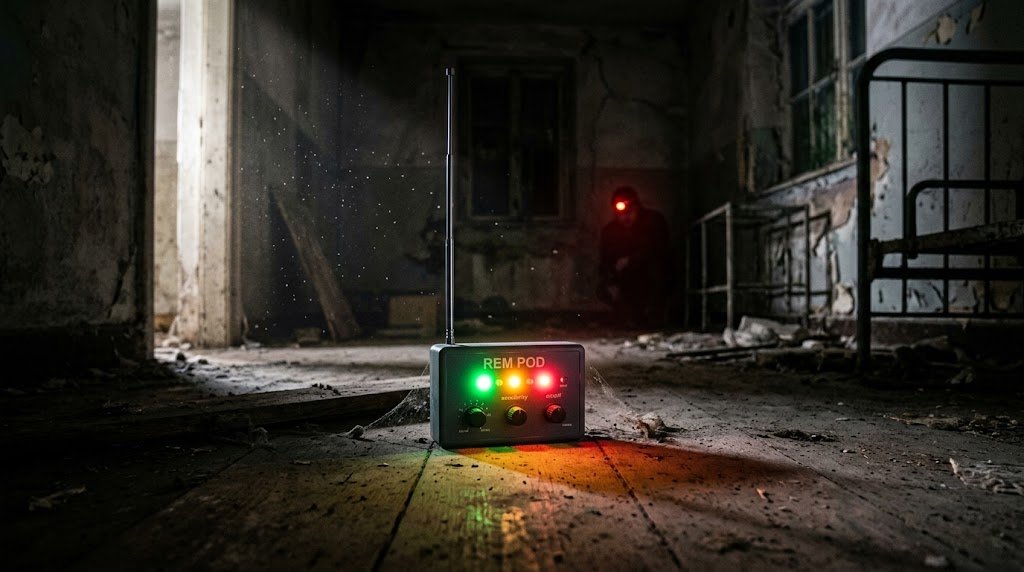
REM Pod: What It Is, How It Works, and Can It Detect Ghosts?
A REM Pod is an electronic device commonly used during paranormal investigations. It responds to disturbances around its sensing antenna and may produce lights or sounds when its activation conditions are met. Some ghost hunters interpret these alerts as possible spirit activity, but a device response alone does not establish that a ghost is present.
Table of Contents
- What Is a REM Pod?
- How Does a REM Pod Work?
- What Is a REM Pod Used For?
- Can a REM Pod Detect Ghosts?
- What Makes a REM Pod Go Off?
- REM Pod vs. EMF Meter vs. Spirit Box
- How to Use a REM Pod
- Common Mistakes to Avoid
- REM Pod Investigation Checklist
- Frequently Asked Questions
- Conclusion
Key Takeaways
- A REM Pod is an electronic sensing device used in paranormal investigations.
- Its lights and sounds indicate that its activation conditions have been met.
- Radio transmissions and nearby objects can affect some models.
- A REM Pod alert does not independently prove the presence of a ghost.
- Baseline readings, detailed notes and controlled tests help investigators assess unusual events.
- Different versions may have different features, so always check the correct operating manual.Skeptical Inquirer+1
What Is a REM Pod?
A REM Pod is a sensor-based device that paranormal investigators use to monitor changes around an antenna. When the device detects a change that meets its trigger conditions, it can respond with lights, tones or other indicators, depending on its design.
The phrase used to explain the name varies between sources. Skeptical Inquirer describes REM as “radiating electromagneticity,” while the product website uses “Radiating ElectroMagnetic energy.” The terminology is not a standardized scientific measurement, so the name should not be taken as proof of paranormal detection.
What does a REM Pod look like?
A typical device has a main housing, an antenna and visual or audio indicators. Specific features vary by model. The Rev 3 operating manual, for example, documents the controls and setup for that particular version rather than every device marketed as a REM Pod.
theshadowlands.net
Investigators generally position the unit in a location they want to monitor. They may then record its responses alongside video, audio or notes about the surrounding conditions.
Who uses a REM Pod?
A REM Pod is primarily associated with:
- Paranormal investigators exploring reportedly haunted locations.
- Ghost-hunting hobbyists interested in electronic sensors.
- Video creators producing paranormal investigation content.
- Beginners learning about investigation equipment.
The device can demonstrate how an electronic sensor responds to its surroundings. However, observing a response and identifying its cause are two separate tasks.
How Does a REM Pod Work?
A REM Pod uses an antenna and electronic circuitry to respond to changes in its sensing environment. The precise mechanism depends on the model, so the operating manual is the best source for understanding a particular unit.
1. The antenna interacts with its surroundings
In the original device examined by Kenny Biddle for Skeptical Inquirer, the internal circuitry was identified as a Junior Theremin circuit. A theremin is an electronic musical instrument whose sound can be influenced by changes in the position of a person’s hands near its antenna. The article explains how this principle was adapted in the device it examined.
Skeptical Inquirer
This finding is specific to the model examined in that investigation. It should not be assumed that every current REM Pod uses identical circuitry.
2. The sensing conditions change
A nearby hand or conductive object may alter the antenna’s electrical environment. External radio transmissions may also interfere with some units. Sensitivity, antenna design and surrounding conditions influence how a particular device responds.
Skeptical Inquirer
+1
3. The electronics respond
When a change reaches the device’s activation threshold, the circuit may trigger its indicators. The response tells the user that the device has activated, not what caused the activation.
4. The user observes an alert
Depending on the model, the alert may include lights, a tone or other indicators. Investigators sometimes interpret a response during a question as an answer from a spirit. However, timing alone does not establish that a question caused the device to activate.
How to interpret an alert
A possible environmental change
The sensor responds
An alert occurs; the cause needs investigation
This framework helps distinguish the observable event from the explanation someone proposes for it.
What Is a REM Pod Used For?
A REM Pod is used mainly to monitor sensor responses during paranormal investigations. Investigators place it in a chosen location and observe whether it activates during a session.
Monitoring a room
A stationary unit lets investigators watch a location without continuously holding the sensor. They may place it on a stable surface in a hallway, bedroom or other area of interest.
Conducting question-and-answer sessions
Some investigators ask questions and wait for the device to respond. They may interpret a light or tone as a reply, but this interpretation requires caution because unrelated events can occur at the same time.
A more careful method records every activation, including those that occur when no question is asked.
Comparing observations
Investigators may use a REM Pod alongside cameras, audio recorders or other instruments. Multiple recordings can help establish when an event occurred, but agreement between devices does not automatically establish a paranormal cause. Each instrument has its own limitations.
Can a REM Pod Detect Ghosts?
There is no established scientific evidence that a REM Pod reliably identifies ghosts. It can produce observable electronic responses, but interpreting those responses as communication with spirits requires evidence beyond the activation itself.
Skeptical Inquirer
+1
What a REM Pod can demonstrate
A functioning device can demonstrate that its activation conditions were met. An alert may be visible on video or audible in a recording.
That is a meaningful observation about the device. It does not, by itself, identify the source of the change.
What remains unproven
A flashing light or audible tone does not demonstrate that an invisible entity was nearby. To support that interpretation, investigators would need to rule out plausible ordinary causes and produce results that can be independently tested and repeated.
McGill University’s Office for Science and Society discusses the limitations of paranormal investigation gadgets, including the risk of interpreting an instrument’s response as evidence of a ghost without sufficient controls.
McGill University
A practical way to evaluate a claim
Before concluding that an alert is paranormal, ask:
- Was anyone standing close to the device?
- Were phones, radios or other electronic equipment active?
- Was the unit touched, moved or adjusted?
- Did the alert occur when a question was asked, or did similar alerts happen at other times?
- Can the response be reproduced by changing an ordinary environmental factor?
- Are the original recordings and notes available for independent review?
If these questions remain unanswered, the cause is uncertain. Calling the event unexplained is more accurate than treating it as proof of a ghost.
What Makes a REM Pod Go Off?
A REM Pod may activate when something changes the conditions around its antenna enough to trigger a response. The exact causes depend on the model and environment.
| Possible influence | Why it matters | What to check |
|---|---|---|
| Nearby people | Hands or conductive objects can affect some antenna-based sensing arrangements | Keep observers at a consistent distance |
| Radio transmissions | A two-way radio can interfere with a tested REM Pod design | Record radio use and repeat tests without transmissions |
| Nearby electronics | Electrical equipment may introduce environmental changes | Turn devices off one at a time where safe |
| Handling or movement | Changing the device’s position changes its surroundings | Keep the unit stationary during the test |
| Sensitivity settings | Different settings may change when an alert occurs | Record the setting for every session |
| Unknown factors | The available evidence may not reveal the trigger | Document the uncertainty instead of guessing |
In his examination for Skeptical Inquirer, Kenny Biddle reported that two-way radio transmissions could trigger the particular REM Pod he tested. This is evidence of a potential interference source for that device, not a guarantee that every radio will trigger every model.
Skeptical Inquirer
Practical example 1: An alert in an empty room
Imagine a team leaves a REM Pod in a room while the investigators stand outside. The device lights up, and the team initially suspects paranormal activity.
A review of the recording shows that someone used a two-way radio at approximately the same time. The team repeats the session without radio transmissions and keeps the device in the same position.
If the pattern changes, the team has useful information to investigate. The test may support a radio-interference explanation, although further testing may be needed to establish causation. The original alert alone cannot prove that a spirit was present.
REM Pod vs. EMF Meter vs. Spirit Box
A REM Pod, an EMF meter and a spirit box serve different purposes. Knowing what each device actually measures or produces makes it easier to interpret observations correctly.
| Feature | REM Pod | EMF meter | Spirit box |
|---|---|---|---|
| Main function | Responds to disturbances around its sensing arrangement | Measures electromagnetic fields within its capabilities | Scans radio frequencies to produce audio |
| Typical output | Lights or tones, depending on model | Numeric readings or indicator lights | Changing audio |
| Main limitation | An alert does not identify its cause | A reading does not identify a ghost | Audio can be misheard or taken out of context |
| Typical use | Monitoring sensor activation | Checking electromagnetic conditions | Exploring audio during investigations |
| Useful control | Check interference and keep setup stable | Record environmental readings | Preserve recordings and assess interpretations objectively |
The distinction between these devices is important: an EMF meter measures an electromagnetic field, while a REM Pod’s operation depends on its particular sensing arrangement. A spirit box produces audio through radio scanning. None of these devices independently proves that a ghost exists.
Skeptical Inquirer
+1
How to Use a REM Pod
Beginners can use a REM Pod more carefully by following the model’s instructions, establishing a baseline and recording every activation. The exact controls and setup procedure depend on the device.
Step 1: Read the correct manual
Learn how to power on the device, adjust its settings and interpret its indicators. The REM-POD Rev 3 Operation Manual is a reference for that revision.
theshadowlands.net
Step 2: Choose a stable location
Place the unit on a secure surface where it will not be bumped. Follow the manufacturer’s guidance for antenna placement and avoid changing the setup unnecessarily.
Step 3: Check the surroundings
Note nearby radios, phones, appliances, wiring and other potential sources of interference. Do not disconnect essential equipment or compromise safety to perform a test.
Step 4: Establish a baseline
Observe the device before asking questions or changing the environment. Record its location, settings, nearby equipment and any initial alerts.
Step 5: Log every response
Write down the time of each activation. Include alerts that occur when no question is being asked. A complete record is more useful than selecting only the events that seem meaningful.
Step 6: Test one possible cause at a time
For example, compare a session with nearby radio transmissions against one without them. Keep other conditions as consistent as possible.
Step 7: State the result accurately
Separate the observation from the interpretation.
- Observation: The device activated at 9:14 p.m.
- Context: A team member was using a radio nearby.
- Test: The session was repeated without radio transmissions.
- Conclusion: Record whether the alert repeated and whether the cause remains uncertain.
This procedure cannot guarantee a definitive explanation, but it makes the investigation easier to evaluate.
Common Mistakes to Avoid
The biggest mistake is interpreting an alert before checking ordinary explanations.
Avoid these habits:
- Treating every activation as proof of a ghost.
- Ignoring radios or nearby electronic equipment.
- Asking leading questions and treating coincidental timing as confirmation.
- Recording only the most dramatic events.
- Changing several test conditions at the same time.
- Assuming that all REM Pod models use identical technology.
- Treating a lack of explanation as evidence of a supernatural cause.
A good investigation begins with an observation and tests possible explanations before reaching a conclusion.
Practical example 2: Testing repeated alerts
Suppose a REM Pod activates several times during a session. The investigators suspect that something is approaching the device.
They can use this simple test plan:
- Record the device’s behaviour during a baseline session.
- Keep the device in the same position and note who is nearby.
- Repeat the session while controlling radio use.
- Compare the number and timing of alerts.
- Repeat the test to see whether the pattern continues.
If the alerts correlate with an ordinary environmental change, that may help explain them. If no cause is identified, the result remains inconclusive. Neither outcome independently demonstrates paranormal activity.
REM Pod Investigation Checklist
Use this checklist before interpreting an alert.
- Read the manual for the exact model.
- Choose a stable location and document the setup.
- Record the device’s sensitivity settings.
- Identify nearby radios and electronic equipment.
- Establish a baseline before asking questions.
- Record all alerts with timestamps.
- Change one test condition at a time.
- Review the full recording, including quiet periods.
- Separate observations from interpretations.
Author experience note: Before publishing first-hand testing claims, add a genuine documented test here: [AUTHOR EXPERIENCE: Describe the device tested, setup, conditions, observations and limitations.] Do not imply that iTechPulseHub conducted a test unless it actually did.
Frequently Asked Questions
1. What does REM Pod stand for?
The phrase associated with REM varies between sources. Skeptical Inquirer uses “radiating electromagneticity,” while the product website uses “Radiating ElectroMagnetic energy.” The wording is not a standardized scientific measurement, so readers should focus on the actual operation and documented capabilities of the device.
2. What is a REM Pod used for?
A REM Pod is used mainly by paranormal investigators to monitor electronic sensor responses in a location. It may produce lights or sounds when its sensing conditions change. Investigators sometimes interpret these alerts as possible spirit activity, but the alerts need to be evaluated alongside environmental conditions and other observations.
3. Can a REM Pod really detect ghosts?
There is no established scientific evidence that a REM Pod reliably detects ghosts. An electronic response does not establish a supernatural cause. A strong investigation would need to document the conditions, test ordinary explanations, preserve the original evidence and allow others to examine whether the result can be repeated.
4. What makes a REM Pod go off?
A REM Pod may activate when its sensing conditions change enough to meet its trigger threshold. Depending on the model, nearby people, conductive objects and radio transmissions may influence its response. If the device activates unexpectedly, record the event and test plausible explanations before assigning a cause.
5. Is a REM Pod the same as an EMF meter?
No. A REM Pod responds to disturbances around its sensing arrangement, while an EMF meter measures electromagnetic fields within its specified capabilities. Their outputs and limitations differ. Neither device can identify a ghost simply by activating or displaying a reading.
6. Can a phone or radio trigger a REM Pod?
Radio transmissions have triggered the particular REM Pod examined by Kenny Biddle, demonstrating that interference is a potential concern. However, results depend on the device, environment and transmission conditions. Keep a record of nearby electronic activity and test under controlled conditions rather than assuming every phone or radio will cause an activation.
7. Are all REM Pod models the same?
No. Product versions may differ in circuitry, antenna design, controls and additional features. The original device examined in Skeptical Inquirer contained a Junior Theremin circuit, but that finding should not be applied automatically to every later model. Consult the relevant operating manual and verify specifications with the manufacturer.
8. Is a REM Pod worth buying for ghost hunting?
That depends on your goal and budget. If you want to explore electronic sensing and practise recording observations, it may be an interesting piece of equipment. If you expect it to confirm the existence of ghosts, its alerts cannot establish that conclusion. Review the model’s features, operating instructions and limitations before purchasing.
Conclusion
A REM Pod is an electronic sensing device used during paranormal investigations. It can produce observable alerts when its sensing conditions change, but those alerts do not independently establish the presence of a ghost.
Beginners should focus on understanding the device, checking for interference, recording complete observations and testing possible explanations. Careful documentation makes an investigation more informative, even when the cause of an event remains unknown.
For more technology explainers, explore relevant iTechPulseHub articles about electronic sensors, electromagnetic fields and measurement devices.






One Comment