
Free Proxy Server: How It Works, Uses, Safety & Privacy Guide
The internet connects people to websites, services, and information within seconds. However, there are situations where someone may want to access the web without sending a website their usual IP address. This is where a free proxy server can become useful.
A proxy works as an intermediary between your device and the website you are visiting. Instead of connecting directly to a destination, your request can pass through the proxy first. Depending on the type of proxy, this may change the IP address visible to the destination website.
Free proxy services can be convenient for simple browsing tasks, testing websites, or learning how proxy technology works. At the same time, free services can have important limitations. Understanding how they operate can help you decide when using one makes sense and when another solution may be more appropriate.
What Is a Free Proxy Server?
A free proxy server is a server that allows users to route internet requests through another computer or network without paying a subscription fee.
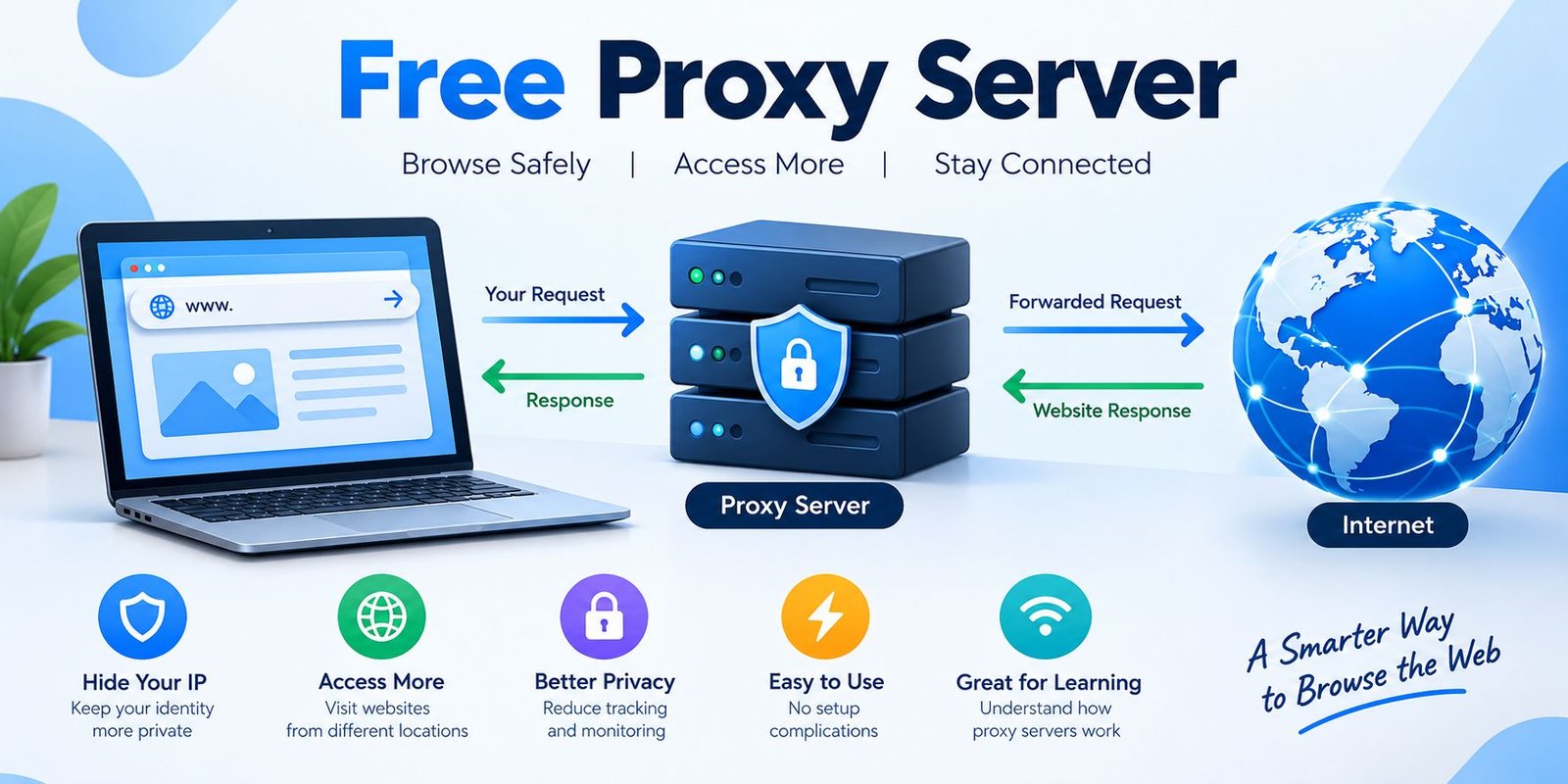
When you connect through a proxy, the communication path can look like this:
Your Device → Proxy Server → Website
The website may see the proxy server’s IP address instead of the IP address directly associated with your connection.
The exact behavior depends on the proxy configuration. Some proxies provide only basic IP masking, while others can modify or forward additional information in HTTP requests.
How Does a Proxy Server Work?
A proxy receives a request from a user and forwards that request toward its destination. When the website responds, the proxy can pass the response back to the user’s device.
For example, suppose you want to visit a public website. With a direct connection, your device communicates with the website without an intermediate proxy.
With a proxy connection, the request first reaches the proxy. The proxy then contacts the destination website and returns the response.
This intermediary role is the main reason proxies are used for different networking and browsing purposes.
Why Do People Use Free Proxy Servers?
There are several legitimate reasons someone might use a free proxy server.
Basic IP Address Masking
A proxy can make the proxy’s IP address visible to a destination instead of your regular public IP address. This can provide a basic layer of separation between your connection and the website.
Website Testing
Developers and website owners may use proxies to test how a website behaves from different network locations or under different connection conditions.
Learning About Networking
Free proxy services can also be useful for students and beginners who want to understand concepts such as IP addresses, HTTP requests, servers, and network routing.
Accessing Public Websites
Not every proxy works in exactly the same way. Understanding the main categories can make it easier to choose an appropriate service.
HTTP Proxy
An HTTP proxy is primarily designed for web traffic. It can handle HTTP requests and is commonly associated with browser-based activities.
HTTPS Proxy
An HTTPS proxy can be used with websites that rely on HTTPS connections. HTTPS protects information between the browser and the website through encryption, although the security characteristics of the complete connection depend on the proxy and configuration.
SOCKS Proxy
SOCKS proxies operate at a lower level than traditional HTTP proxies and can support different types of internet traffic. SOCKS5 is a commonly discussed version because of its broader capabilities.
Transparent Proxy
A transparent proxy generally does not attempt to hide the user’s original IP address from the destination. These proxies are often used for network management, filtering, caching, or organizational purposes rather than anonymity.
Anonymous Proxy
An anonymous proxy is designed to reduce the amount of identifying connection information exposed to a destination website. However, the degree of privacy depends on the specific service and its configuration.
Free Proxy vs. Paid Proxy
One of the biggest differences between free and paid proxy services is the level of service and control they provide.
| Feature | Free Proxy | Paid Proxy |
|---|---|---|
| Cost | Usually no subscription fee | Usually requires payment |
| Reliability | Can vary significantly | Often more consistent |
| Speed | May be limited | Often better |
| Server availability | May change frequently | Usually more managed |
| Support | Often limited | May include customer support |
| Privacy policies | Vary widely | Usually documented by the provider |
This does not mean every paid proxy is automatically trustworthy or that every free proxy is unsafe. The provider’s policies, technical setup, reputation, and transparency matter.
Are Free Proxy Servers Safe?
Safety is one of the most important issues to consider before using a free proxy server.
A proxy provider may be able to observe certain information passing through its infrastructure. Some free services may also use aggressive advertising, collect connection data, or provide unclear privacy policies.
Before using a proxy, check whether the provider clearly explains:
- What information it collects
- How long connection data is retained
- Whether browsing activity is logged
- How data is handled
- Who operates the service
- Whether the service uses encryption where appropriate
Avoid entering passwords, payment information, or other sensitive data through an unfamiliar proxy service.
Free Proxy Servers and Online Privacy
A proxy should not automatically be considered a complete privacy solution.
A proxy can change the network path and may hide your IP address from a destination website, but it does not necessarily provide comprehensive anonymity. Websites can use other technologies, such as cookies, browser characteristics, account information, and tracking systems, to identify or recognize visitors.
For that reason, users should understand the difference between IP masking and complete online privacy. They are not the same thing.
Free Proxy Server Speed and Reliability
Another common issue with free proxy services is inconsistent performance.
Because many people may use the same public proxy, the server can become crowded. This may result in:
- Slow page loading
- Connection failures
- Frequent disconnections
- Unavailable proxy addresses
- Higher latency
A proxy that works well today may become unreliable later. Server availability can change without warning, particularly when the service is publicly shared.
Can a Free Proxy Be Used for Everything?
Not necessarily.
A free proxy may be suitable for simple, low-risk browsing or testing purposes, but it may not be appropriate for activities involving sensitive information or accounts.
For example, users should think carefully before using an unknown proxy for:
- Online banking
- Shopping transactions
- Password-based accounts
- Confidential business information
- Private communications
For sensitive activities, relying on an unknown intermediary can create unnecessary privacy and security risks.
How to Choose a Free Proxy Server
If you decide to try a free proxy, consider more than simply looking for the fastest IP address.
1. Check the Provider
Find out who operates the service and whether the provider publishes clear information about its infrastructure and policies.
2. Read the Privacy Policy
A transparent privacy policy can help you understand what information may be collected.
3. Test the Connection
Check whether the proxy provides acceptable speed and stability for your intended task.
4. Avoid Suspicious Websites
Be cautious of proxy pages that display excessive advertisements, unexpected downloads, or requests for unnecessary personal information.
5. Never Assume Complete Anonymity
A proxy can provide IP masking, but it should not be treated as a guarantee that all online activity is anonymous.
Free Proxy Server and Website Compatibility
Some websites may not work properly when accessed through a proxy. A website can detect unusual traffic, shared IP addresses, or automated-looking behavior and may restrict access.
Common signs of proxy-related problems include:
- CAPTCHA challenges
- Temporary access restrictions
- Very slow connections
- Login verification requests
- Blocked IP addresses
These restrictions are often implemented by websites to protect their systems from abuse or suspicious traffic.
Proxy Server vs. VPN
Proxy servers and VPNs are sometimes confused because both can route traffic through another server.
A proxy generally handles traffic according to its particular protocol and configuration. A VPN, on the other hand, normally creates an encrypted tunnel between the device and the VPN service for supported network traffic.
Neither option should be judged only by whether it changes an IP address. Privacy policies, encryption, provider trust, technical configuration, and the intended use all matter.
Advantages of a Free Proxy Server
Free proxy services can have several practical benefits:
- No subscription cost
- Easy to experiment with
- Useful for basic networking tests
- Can provide an alternative IP address
- Helpful for learning about proxy technology
These advantages make free proxies appealing for casual and educational purposes.
Limitations of Free Proxy Services
Free services also come with potential drawbacks:
- Unstable connections
- Limited server choices
- Lower speeds
- Shared IP addresses
- Unclear privacy practices from some providers
- Limited customer support
For this reason, users should consider the purpose of the proxy before relying on one for an important task.
Frequently Asked Questions
What is a free proxy server?
A free proxy server is an intermediary server that can forward internet requests without charging the user a subscription fee. Depending on its configuration, it may also make the proxy’s IP address visible to the destination website.
Does a free proxy hide my IP address?
Many proxies can hide your regular public IP address from the destination website, but the exact behavior depends on the proxy type and configuration.
Are free proxy servers completely anonymous?
No. A proxy should not be treated as a guarantee of complete anonymity. Websites can use other information to recognize or identify visitors.
Is a free proxy safe for passwords?
Using an unknown proxy for passwords or other sensitive information can introduce unnecessary risks. It is better to understand and trust the intermediary before sending sensitive data through it.
Why is my free proxy slow?
Free proxies can have many users sharing the same server. High traffic, server distance, limited resources, and network congestion can all affect performance.
Can I use a free proxy on my phone?
Some proxy services can be configured on mobile devices, depending on the operating system, application, and proxy protocol they support.
Final Thoughts
A free proxy server can be a convenient way to learn about internet routing, test websites, or perform simple browsing tasks without paying for a proxy service. However, free access does not automatically mean strong privacy, reliable performance, or complete anonymity.
Before choosing a proxy, look at its reliability, privacy policy, technical features, and intended use. For ordinary, low-risk activities, a reputable free service may be sufficient. For sensitive information or situations requiring stronger security and privacy controls, users should carefully evaluate alternatives rather than relying on an unknown free proxy.
Understanding what a proxy can—and cannot—do is the most useful first step toward making informed decisions about internet privacy and networking.